A Detailed Guide to Growing and Caring for the Roseleaf Raspberry
The roseleaf raspberry has cylindrical branchlets. Problems often arise when growing the roseleaf raspberry. What points should be noted when growing the roseleaf raspberry? This article gives a detailed introduction that you can use as a reference.
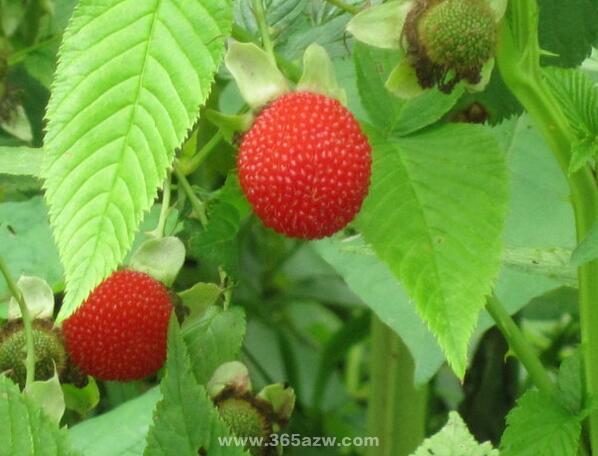
Introduction to the Roseleaf Raspberry
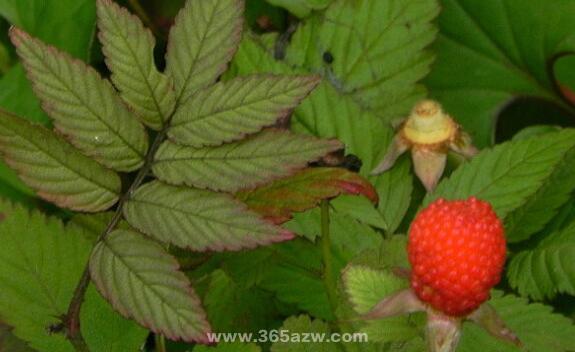
Roseleaf raspberry (scientific name: Rubus rosaefolius Smith): branchlets cylindrical, with soft hairs or nearly hairless, often with pale yellow glandular dots, sparsely bearing rather upright prickles. Leaflets ovate-lanceolate or lanceolate, apex acuminate, base rounded, sparsely covered with soft hairs on both surfaces, with pale yellow shiny glandular dots, sparsely small prickles along the midrib beneath, margins with sharp incised double serrations; the terminal leaflet and the leaf rachis both have soft hairs and small prickles, covered with pale yellow glandular dots; stipules ovate-lanceolate or lanceolate, with soft hairs.
Cultivation Techniques for the Roseleaf Raspberry
Planting Method
For ground planting, roseleaf raspberry seedlings are mostly planted in spring. A site with higher terrain and full sunlight should be chosen. Dig holes measuring 50 cm in diameter and 50 cm deep. It is best to apply barnyard manure in the holes, taking care to cover it with subsoil so as not to burn the roots. Usually put one three-year-old seedling in each hole, first straighten it, spread the root system out, then fill in soil and firm it by stepping on it. Then water thoroughly once, and after 3-5 days, water a second time. The planting operation is best carried out on an overcast day.
Key Management Points
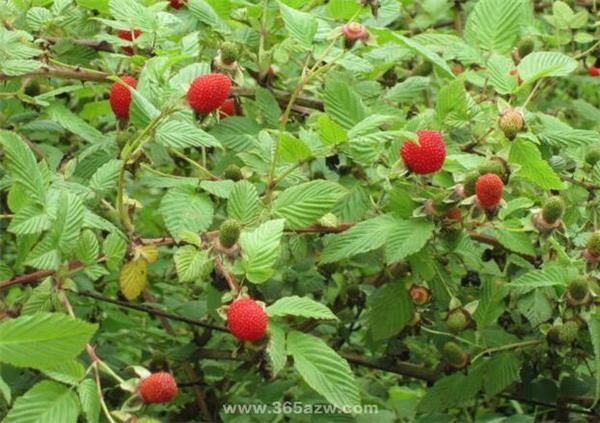
The roseleaf raspberry prefers a slightly moist, somewhat dry soil environment, but during the vigorous growth stage the water supply should be guaranteed. It has a relatively high demand for fertilizer; besides applying base fertilizer at planting time, it can be top-dressed once every 2-3 weeks during the vigorous growth stage. The roseleaf raspberry prefers an environment with sufficient sunlight and also tolerates shade; it should receive no less than 4 hours of sunlight per day. It likes warmth and fears severe cold, growing well within a temperature range of 14-26°C, and the overwintering temperature should not be lower than -5°C. In actual cultivation, the roseleaf raspberry will be harmed by powdery mildew, black spot and other diseases, and will be attacked by harmful animals such as pear round aphids, mites, rose white scale insects and bagworms; if these occur, measures should be taken promptly to deal with them.
Planting Lifespan
The roseleaf raspberry is a perennial with a relatively long lifespan; a mature plant can be grown in the same spot for more than 10 years. If phenomena such as continuous weakening of growth occur, renewal can be considered. Be careful not to practice continuous cropping; it is best to plant in a different location.
Propagation Methods for the Roseleaf Raspberry
The roseleaf raspberry is easy to cultivate, propagates quickly and produces a large quantity of fruit, making it a convenient raw material for extracting natural plant pigments.
The roseleaf raspberry is mainly propagated by cuttings, mostly carried out in spring and autumn each year. Methods such as division and layering can also be used for raising seedlings. A loam soil that drains well and is loose and fertile should be chosen.
Dietary or Medicinal Value of the Roseleaf Raspberry
Edible Value
The fruit is edible.
Source
The plant roseleaf raspberry, of the genus Rubus in the family Rosaceae.
Medicinal Parts
The roots, young branches and leaves are used as medicine. Collected in summer and autumn, used fresh or dried in the sun.
Nature, Flavor and Meridian Tropism
Bitter, sweet, astringent, cool.
Functions and Main Indications
The whole plant is used to treat dysentery, irregular menstruation, excessive menstruation, vomiting, cough in children, and scalds. Root (Daochusan): pungent, slightly bitter, cool. Clears heat and detoxifies, invigorates blood and relieves pain, stops vaginal discharge, stops sweating, relieves cough, stops dysentery. Used for reverse menstruation, cough with phlegm and asthma, night sweats, rectal prolapse, red and white dysentery, and pertussis in children.
That is all for today's introduction to how to grow the roseleaf raspberry. I hope you enjoy today's article.