How to grow Iris? Detailed Guide to Cultivation Methods and Care Tips
Iris flowers have huge petals and beautiful colors, and growing them indoors adds a decorative touch. Today we will give you a detailed introduction to iris cultivation methods.
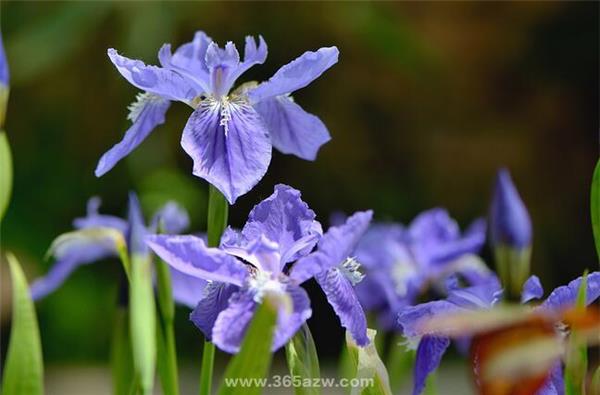
Iris symbolizes freedom and light, and it can also be processed into essence for making perfume, so many people grow irises at home. Iris is also known as butterfly orchid and belongs to the Iridaceae family. Iris flowers are beautiful with bright colors, making them excellent material for landscaping gardens and communities and for making flower baskets.
Iris originated in Egypt, Africa, and later, because of its fame, it is now cultivated all over the world. It grows best in cool, humid environments with ample light, but it has poor cold tolerance; the minimum overwintering temperature is 4°C, and the optimum growing temperature is around 18°C. In landscaping, such plants are usually grown in greenhouses; they sprout and grow in autumn, bloom in winter and spring, and go dormant in summer. They require fertile, moist, well-drained neutral sandy loam.
Morphological Characteristics of Iris
Iris is a perennial herb with alternate leaves arranged in 2 rows, sword-shaped, 30-45 cm long and about 2 cm wide.
Iris flowers are blue-purple, with 1-3 flowers arranged in a raceme; at the base of the pedicel there is a spathe about 4-5 cm long; there are 6 tepals in 2 whorls, the outer 3 rounded with a crest-like ridge on the surface, white or blue, and the inner 3 smaller, arched and upright; there are 3 stamens, attached at the base of the outer tepals; the ovary is inferior.
Iris grows about 80 cm tall. The leaves are sword-shaped, thin, and light green. The pedicel bears several flowers, and the corolla is purple-white. The outer 3 tepals are larger and droop in a rounded shape; the inner 3 are smaller and obovate. The stamens are opposite the outer tepals; the style is 3-lobed, flat and petal-like, covering the stamens.
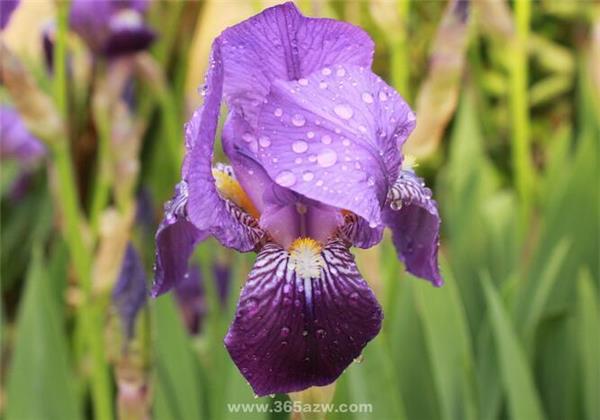
The rhizome is flat and cylindrical, grayish-brown on the surface, with nodes; the nodes often branch, and the internode sections are swollen at one end and narrowed at the other; the swollen parts are densely covered with concentric ring lines, becoming denser toward the tip.
The iris capsule is oblong-elliptical, with 6 ridges, 3-4 cm long. The seeds are numerous, round, and black.
Iris flowers emerge from the leaf cluster and come in blue, purple, yellow, white, pale red, and other colors; the flowers are large and beautiful. The flowering period is April to May, and the fruiting period is October to November; the capsule has 6 ridges.
Iris Cultivation Methods
1. Soil requirements: Iris grows poorly in acidic soil, so when cultivating iris you should choose humus-rich clay loam, or an alkaline soil mixed with lime. Before planting, the soil should be thoroughly tilled, and decomposed compost plus a small amount of bone meal, plant ash, etc. should be applied as a base fertilizer. In addition, irises should not be planted too deep, and the rhizome should be pressed firm.
2. Light and temperature: The optimum growing temperature for iris is 15-17°C, and it prefers a sunny, humid environment. However, if the light is too strong, appropriate shading should be provided; if the humidity is too high, the humidity can be reduced by heating and ventilation.

3. Watering: After planting, iris should be watered thoroughly once, and afterward watering can be done according to the dryness and wetness of the soil, generally with the soil slightly dry being preferable. Do not let the soil become waterlogged or remain too wet for a long time, to avoid root rot or disease. To keep the plant looking attractive, the leaves can be washed.
4. Fertilizing: From spring sprouting and growth to before flowering, iris should be given 1-2 applications of decomposed dilute cake fertilizer water or compound flower fertilizer. After the flowers fade, it is best to apply liquid fertilizer once more.
5. Pest and disease control: The main disease that irises are prone to during cultivation is soft rot. If soft rot is found on the plant, the plant should be dug up promptly, the rotted parts removed, and the planting site changed or the pot changed for replanting. The main pest of iris is the bean beetle; control is mainly by manually catching adults and poisoning larvae.
Between April and May, iris can be drenched with 250 times diluted 25% wettable phosmet to prevent damage from underground pests; in winter, dead leaves and destroyed branches should be cleaned up, which can also reduce the occurrence of iris pests and diseases.
6. Iris propagation methods: Iris is usually propagated by division and cuttings, and can also be propagated by seed. Division propagation is mostly done in early winter or during the early spring dormant period, cutting propagation is mostly done in spring, and sowing is done immediately after the seeds are harvested.
The above is the relevant introduction to iris cultivation. We hope it is helpful to you.