How to grow a dragon bone cactus? Detailed guide to cultivation methods and care tips
Growing a dragon bone cactus is very convenient, no need for daily maintenance. This article summarizes the key points for caring for a dragon bone cactus, which you can use as a reference.
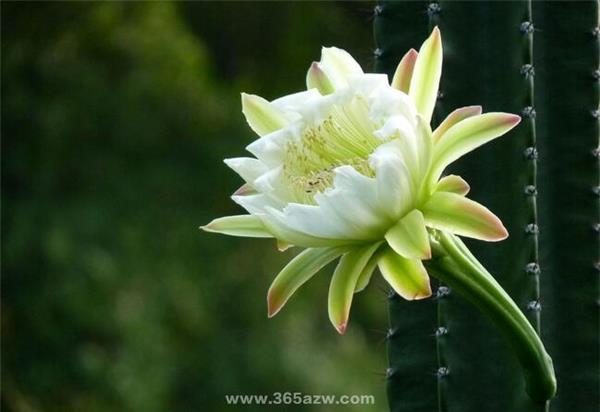
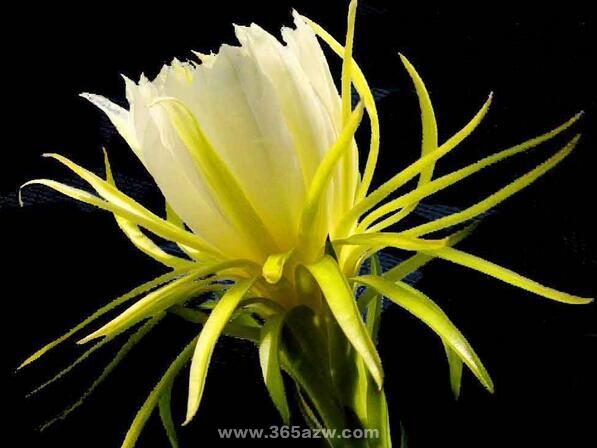
Dragon bone is a plant of the genus Hylocereus in the cactus family. It is also called sword flower, measuring-the-sky ruler flower, overlord flower, overlord whip, etc. Its stem is extremely long, green and fleshy, often constricted into segments, with 3 broad ribs whose edges are wavy. The leaves have degenerated into spines in the small areoles in the axils of the rib edges. It uses aerial roots to climb on shrubs, trees or walls. The flowers are solitary, opening at night and closing during the day, white, large, blooming in summer and autumn. The fleshy berry is oval, about 10 cm long, red, with scales, nearly smooth when ripe, which is what is commonly called dragon fruit.
Care of the dragon bone cactus
The dragon bone cactus likes warm, humid and semi-shaded environments, and the plant turns yellow under direct strong sunlight. It can tolerate drought but fears low temperatures and frost. The suitable growth temperature is 25-35°C, and the winter overwintering temperature must not be lower than 7°C, otherwise it is prone to frost damage and the stem segments rot easily. It likes fertile loam rich in humus, so the following points should be noted when cultivating it:
1. Planting: Sandy loam rich in humus is best, so you can use a potting mix made of 1 part leaf mold and 1 part coarse sand mixed with a small amount of decomposed chicken manure or cow manure.
2. Light and temperature: Since the dragon bone cactus turns yellow under direct strong sunlight, it should be kept in a semi-shaded environment in summer, while in winter it requires sufficient light and should be placed in a sunny spot indoors, with the temperature preferably kept above 10°C.
3. Watering and fertilizing: The dragon bone cactus is a drought-tolerant plant, so watering in spring should not be excessive; watering once every 10-15 days is enough, but the plant should be misted daily to increase air humidity. In summer it should be watered once a day, preferably in the morning or evening. In winter the potting soil should be kept moderately dry, and a plastic film can be wrapped around the pot for protection during overwintering.
Feng shui effects of the dragon bone cactus
Plants have a close relationship with feng shui. Since ancient times it has been said that trees facing the house are auspicious and those facing away are inauspicious, which shows that traditional feng shui holds that plants have a great influence on the feng shui of a home. Generally speaking, in places that have a life-promoting effect in feng shui, such as balconies, plants are relatively tall and sturdy, and the thicker, larger and greener the leaves, the better. Therefore, placing large-leaved evergreen plants in auspicious positions has a life-promoting effect. In unfavorable directions, for example, if looking out from the balcony the surrounding environment is harsh, with sharp corner clashes nearby, streets rushing straight at the building, streets curving away like a bow, or facing temples, hospitals, cemeteries and so on, then plants that can dissolve negative energy must be placed there. Usually, what distinguishes energy-dissolving plants from life-promoting plants is that their trunks, stems, flowers or leaves have thorns. Therefore, placing thorny plants such as cacti has the effect of dissolving negative energy, making it retreat, and can protect the home. So a plant as imposing and uniquely shaped as the dragon bone cactus, with a trunk growing upright like an erect dragon spine and full of power, is most suitable for placement in unfavorable directions, with a strong effect of resisting external negative energy.
The dragon bone cactus's impact on the home environment
In home applications, besides its energy-dissolving effect, the dragon bone cactus also has a good purifying effect. For newly renovated homes and offices, it has a good adsorption effect on formaldehyde, benzene, radon, ammonia and TVOC.
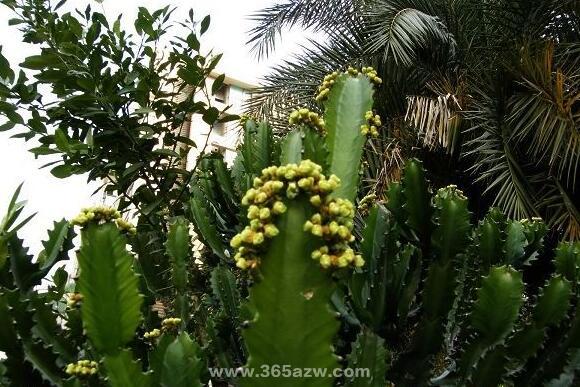
However, growing the dragon bone cactus indoors requires special attention, because its fleshy stems have sharp spines, and the white sap in the stems is toxic, especially if it gets into the eyes. Therefore, when growing it at home, special attention must be paid to where it is placed, to avoid children and the elderly being pricked or poisoned. Furthermore, the dragon bone cactus is drought-tolerant and sun-tolerant, suitable for places with ample sunlight, and not suitable for relatively dark indoor spots. Therefore, a dragon bone cactus kept indoors for viewing should be placed as close to a sunny window as possible.
That is all for the introduction to the dragon bone cactus today. I hope it is helpful to you.