How to grow Aeonium (Mountain Rose)? A detailed guide to care methods
Aeonium, also known as Mountain Rose, is a foliage plant. Mountain Rose grows in clusters shaped like rose blossoms. How do you grow Mountain Rose? Here is a detailed introduction to the care methods.
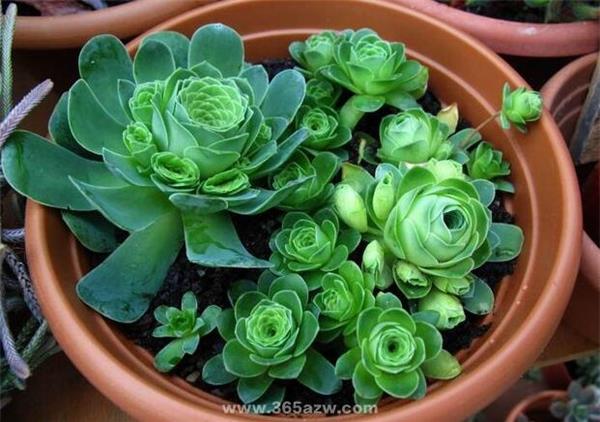
Mountain Rose is a succulent in the Crassulaceae family, genus Aeonium (many species in Crassulaceae, genus Aeonium share the trait of leaves opening during the growing season and closing during dormancy, just not as noticeably as Mountain Rose, such as the well-known Aeonium 'Zwartkop').
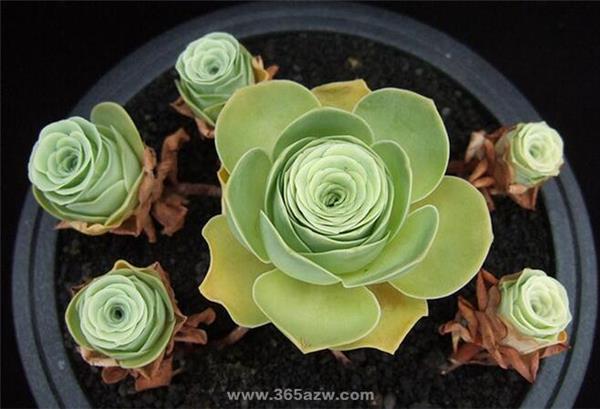
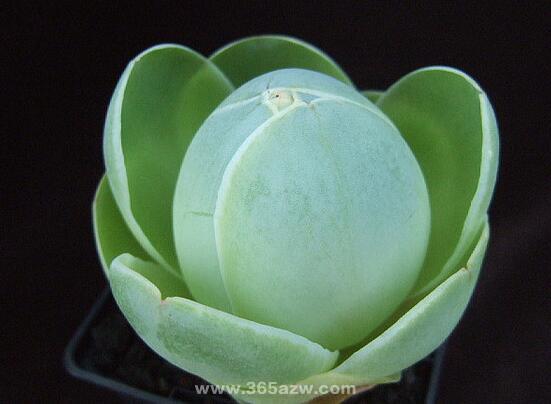
The fleshy leaves are arranged in a rosette. The plant's spread varies greatly depending on the variety: the small species Aeonium aizoon is only 2 to 4 cm, while the large species 'Aeonium diplocyclum' can grow to 30 cm to 40 cm or larger. Leaf colors include gray-green, blue-green or emerald green. After intense sun exposure, the leaves sometimes develop reddish-brown markings. Some varieties have a slight white powder and fine hairs on the leaf surface, with eyelash-like hairs along the leaf margins. Its flowering period runs from late spring to early summer, with racemose inflorescences and yellow flowers. After flowering, as the seeds mature, the parent plant gradually withers, but small shoots grow from its base. It was formerly its own genus, later merged into Aeonium. There are varieties such as Greenovia aizoon, Greenovia aurea, Greenovia diplocycla and Greenovia dodrentalis. There are about 5 species, with common ones including Mountain Rose, Golden Rose and Green Rose rosette.
How to grow Mountain Rose:
Preparing the substrate
If indoor ventilation is poor, when preparing the substrate you should reduce the amount of non-granular material, generally keeping the non-granular portion to about one sixth. Non-granular materials include rice husk and peat, etc. The remaining portion of the substrate should consist entirely of granular materials, including coal cinders, pumice, LECA, orchid stone, small pebbles, etc. In addition, because Mountain Rose has an underdeveloped root system, when choosing granular materials, try to select materials with a diameter of less than 3 mm.
Sowing
Mountain Rose is generally grown by sowing, because this method is relatively the simplest. Before sowing, soak the seeds in a low-concentration potassium permanganate solution for about half an hour, to eliminate toxins carried by the seeds. After half an hour, pour the seeds together with the disinfecting solution into a pot, and then you can wait for the seeds to germinate.
Watering
When growing Mountain Rose, try to raise the humidity of the air at home, and place the Mountain Rose in a ventilated, shady spot. Watering once every four weeks is enough. Because Mountain Rose originates from high mountain areas, it is naturally cold-tolerant and drought-tolerant, so the pot should be kept relatively dry to prevent the core from rotting.
Light
If you want Mountain Rose to receive light, it is best to choose a south-facing window or grow it outdoors. For Mountain Rose, light has another wonderful effect: it can turn Mountain Rose purplish-red, which is very beautiful.
About propagating Mountain Rose
Mountain Rose can be propagated by sowing, division and beheading.
Sowing: Seeds should be kept in the refrigerator's compartment, where they still have a high germination rate after about 5 years. Sow during the growing season, with autumn being the best. Sprinkle the seeds evenly on the soil surface without covering with soil, place in a spot without direct sunlight, and water using the immersion method to avoid the tiny seeds being washed away. After sowing, they germinate in 5 to 10 days. During the seedling stage, keep the soil moist and provide sufficient, soft light. When the seedlings become too crowded, thin them promptly so as not to affect their growth.
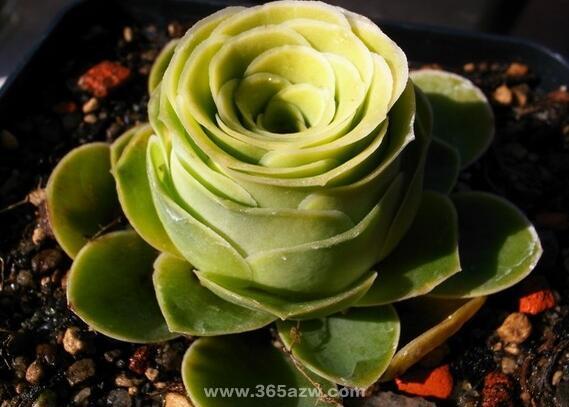
Division: Apart from a few varieties such as Aeonium diplocycla, Mountain Rose readily produces side shoots. During the growing season you can twist them off, let them dry for 3 to 5 days, and once the wound has dried, plant them directly in a pot. They root easily whether they have roots or not.
Beheading: In autumn, insert dental floss or fishing line into the gap between the leaves, wrap it around the plant at a mid-height position, and pull tight to separate the core from the base. Leave the base in the original pot, being careful not to let the wound get wet, otherwise it will easily rot, and it will soon sprout many side shoots between the leaves. Place the removed core in a ventilated spot to let the wound dry. Depending on the size of the plant and the ambient humidity, dry it for anywhere from two or three days to a week, then plant it in moist soil (meaning the substrate is moist but not wet: it clumps when squeezed in the hand and falls apart when released), and wait for it to root. Once you observe signs of growth, you can water and care for it normally.
That is all for today's introduction on how to grow Mountain Rose. I hope you enjoy the content shared today.
I hope you enjoy the content shared today.