Introduction to Haworthia tessellata Cultivation Methods and Care Tips
The Haworthia tessellata plant has a very distinctive shape, much like a lotus. What issues should be noted when cultivating Haworthia tessellata? Let's go through a detailed introduction for everyone.
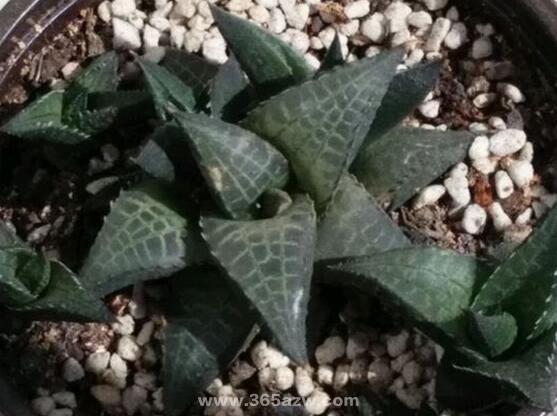
Haworthia tessellata, also known as snake skin haworthia, belongs to the Liliaceae family, Haworthia genus, and is a very ancient variety of the Haworthia genus. Its plant has no stem, and its succulent leaves grow in a spiral pattern, appearing to be arranged in a regular order, much like a lotus. The leaf texture is thick and hard, triangular-ovate in shape, with leaf color being dark green. The back of the leaves is slightly reddish-brown, with irregularly arranged small white wart-like protrusions. The leaf margins have small white teeth and curl inward, appearing transparent or semi-transparent. The leaf surface is relatively flat, and the leaf veins divide the leaf surface into snake-skin-like grid patterns, looking very vivid and lifelike.
Haworthia tessellata, like most plants, prefers a dry and warm climate and a sunny environment. It is also a cold-tolerant, drought-tolerant, and semi-shade-tolerant plant, particularly afraid of waterlogging and exposure to strong sunlight. High summer temperatures will cause it to enter a dormant state. Therefore, it can be planted in damp and shady places. In summer, you can water it less or not at all to avoid root rot.
There are quite a few horticultural varieties of Haworthia tessellata. The differences in the formation of the leaf reticulation, the protrusion at the base of the forked spines on the leaf back, and the tooth shape on the leaf margins are the main methods for distinguishing Haworthia tessellata varieties. Its main horticultural varieties include: 'Crocodile Scales', 'Stegosaurus Scales', 'Sleeping Dragon Scales', and many more varieties that we will not list one by one.
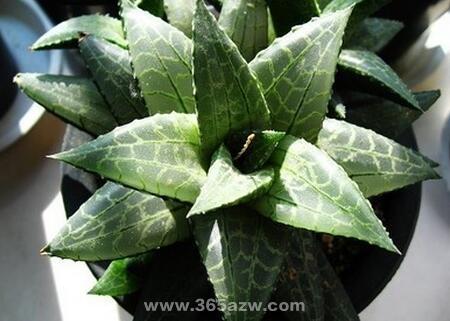
Cultivation Key Points:
For friends growing Haworthia tessellata, the most interesting aspect is its cultivation key points, which is also the focus of this article. The optimal temperature for Haworthia tessellata growth is maintained at around 22-26°C, and in winter it should not go below 5°C. Generally, a mixture of leaf mold and coarse sand can be used as the planting medium, with a small amount of bone meal and dried cow manure added. During the growing period, keep the potting soil moist. During the hot summer dormant period, watering must be strictly controlled and not too much. If there is strong sunlight, appropriate shading is also needed. In the cold winter, keep the potting soil dry. Generally, fertilizing once a month during the growing period is sufficient.
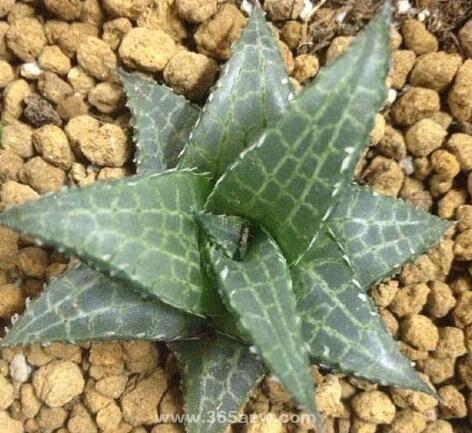
Common propagation methods are division and sowing. Division can be done throughout the year, often during repotting in April-May, when small offsets growing beside the mother plant are separated from the mother plant and directly potted. Newly potted plants should not be watered too much to avoid affecting root recovery. Sowing is generally done indoors in pots in April-May, with an optimal germination temperature of 18-21°C. After sowing, they germinate at 14-21°C, and seedlings grow relatively slowly.
Haworthia tessellata Care Experience
Haworthia tessellata can adapt to a variety of different cultivation environments, but it must have sufficient light and timely water supply to grow well. The basic principles of cultivation work are when to water, how to water, what soil to use, and when to fertilize, etc. These are the foundations of the work. And different cultivation environments will determine how you solve these problems. For example, growing Haworthia tessellata on a windowsill in Mexico is different from growing them in a greenhouse in Tucson (a place name, a city in southern Arizona, USA), and different methods should be adopted for cultivation.
The above is an introduction to Haworthia tessellata cultivation methods and experience. We hope it is helpful to you.