How to protect the rare native plant Taiwan trident maple? Dividing and planting Taiwan trident maple, weeding and care
Taiwan trident maple, do you know this plant? Currently, the number of this plant is not large. For this reason, to cultivate this rare native plant, there are dedicated people who plant it.
Dividing and planting
On this day everyone gathered in the large greenhouse, and at the start they opened two large bags of potting medium and mixed in white perlite. The volunteers took turns thoroughly mixing the soil with shovels, then sprinkled water little by little, and the mixed potting medium was piled into a small mound. Lin Jianrong, an assistant research fellow at the Fushan Research Center, explained the day's work: several volunteers were responsible for dividing and planting Taiwan trident maples that had been collected in the field last year and had grown root systems after sowing.
Xixi first carefully tipped the Taiwan trident maple out of the pot, and at a glance the roots could be seen to be slender and complete. He carefully separated the roots one plant at a time and distributed them into pots, while noting the name, source and date on labels; then Xiong Ba and Guilan were responsible for covering with soil and firming it, completing the planting and inserting the labels. Rows of small Taiwan trident maple plants stood on the greenhouse shelves, receiving regular watering.
Taiwan trident maple (Acer buergerianum var. formosanum) is rated as a Critically Endangered (CR) species in the vascular plant red data book. It is distributed along the north coast and in coastal or valley areas near Yilan. It shares the fate of most threatened plants: collection pressure, and habitat loss and fragmentation because its habitat is close to areas of human activity.
Adding soil and health checks
Zheng Yingzhi and Zhang Ziwen went to several tunnel net houses and checked the soil condition of each potted plant one by one, bringing back to the large greenhouse the potted plants that needed additional soil. Which potted plants need additional soil? If the plant appears sunken in appearance, it may be that the medium at the bottom of the pot has been lost.
Lin Jianrong explained that over years of watering, it is unavoidable that the soil in the pot is lost, causing the root system of the plant to be suspended; when the roots are suspended for a long time, the plant will certainly become weaker and weaker, and the root hairs that cannot absorb water will die. Therefore, the soil condition of potted plants must be inspected regularly, and when plants are found to be in poor condition, additional soil will be assessed to avoid affecting growth due to insufficient soil.
The two first separated the plants from the pots, then added new soil to fill out the soil in the pots. During the process they took the opportunity to tidy the plants, pull weeds, and remove dried-out and dead plants, making the pots cleaner.
If the bottom has been hollowed out, it is difficult to judge from the appearance, and at such times it depends on the careful observation gained from frequent inspections over many years. Lin Jianrong spends some time working in the nursery every day, checking the condition of the seedlings and the causes of failures, gradually accumulating practical experience through the process and increasing the chances of plant reproduction and survival.
Weeding
Fushan is surrounded by the natural environment, and wildlife and water source issues must be considered, so no chemicals are used at all in planting; relatively speaking, the demand for manpower is very high. The most important work in the nursery is none other than pulling weeds, and volunteers always have endless weeds to pull; in addition, although fertilizer use is not restricted in the nursery, it is almost never used, which implies a manpower consideration: "After fertilizing, the weeds grow better than the target plants," Lin Jianrong said.
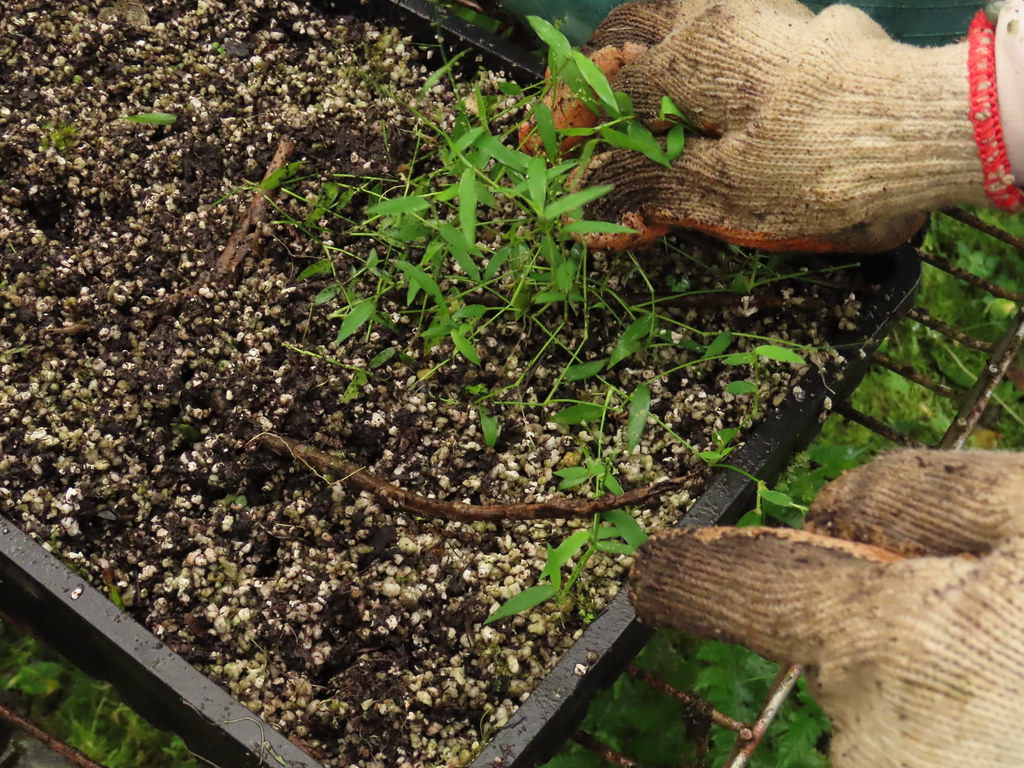
The next morning, the volunteers devoted themselves to clearing weeds in the greenhouse, entirely by hand. Do not think that only open-air nurseries have fast-growing and abundant weeds; inside the greenhouse, whether on the ground, in pots or on shelves, all kinds of plants thrive, but some non-target plants must be treated as weeds, and the process must be handled meticulously so as not to harm the innocent: the target plants.
Zheng Yingzhi said that the key point of weeding is to remove the roots; you cannot just clear the green leaves above the ground, but must grab the root system with your hands and remove it as much as possible to delay its growth rate, and not a single weed can be carelessly missed. Guilan is the least senior of several volunteers, yet has also served for more than three years. He said that every time he comes there are always endless weeds to pull, especially when working under the strong sun in summer and encountering stubborn roots, which is quite hard. Occasionally a small snake visits the open-air nursery, which is a rather unusual experience.
The weeds on the nursery shelves also need to be cleared. In some potted plants where weeds run rampant and take over as the main act, sometimes it is impossible to tell who the main character of the pot is, so you have to follow the clues, look at the label, or ask Lin Jianrong. However, plant identification mostly does not stump Xixi, and after tidying up, the main character in the pot finally shows itself.
In fact, some weeds include Taiwan endemic species such as Taiwan trigonotis and native species such as oval-leaf bulbine, but to let the target plants grow well, they must be removed. However, they soon grow back again!
While pulling weeds, you also learn to recognize plants. New plants are always moving into the nursery, so you take the opportunity to learn plant knowledge. For Zheng Yingzhi, constantly learning new knowledge is deeply attractive.
The volunteers believe that serving has a healing effect, especially weeding. Xixi said that every time he comes, body, mind and spirit can let go; he usually serves as an interpretive tour volunteer elsewhere, and coming to Fushan lets him keep his mouth shut and just chat with his partners. His sense of achievement is built on helping plants live better; especially during the flowering season, viewing each blooming flower fills his heart with beauty.
In addition to mixing soil, planting and weeding, volunteers also provide services such as moving beds, planting out, and pruning trees in the botanical garden. The Fushan Botanical Garden nursery has about 800 species and more than 3,000 plants. Under the guidance of researchers, combined with volunteers' tireless hands-on work, it builds a base suitable for plant conservation.