What is the flower language of the snowflake lotus? Detailed explanation of cultivation methods
The flowers of the snowflake lotus are pure white in color and very beautiful in shape, like lanterns. What issues should be noted when cultivating snowflake lotus? Next, I will introduce them in detail for everyone.
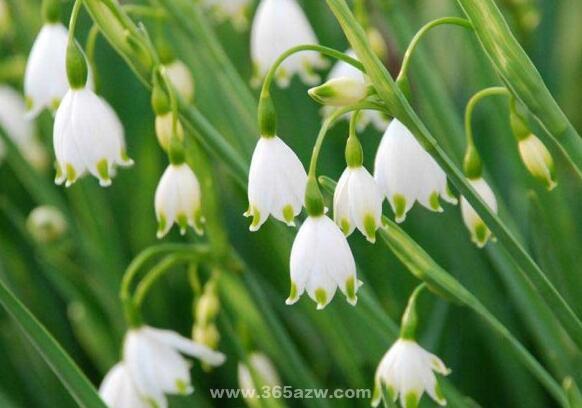
The snowflake lotus is a bulbous plant that produces white bell-shaped flowers. The green spots on the edges of the petals are its most distinctive feature, and its style is clear and bright, just like the flower's name, snowflake lotus. In Europe, the snowflake lotus is regarded as the flower that signals the arrival of spring. When it blooms in whole patches across meadows, it seems to express the joy of the earth welcoming spring. Therefore, its meaning is "new life."
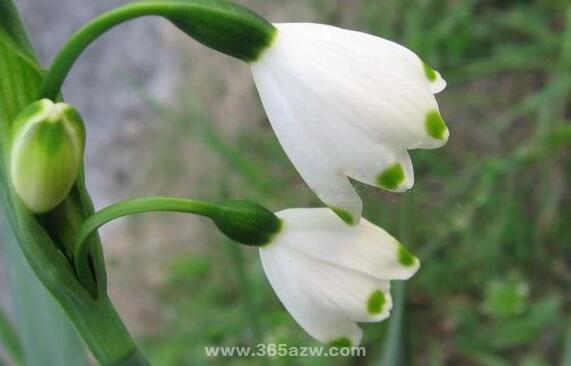
Plant height 20-30 cm, with bulbs. Leaves clustered, linear and strip-shaped, about 20 cm long. The flower scape is short and hollow, flat-round, with a single terminal flower or a few gathered into an umbel, drooping, broadly bell-shaped, with 2-8 flowers. The number of leaves is large. The 6 petals are completely identical, the flowers are white, with a yellow-green spot at the tip, and the flowering period is March-April. It is a plant of the genus Galanthus. The plant is short and small, with bell-like flowers hanging among the green leaf clusters. It is delicate and exquisite, with snow-white petals and beautifully shaped colored spots set at the tips, making it appear especially friendly and lovely. It is currently one of the important bulb flowers for ornamental viewing in small European and American courtyards or as indoor potted plants in early spring.
Plants of the genus Leucojum are native to Europe and western Asia. Most grow naturally on slopes at forest edges, but some also grow beside stones or in rock crevices. Their wild distribution ranges from the Pyrenees in Europe to Ukraine, including Turkey, Lebanon, Bulgaria, Greece, the former Yugoslavia, the Caucasus, and the Aegean Islands. They prefer cool, humid, and semi-shaded environments. They are hardy to severe cold, and most species and cultivated varieties can tolerate low temperatures of -15°C. They avoid intense sunlight and drought. They are suitable for humus-rich, loose, and well-drained sandy loam soil.
Cultivation techniques for snowflake lotus
Key cultivation points
When cultivating snowflake lotus in flower beds and gardens, apply an appropriate amount of decomposed farmyard manure as a base fertilizer before planting. The planting depth of bulbs is 5 cm, and 50-60 bulbs with a circumference of 4 cm to 5 cm are planted per sq m; for pot cultivation, the depth is 3 cm to 4 cm, and 3-5 bulbs are planted in a 15 cm pot. Plant in autumn from September to October, and they bloom from February to March the following year. Generally, no additional fertilizing is needed. For potted ornamental cultivation, apply once before flowering a special fertilizer for pot flowers, Huiyou 15-50-30. Dormant bulbs are often stored in sand at a storage temperature of 15°C to 17°C, which is beneficial for flower bud differentiation of the bulbs. For forced cultivation, they can be potted in November. After potting, place them outdoors temporarily, and after they root and begin to sprout, move them indoors to a place with sufficient sunlight. They can bloom in about 50 days.
Propagation methods of snowflake lotus
Division propagation
Snowflake lotus is often propagated mainly by division. After the aboveground parts of the plant wither, dig up the bulbs and divide them. Flowering bulbs are divided into three specifications: circumference 4 cm to 5 cm, 5 cm to 6 cm, and over 6 cm. If the goal is to increase the number of propagated bulbs, dormant bulbs can be cut in early summer to encourage more bulblets to sprout.
Specific method: use a sharp knife to make 6-8 cross cuts from the base of the bulb toward the top, then make 2 horizontal cuts, then disinfect the cut surfaces with a mercury solution, and place them on a propagation bed at 20°C for cultivation. After 3 months, 1-2 small bulbs can form on each bulb piece, and the propagation coefficient can reach more than 20. Generally, divide once every 4-5 years. For seed propagation, collect the seeds after they mature and sow them immediately. The suitable germination temperature is 13°C to 18°C. After emergence, summer has arrived, so shade should be provided to protect the seedlings, but seed propagation is not suitable for cultivated varieties.
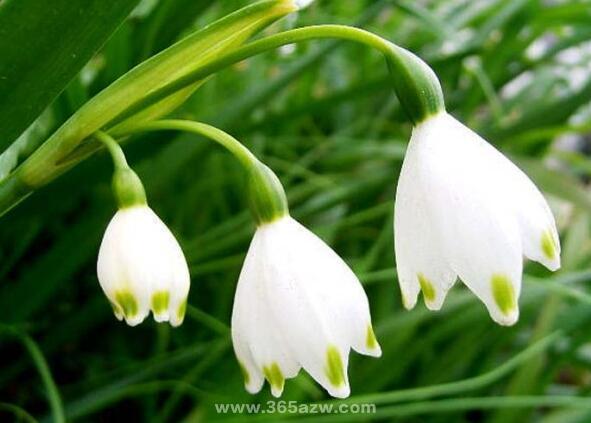
Snowflake lotus flower language: new life
Flower language interpretation: In Europe, the snowflake lotus is regarded as the flower that signals the arrival of spring. When it blooms in whole patches across meadows, it seems to express the joy of the earth welcoming spring. Therefore, its flower language is new life. Anyone born under the blessing of this flower often sets new goals and works hard to achieve them. They are also the type who do their utmost for their lover, willing to devote themselves to perfect and flawless love.
The cultivation methods of snowflake lotus are introduced here. I hope it is helpful to you.