A Detailed Guide to the Flower Language and Symbolism of Fritillaria imperialis and Its Cultivation Methods
Fritillaria imperialis has brilliantly colored flowers and is also known as crown imperial, crown fritillary, imperial fritillary, and king fritillary. It is a plant in the genus Fritillaria of the Liliaceae family. Next, we will introduce the cultivation methods for Fritillaria imperialis.
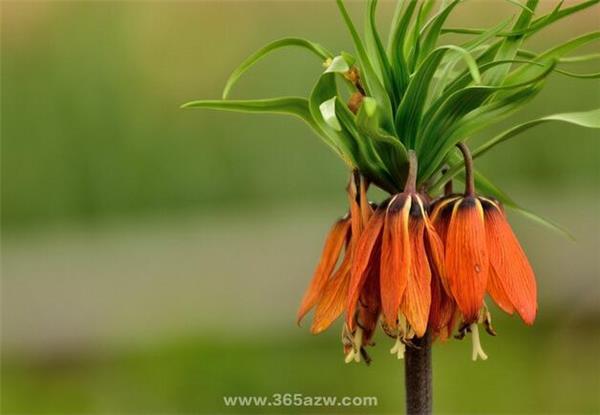
The flower language of Fritillaria imperialis: endurance.
Fritillaria imperialis, with the Latin scientific name Fritillaria imperialis, is also known as crown imperial, crown fritillary, imperial fritillary, and king fritillary. It is a plant in the genus Fritillaria of the Liliaceae family, native to the temperate regions of Eurasia, from the Himalayan region to Iran and other places, and is now distributed throughout the world.
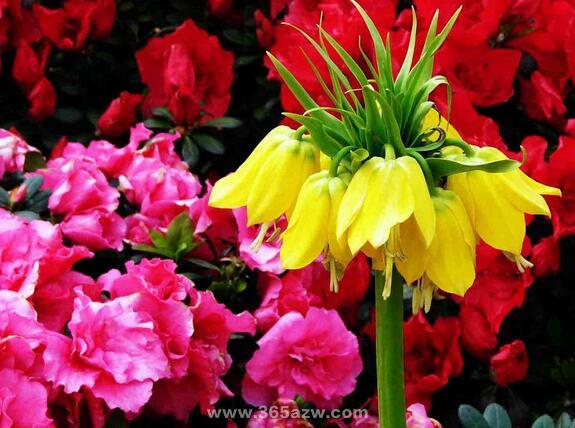
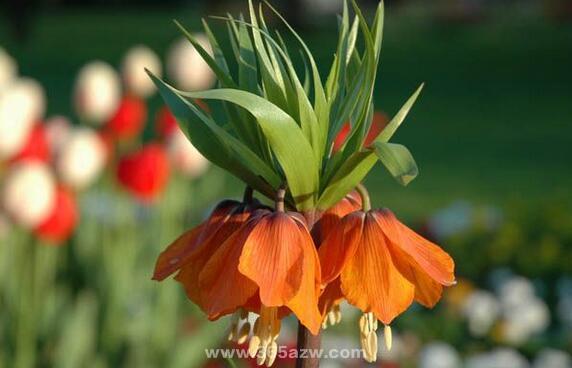
Fritillaria imperialis is a perennial bulbous flower. The plant height is about 70 cm, and the leaves are ovate-lanceolate to lanceolate. The flowers are borne at the top of the plant, with bell-shaped corollas. Several flowers hang around the stem and grow beneath a whorl of leaf-like bracts, which is very unique. Its cultivation history is long, about 400 years, and there are many cultivated varieties, with various flower colors such as yellow and red, as well as double-flowered types.
The charm of Fritillaria imperialis lies in the crown of flowers at the top, as well as the leaves borne above the flower cluster (more precisely, bracts). It is called the representative flower of Isidore, Bishop of Seville in the sixth century. This bishop was very enthusiastic about education, and the most important quality for educators is endurance. Perhaps combined with the fact that its flowers always hang their heads, the flower language of the crown imperial is therefore endurance.
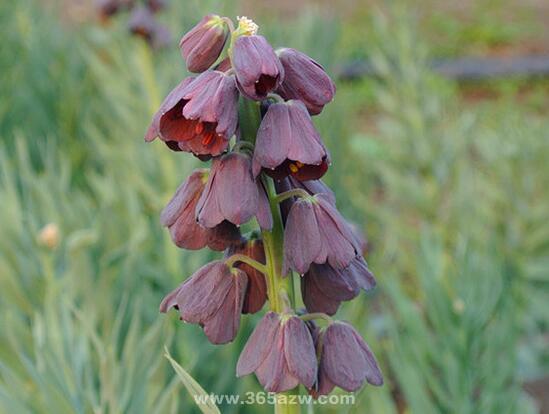
The flowers of Fritillaria imperialis are bright red, orange-yellow, and yellow, with a flowering period from April to May. There is also Fritillaria persica, with a plant height of 80 cm, long flower spikes, blooming in early summer, and can be used in flower borders. Fritillaria michailovskyi, also known as Michelavich fritillary, has a plant height of 20 cm, fine gray-green leaves, small flower spikes, and bell-shaped, drooping flowers, with a flowering period in early summer.
Cultivation Techniques for Fritillaria imperialis
To plant Fritillaria imperialis, choose loose, fertile sandy loam rich in organic matter, well-drained, with a pH of 6.0-7.5. Apply sufficient base fertilizer before planting; decomposed organic fertilizer or fish and bone meal are both suitable. For pot cultivation, use a mixed substrate of equal parts leaf mold, garden soil, and sand. Autumn, September to October, is the suitable planting period. For ground planting, the spacing between plants is about 30 cm, and after planting, cover with 8 cm-12 cm of soil.
In cold climate regions, cover the plants for overwintering. After new shoots emerge in early spring, apply topdressing once in time to promote stem and leaf growth. Keep the soil moist at ordinary times. For varieties that bloom in late spring, proper shading during the flowering period gives better quality. During the growth period, it is susceptible to leaf spot disease and lily black weevil. It can be controlled by spraying 50% thiophanate wettable powder at 700-800 times dilution and 140% omethoate emulsifiable concentrate at 1000 times dilution, respectively. After the aboveground part withers in summer, it enters the dormant period and can be left in the soil to pass the summer, but the soil should not be too wet, to avoid rot of the underground bulbs. It can also be dug up and stored in a cool, ventilated environment for the summer. Bulb rot disease occasionally occurs. In addition to disinfecting the bulbs, Bordeaux mixture can also be sprayed regularly for control.
Propagation Methods of Fritillaria imperialis
Fritillaria imperialis is propagated by bulb division, usually carried out in summer and autumn, and propagation is mainly by dividing small bulblets.
Disease Control of Fritillaria imperialis
Common rust disease of Fritillaria imperialis causes many brown spore masses on the underside of leaves, petioles, and the base of stems. In severe cases, Fritillaria imperialis dies early. The control method is to strengthen field management, promptly remove aboveground residual plants, and before the disease occurs, spray 1000 times dilution of thiophanate-methyl + new high-fat film for control.
Gray mold
Water-soaked lesions appear on green leaves and leaf tips, and later the plants wither and die. For control, spray 500 times dilution of amobam + new high-fat film.
The introduction to Fritillaria imperialis cultivation ends here. We hope it is helpful to you.