What is Avonia? A detailed introduction to Avonia species
Avonia is a succulent plant with a distinctive shape and many varieties. The common ones, classified by flower color, include white-flowered and red-flowered types. Next, we will introduce Avonia in detail.
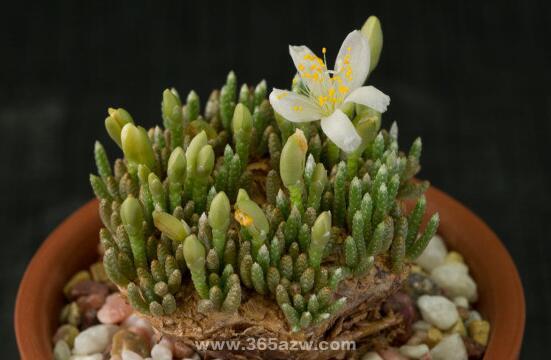
Avonia quinaria -- Anacampserotaceae family, Avonia genus, native to South Africa and Namibia. A perennial succulent with a tuberous root and small leaves with stipules; the stipules are papery and wrap around the tiny leaves. Flowers are 5-merous, and the flowering period is extremely short; some species bloom for only one hour. Avonia is self-pollinating, with a maturation period of about three weeks.
Avonia propagation methods
Propagation is done by sowing seeds.
Avonia cultivation techniques
Avonia is native to the desert regions of South Africa. It prefers a cool, dry, and sunny environment, is drought-tolerant, fears waterlogging, and also fears muggy, humid conditions; it is slightly cold-tolerant. From the end of September to April of the following year is its main growing period, when the fine branches at the top of the rhizome begin to sprout and grow. It can be placed in a sunny spot for care. Watering should follow the principle of not watering until dry, and watering thoroughly when you do, avoiding water accumulation in the soil to prevent the tuberous root from rotting. Because it grows slowly and needs few nutrients, it generally does not need additional fertilization. In winter, control watering; it can tolerate low temperatures of about 5°C. In summer, ensure good ventilation, avoid rain, and strictly control watering to prevent rot caused by muggy humidity and water accumulation in the pot. The potting soil should be loose, breathable, well-draining, and somewhat gritty. It can be mixed with 1 part leaf mold or peat and 3 parts coarse sand or vermiculite, with a small amount of lime-based material such as bone meal added. It can also be grown in materials such as akadama soil.
Avonia variety classification
Avonia is divided into two types: white-flowered Avonia and red-flowered Avonia.
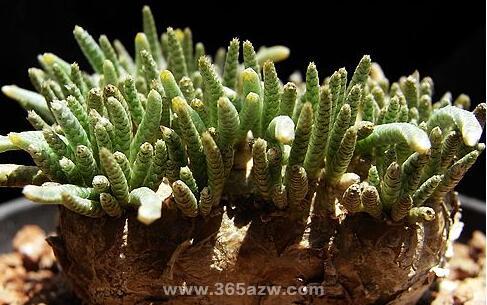
White-flowered Avonia
The scientific name of white-flowered Avonia is: Avonia quinaria subsp. alstonii
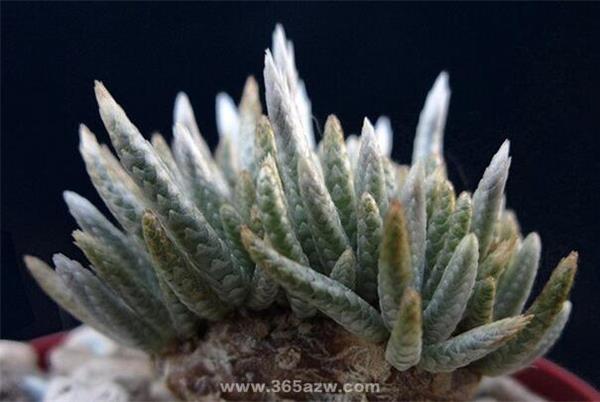
Red-flowered Avonia (A. alstonii), with deep pink flowers; other characteristics are basically the same as Avonia. Similar species in the same genus include A. albissima, also known as "Dance of the Fairies," which has thick, fleshy short stems, clustered slender round branches, and a surface densely covered with scale-like spiral small leaves; and A. papyracea, also known as "White Snake Palace," with thick, short fleshy stems, many branches at the stem tip, extending obliquely or curving toward the ground, the stem surface covered with scale-like white papery small leaves, and small white-green flowers at the tips.
Red-flowered Avonia (A. alstonii), with deep pink flowers,
Red-flowered Avonia
The scientific name of red-flowered Avonia is: Avonia quinaria subsp. quinaria
Synonym: Anacampseros quinaria
Other characteristics are basically the same as Avonia. Similar species in the same genus include A. albissima, also known as "Dance of the Fairies," which has thick, fleshy short stems, clustered slender round branches, and a surface densely covered with scale-like spiral small leaves; and A. papyracea, also known as "White Snake Palace," with thick, short fleshy stems, many branches at the stem tip, extending obliquely or curving toward the ground, the stem surface covered with scale-like white papery small leaves, and small white-green flowers at the tips.
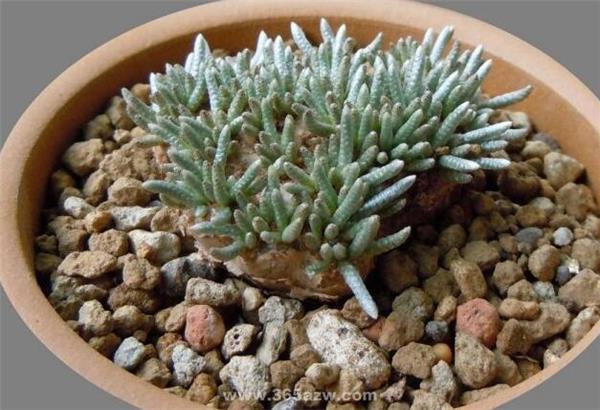
Avonia's garden uses
Its form is peculiar; the tiny branches and the aged rhizome set each other off beautifully, much like a stone sea anemone attached to a rock, and also like writhing silver snakes. Moreover, the plant is compact and slow-growing, like a living handicraft. It is suitable for planting in a small pot and placing in sunny spots, on windowsills, and other places, to be admired carefully in leisure time and to appreciate its magical charm.
That is all for the introduction to this plant, Avonia. I hope everyone enjoys today's article.