A Detailed Guide to the Propagation Methods and Cultivation Techniques of Staghorn Sumac
Staghorn sumac, also known as velvet sumac, staghorn sumac and Canadian sumac, is a deciduous small tree of the genus Rhus in the family Anacardiaceae. Its fruit clusters are bright red, with flat spherical fruits bearing red prickly hairs that cluster tightly into a torch-like shape. It is cultivated more extensively in the provinces (regions) north of the Yellow River basin, and is mainly used for greening barren hills and as a landscape forest tree species on saline-alkali wasteland. Now let us take a look at the cultivation techniques of staghorn sumac!
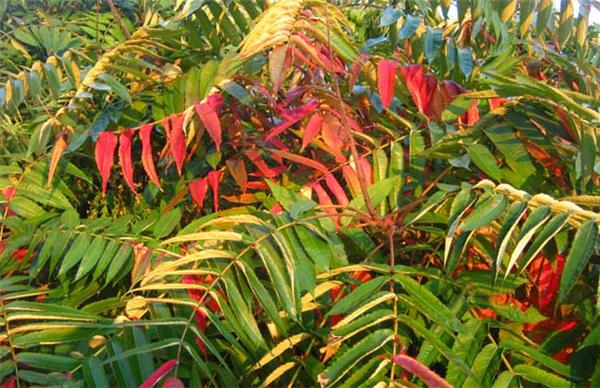
Growth Habits of Staghorn Sumac
Staghorn sumac is native to Europe and America, and often grows on open sandy or gravelly soil. It is light-loving, cold-resistant, highly adaptable to soil, tolerant of drought and poor soil, tolerant of waterlogging, and tolerant of salt and alkali. Its root system is well developed and its sprouting ability is strong; within four years it can produce 30 to 50 sprouting shoots. It is shallow-rooted, grows quickly and has a short lifespan. Its rapid propagation speed is unmatched by many greening tree species, and it possesses unique excellent characteristics as well as serious potential hazards.
Propagation Methods of Staghorn Sumac
1. Seed propagation: Staghorn sumac seeds are relatively small, with a hard seed coat covered externally by red prickly hairs. Before sowing, rub them with alkaline water to remove the red fuzz outside the seed coat and the waxy substance on the seed coat. Then soak them in hot water at 85°C for 5 minutes, remove them and mix them with wet sand for burial, placing them indoors at 20°C to promote germination, sprinkling an appropriate amount of water depending on evaporation. When buds appear after 20 days, they can be sown. The sowing rate is 7 to 10 jin per mu, with a row spacing of 35 cm. After 20 days they have basically all emerged; in that year the seedlings reach 80 cm in height, with a ground diameter of 1 to 1.5 cm.
2. Root cutting propagation: Staghorn sumac has many lateral roots that extend horizontally. Each year when seedlings are lifted from the nursery, select lateral roots with a thickness of more than 1 cm and cut them into root segments 20 cm long. According to the polarity of the root, with the top pointing upward and the stem end pointing downward, insert them vertically into the prepared nursery bed at a spacing of 40 x 30 cm. After insertion, cover the top of the root segments with 2 to 4 cm of thin soil, and spray water frequently to keep them moist. Generally, adventitious buds first develop, breaking through the soil to grow new shoots, and then roots form and the plant survives. In that year the seedlings reach more than 1 m in height.
3. Root sucker propagation: Around staghorn sumac trees more than two years old, many root sucker seedlings often sprout. These can be selected and retained according to row spacing, taking care to remove the root suckers and excess lateral branches, and cultivating them into strong seedlings with a good tree form. In that year the seedlings can reach 1.5 to 2 m in height. They can be transplanted in mid-March of the second year after propagation.
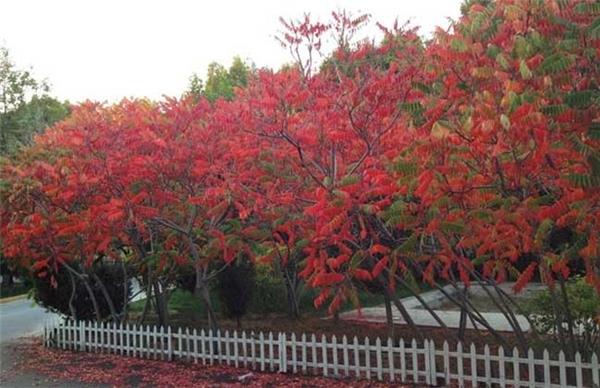
Cultivation Techniques of Staghorn Sumac
1. Water and fertilizer management: After the sown seedlings of staghorn sumac emerge, water once every 10 days, and after 1 month water once every half month. Generally, topdressing is applied 2 times, mainly with urea, at 5 to 7.5 kg per mu, combined with watering. The current-year seedlings of staghorn sumac are relatively tender and prone to freezing damage in winter. From the end of July onward, rub the seedlings and stop watering, fertilizing and loosening the soil; for excessively vigorous branches and leaves, knock off a portion to promote lignification.
2. Thinning and filling in of seedlings: For staghorn sumac, when the seedlings are about 3 cm tall in April to May (3 to 4 true leaves), carry out thinning and filling in of seedlings, performing this 2 to 3 times. When the seedlings are 10 cm tall, finalize the spacing at 30 x 30 cm.
3. Loosening soil and removing weeds: After the seedlings have all emerged, according to soil compaction and weed conditions, loosen the soil and weed once every 10 to 15 days, stopping at the end of July. Staghorn sumac has few diseases and pests; pay attention to timely control.
4. Timely transplanting: Transplanting of staghorn sumac should be carried out from after leaf fall in late autumn to before sprouting the following spring. When planting, the seedlings should be upright and the roots spread out; after planting, large seedlings should be given support stakes. For afforestation on dry and poor mountainous land, the stems need to be cut back for planting, cutting flat at 18 to 20 cm above the ground surface; after lifting the seedlings, cut off the overly long main and lateral roots, retaining 25 cm in length, which makes survival easy.
Pruning and Shaping of Staghorn Sumac
1. Shrub form: For pruning shrub-form staghorn sumac, the main principle is to maintain an open and airy tree body. During cultivation and maintenance, simply thin out redundant branches, dead branches, overly dense branches and drooping branches in a timely manner, and also promptly cut away the surrounding root sucker seedlings.
2. Tree form
① Select seedlings with robust growth and a strong central leader, and thin out all their lateral branches, retaining only the main trunk. In late autumn, cut back the main trunk, and the following year select a robust new branch below the cut as the leader extension branch, thinning out all other new shoots.
② During growth, promptly thin out the lateral branches on the leader extension branch, then in late autumn cut back the main trunk again using the method of the previous year. The following spring, use the method of the second year to select and retain strong branches as the leader extension branch.
③ When the main trunk has grown to a certain height, begin cultivating scaffold branches. The method is to cut back the branch tips, then select and retain three or four robust, evenly distributed branches as scaffold branches. After the scaffold branches grow to a certain length, pinch out their tips to promote the growth of lateral branches.
④ In late autumn, cut back the lateral branches to promote the growth of secondary lateral branches. In this way the basic tree form is formed, and in subsequent maintenance it is only necessary to promptly prune redundant branches, dead branches, drooping branches and dead branches.