Lily Propagation Methods and Growing Environment Requirements
Lily flowers have an elegant form, a pleasant delicate fragrance, and come in diverse colors, so they are quite popular with many households. Whether planted in the ground or grown as cut flowers, they are often the first choice for home greenery. So, if you plan to grow lilies at home, how should they be propagated? What kind of environment do lilies need to grow?
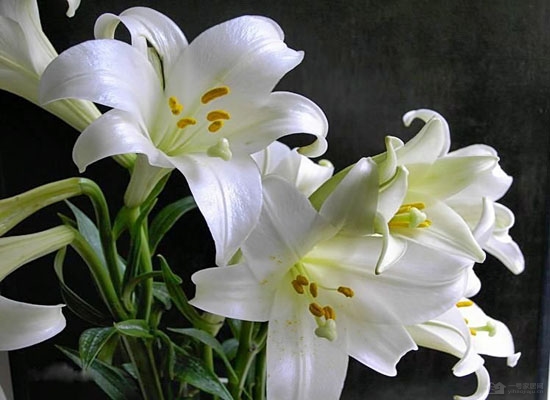
Lilies prefer cool conditions and are relatively cold-tolerant. They grow poorly in high-temperature regions. They like dry conditions and fear waterlogging. If soil moisture is too high, it causes the bulbs to rot and die. They are not strict about soil requirements, but heavy clay soil is not suitable for cultivation. In deep, fertile, loose sandy loam, the bulbs are white in color and thicker in flesh. Lily roots are thick and well developed, and they are tolerant of fertilizer.
Lilies can be propagated both asexually and sexually.
I. Asexual propagation
In production, there are mainly 3 types: scale propagation, bulblet propagation, and bulbil propagation.
1. Scale propagation
In autumn, select healthy, disease-free, plump scales and soak them for 30 minutes in a 1:500 aqueous solution of benomyl or captan. Take them out and dry them in the shade, then insert 1/3 to 2/3 of each scale, base downward, into a seedbed with fertile sandy loam, at a density of 3-4 x 15 cm, and cover with grass to shade and retain moisture. After about 20 days, 1-2 small bulbs will form at the cut end of the lower part of the scale. After 2-3 years of cultivation, the bulbs can weigh up to 50 grams. About 100 kg of seed scales are needed per mu, enough to plant about 15 mu of field.
2. Bulblet propagation
Multiple new small bulblets can grow on the stem axis of the old lily bulb. Collect the bulblets from disease-free plants, disinfect them, and sow them at a row spacing of 25 cm x 6 cm. After one year of cultivation, some can reach seed bulb standard (50 grams); smaller ones continue to be cultivated for another year before being used as seed.
3. Bulbil propagation
Bulbils are harvested after they mature in summer. After harvesting, mix them with moist fine sand and store them in a cool, ventilated place. In September to October of that year, sow the bulbils in the seedbed at a row spacing of 12-15 cm and a depth of 3-4 cm, cover with 3 cm of fine soil, and cover with grass.
II. Sexual propagation
In autumn, collect the mature seeds. Sow them in the seedbed, and small bulbs can be produced in the autumn of the following year. This method takes a long time and the seed traits are prone to change, so it is rarely used in production.
It can be seen from this that lily propagation requires a relatively long time and has certain technical requirements. It seems that to grow lilies at home, it is best to find well-cultivated seedlings for planting.