Detailed Explanation of the Key Technical Points for Asparagus Fern Cultivation and Management
Asparagus fern (Asparagus setaceus) belongs to the Liliaceae family, genus Asparagus. It is used specifically for cut foliage and small potted plants. Grown in pots for ornamental display, it is elegant and graceful, and as an important companion material in cut flowers, its marketable rate is very high. Because it has strong adaptability, simple cultivation and management, and requires little labor, it can be produced using the edges of greenhouses, corners of buildings, and marginal land, and has great prospects for development.
Morphological Characteristics
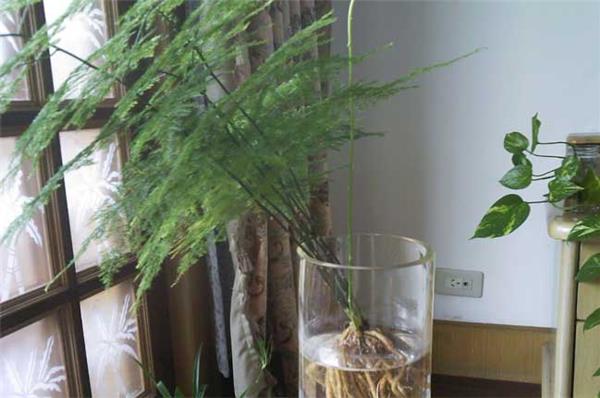
Asparagus fern is a perennial herbaceous climbing plant. The stems grow in clusters from the rhizome. It has many branches, spreading horizontally, with a shape roughly triangular and edges often wavy; the surface is green with numerous small white spots, and the underside is dark red. The flowers and stalks are deep purplish red, clustered and drooping. The berry is spherical, purplish black when ripe, containing 1 to 3 seeds. Also commonly cultivated is dwarf asparagus fern (var. nanus), a variety of asparagus fern with a shorter, smaller plant, clustered upright stems that are non-climbing, and even finer, denser cladodes.
Ecological Habits
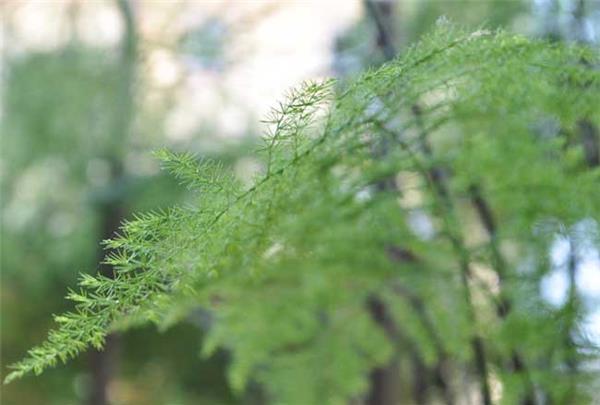
Native to southern Africa, it prefers a warm and humid environment. It fears strong light and low temperatures, requires shading in summer, and winter temperatures should not fall below 5C. Loose, fertile humus soil is most suitable. For field planting, asparagus fern requires well-drained, loose, fertile sandy loam, and waterlogging must be strictly avoided. In winter, the temperature should be maintained at 12C to 15C, and not below 8C.
Propagation Methods
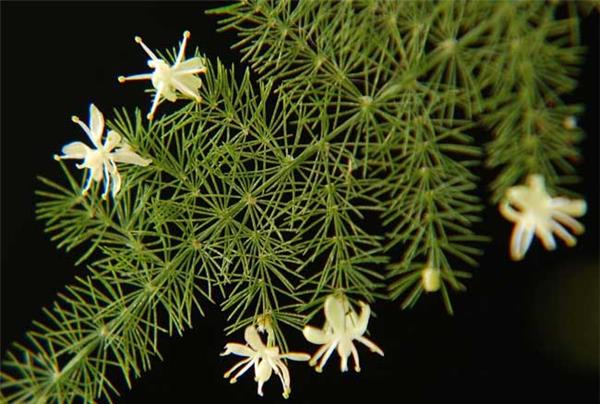
For the propagation of asparagus fern, seed sowing is generally used, and division propagation is also possible, but plants propagated by division tend to be lopsided in the crown at first, with an irregular shape.
1. Seed propagation: The berries of asparagus fern mature successively in winter. When the berries turn purplish black, they can be harvested. After harvesting, rub off the outer fruit skin to extract the seeds. Rinse them clean and they can be sown. If the room temperature is below 15C, sowing should wait until the weather warms in spring; during the interval, the seeds should be stored in sand. Sowing is mainly done in pots indoors, generally sown in shallow pots at a spacing of 2 cm, covered with soil not too deep, soaked in water and then covered with glass or film to reduce water evaporation, keep the potting soil moist, and placed in a sunny spot. After sowing, maintain the temperature at around 20C, and germination occurs in 25 to 30 days; at 15C to 18C, it takes 30 to 40 days to germinate. When the seedlings grow to 3 cm to 4 cm tall, they can be divided and transplanted.
2. Division propagation: Carry this out when repotting in spring. Pull the roots apart, taking care not to damage too many roots, and according to the size of the plant, choose pot planting or field planting. After dividing and planting, water thoroughly and place in a semi-shaded spot or provide shading. Afterwards, watering should be properly controlled, otherwise yellow leaves are easily caused.
Cultivation Techniques
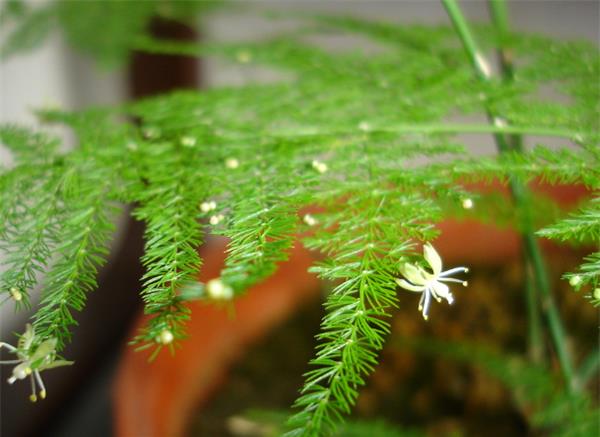
1. The key to managing asparagus fern is watering. Watering too frequently and too much tends to yellow the branches and leaves, causes poor growth, and easily leads to root rot. The amount of water should be adjusted according to the plant's growth condition and the season. In winter, spring, and autumn, watering should be properly controlled, generally watering only when the surface of the potting soil looks dry. If you find the amount of water difficult to judge, you can also alternate between light and heavy watering. That is, after 3 to 5 light waterings, give 1 thorough watering, so that the potting soil remains moist top and bottom without holding too much water. In summer, water in both morning and evening, and a slightly larger amount is not a problem.
2. Although asparagus fern is not particularly fond of fertilizer, when potted, especially for plants being kept for seed, more nutrients should be supplied. Fertilization for asparagus fern should be light and frequent, and concentrated fertilizer should be avoided. During the growing season, generally apply decomposed organic liquid fertilizer once every 15 to 20 days. Asparagus fern prefers slightly acidic soil. Therefore, in combination with fertilization, an appropriate amount of alum fertilizer water can be applied to improve the soil's pH.
3. Asparagus fern should overwinter indoors, and the winter room temperature is best kept at around 10C, with sufficient light provided; after April of the following year, it can be moved outdoors for care. Field-planted asparagus fern has luxuriant branches and leaves and rapid new vine growth, so trellises must be set up in time to facilitate ventilation and light penetration. Prune dead branches and old vines appropriately to encourage the sprouting of new vines. Before flowering, apply an additional dose of bone meal or superphosphate to increase the seed-setting rate. For asparagus fern used as cut foliage, at harvest select branches that reach the length required for market and cut them off at the base, tie them in bundles of 20 branches for market, and generally the winter price is more than 20% higher than the summer and autumn price.
That is all the editor has to introduce about asparagus fern cultivation and management techniques. I hope it is helpful to you!