What Kind of Plant Is Snake Plant? Introduction to Common Varieties
Snake plant (Sansevieria) is a fairly common houseplant nowadays. It is said to have a strong ability to absorb formaldehyde and purify the air, so it is sought after by many households, especially newly renovated homes. So, what kind of plant is snake plant? What varieties are there?
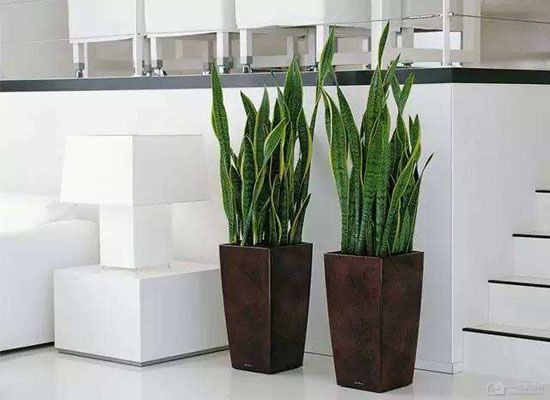
Snake plant (scientific name: Sansevieria trifasciata Prain), also known as tiger skin plant, brocade orchid, thousand-year orchid, tiger tail palm, yellow tail orchid or mother-in-law's tongue, is a perennial herbaceous foliage plant of the genus Sansevieria in the family Liliaceae. It has rhizomes, and its leaves are basal, fleshy, linear-lanceolate, hard and leathery, upright, with the base slightly grooved; dark green, with horizontal bands of light green and dark green alternating on both sides; racemose inflorescence, flowers white to pale green; berries about 7-8 mm in diameter. Flowering period is November to December.
I. Morphological Characteristics
Snake plant has horizontal rhizomes. Leaves are basal, usually 1-2, sometimes 3-6 in clusters, upright, hard and leathery, flat, long strip-lanceolate, 30-70 (-120) cm long, 3-5 (-8) cm wide, with alternating light green and dark green horizontal band markings, green margins, gradually narrowing toward the base into grooved stalks of varying lengths.
The flowering stem is 30-80 cm tall, with pale brown membranous sheaths at the base; flowers are pale green or white, in clusters of 3-8, arranged in a raceme; pedicels are 5-8 mm long, with the joint located in the middle; the perianth is 1.6-2.8 cm long, with the tube and lobes approximately equal in length.
Berries are about 7-8 mm in diameter. Flowering period is November to December.
II. Growth Habits
Snake plant is highly adaptable. It prefers warm and humid conditions, tolerates drought, and likes light but also tolerates shade. It is not demanding about soil, but well-drained sandy loam is better. Its optimum growth temperature is 20-30°C, and its overwintering temperature is 10°C.
III. Main Varieties
1. Short-leaf snake plant
Also called small orchid tiger or tiger ear orchid. The plant is low-growing, with a height not exceeding 20 cm. The leaves grow in a spiral from the center outward, overlapping each other to form a bird's nest shape. The leaves are short and wide, ovate, with acuminate tips and a distinct short tail point. The leaves are 10-15 cm long and 12-20 cm wide, dark green in color, with relatively wide yellow bands on both sides of the leaf margins and irregular silver-gray stripes on the leaf surface. The leaves are clustered and lush.
2. Silver short-leaf snake plant
Also known as silver-edged short-leaf snake plant. It is a cultivar of snake plant. Both its plant shape and leaf shape are similar to those of the short-leaf snake plant. The leaves are short, silvery white, with indistinct horizontal markings.
3. Round-leaf snake plant
Also known as stick-leaf snake plant, tube-leaf snake plant, tube thousand-year orchid, etc. The stem is short or absent, and the fleshy leaves are slender and cylindrical, with pointed tips, hard in texture, growing upright, sometimes slightly curved. The leaves are 80-100 cm long and 3 cm in diameter, dark green on the surface, with horizontal grayish-green tiger-stripe markings. Racemose inflorescence, with small white or pale pink flowers.
4. Dwarf-leaf snake plant
The plant grows in a radial pattern, with hard leaves, broadly conical, grooved on the upper surface and semicircular on the back, with yellow-brown leaf margins. The leaf color is dark green, with horizontal light green tiger-stripe markings.
5. Other varieties
For example: silver-veined snake plant, which has silver-white longitudinal stripes of varying widths on the leaf surface; broad-leaf snake plant (also called fan-leaf snake plant), which has broad fan-shaped leaves, is also seen in cultivation.
Snake plant is actually a quite hardy plant. As long as the climate is suitable, it does not need overly meticulous care. However, from an ornamental point of view, to make it grow more attractively, scientific cultivation is needed.