There is a great deal to pay attention to in anthurium watering methods; understand this before planting
Many friends have reported that the anthurium is a rather delicate flower; improper watering will not only cause it to rot but may even prevent it from surviving. So what are the anthurium watering methods? Watering anthuriums does indeed involve many particularities, and understanding them before planting is certainly helpful for improving the anthurium's survival rate.
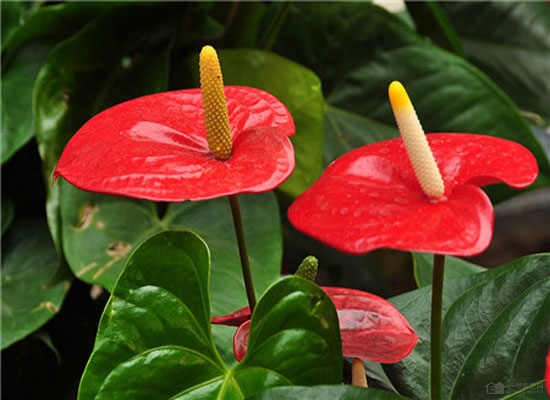
The correct watering method is the key to growing anthuriums well; improper watering will cause anthuriums to wither or even rot, affecting their normal growth. So how should you water anthuriums, how often should you water them, and what kind of water should you use?
1. Water quality requirements
Anthuriums are relatively sensitive to salt, so choose slightly acidic water for watering whenever possible. Ordinary household water can be used after sitting for 2 to 3 days. However, water that is too acidic will reduce its ornamental value. Natural rainwater is the best water source for caring for anthuriums, so when it rains, you might as well store a little extra.
For home cultivation, you can fill discarded cola bottles or mineral water bottles with tap water and let them sit for 3 to 4 days, then spray the anthurium's leaves. After tap water has been left standing for a certain period, the chlorine in the water volatilizes.
2. Watering frequency
Potted anthuriums have different water quality requirements at different stages.
① During the seedling stage, because the plant's root system is weak and distributed relatively shallowly in the growing medium, it is not tolerant of drought. After planting, water should be sprayed 2-3 times a day, and the medium should be kept moist at all times to encourage early and abundant new root growth, while also paying attention to the dryness and moisture of the medium on the pot surface.
② During the medium and large seedling stages, the plants grow quickly and need more water, so the water supply must be sufficient.
③ During the flowering stage, watering should be appropriately reduced and phosphorus and potassium fertilizers increased to promote flowering.
3. Watering time
In the three seasons of spring, autumn, and winter, choose warm, sunny weather for watering whenever possible, in the morning or at noon, and avoid watering during cold, overcast times. In summer, watering is generally done in the evening, and absolutely do not water at noon. You can choose to spray water once at 10 to 11 a.m. and once after 15:00.
4. Precautions for watering anthuriums
Water temperature control
The water temperature for watering anthuriums should be kept at around 15°C (including the nutrient solution used for watering), and this is especially important in severe cold and extreme heat. The moisture in the medium should not be too wet, because the anthurium's roots are semi-succulent and store a large amount of water themselves; too much water in the medium causes a lack of oxygen in the medium, obstructs root respiration, and if kept in an overly wet state for a long time, will cause root rot.
Humidity maintenance
Anthuriums like environments with relatively high humidity. The humidity mentioned here refers to the relative humidity in the air, not just the water content in the soil. For example, in northern regions, where it is dry and windy, moisture evaporates relatively quickly, and if water is not replenished in time, the humidity will quickly drop.
Generally speaking, the environmental humidity for anthuriums should be maintained at 70-80%. The best way to check whether the humidity for anthuriums meets the standard is to observe the plant's leaves; when the leaf tips become dry, it indicates that the humidity is insufficient and water should be sprayed in time.
Anthuriums at different growth stages have clearly different water requirements. If this point is not paid attention to, it may indeed bring many disadvantages to the anthurium's growth.