How to grow Anthurium so it looks more vibrant? Master these nine cultivation essentials
Anthurium, with its bright red spathe and a golden spadix at the center, is vibrant and festive, making it a favorite houseplant in many homes. However, growing Anthurium involves quite a few finer points; otherwise, your Anthurium may lose its luster. So how should you grow and care for it to make it a showpiece in your home?
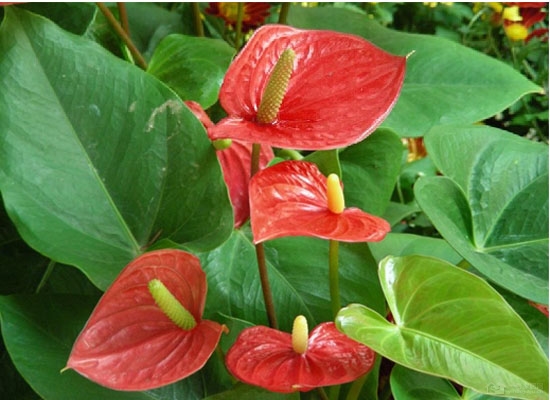
Anthurium belongs to the genus Anthurium in the family Araceae, and has now become one of the well-known important potted flower crops. Because of its vibrant flower colors, unique flower shape and long flowering period, it is deeply loved by people. To grow potted Anthurium well, you should master the following nine essentials.
I. Nutrients
1. Carbohydrates are the most important nutrient for Anthurium growth, and they come from photosynthesis.
2. Macroelements are the elements that Anthurium needs in relatively large amounts during growth. They include the 6 elements nitrogen, phosphorus, potassium, sulfur, magnesium and calcium, and are mainly obtained from the growing medium or added manually.
3. Microelements, such as iron, manganese, copper, zinc, molybdenum and boron, come from the growing medium or are added manually.
II. Light
Too much light will inhibit plant growth and cause the leaves and the spathe of the flower to discolor or become scorched. Conversely, when light intensity is too low, insufficient assimilation products in the plant tend to cause smaller flowers, softer flower stems and reduced yield. The suitable light intensity for Anthurium growth is 10000 to 22000 lux.
III. Temperature
Anthurium is relatively sensitive to temperature during growth. The suitable growing temperature is 14°C to 35°C, the optimum temperature is 19°C to 25°C, and a day-night temperature difference of 3°C to 6°C is appropriate; that is, a daytime temperature of 21°C to 25°C and a nighttime temperature of about 19°C are most suitable for Anthurium growth. If the temperature stays below about 13°C for a long time, the plant will not die, but it will be difficult for it to resume growth for a long time; when the temperature is above 35°C and light is relatively sufficient, leaf surfaces are prone to scorching, and because damaged leaves do not recover, this will directly affect the overall quality of the Anthurium.
IV. Humidity
Anthurium has relatively high requirements for air humidity. When the temperature is 20°C to 28°C, humidity should be 60% to 70%; when the temperature reaches above 28°C, humidity should be between 70% and 80%. But in winter, even if the greenhouse temperature is relatively high, you should not keep it too humid, because leaves that are too wet will instead reduce the plant's cold resistance, making it prone to frost injury and unfavorable for safe overwintering.
V. Watering
Natural rainwater is the best water source for Anthurium cultivation. The pH of the water should be controlled between 5.2 and 6.1. Potted Anthurium has different water requirements at different growth and development stages. In the seedling stage, because the root system is weak and distributed relatively shallowly in the growing medium, it is not tolerant of drought, so you should water thoroughly at one time, keep the growing medium moist frequently, encourage early rooting and more new roots, and pay attention to the dryness and moisture of the growing medium on the pot surface; in the medium and large seedling stages, the plant grows quickly and needs more water, so the water supply must be sufficient; during the flowering stage, watering should be appropriately reduced and phosphorus and potassium fertilizers should be increased to promote flowering. During watering, be sure to alternate wet and dry conditions, and never water when the plant is suffering from severe water shortage, as this will affect its normal growth and development.
VI. Growing medium
The commonly used growing medium is imported peat. In addition to peat, more and more growers are now beginning to use coconut coir. Coconut coir that has passed through a screen can be used to replace peat; it has good capillary action and a relatively high air content. Using 40% coconut coir in cultivation will not cause any problems.
VII. Fertilization
The fertilization principle is "light fertilizer, applied frequently." Fertilize with different compound liquid fertilizers according to the different growth stages of Anthurium. Generally, depending on the dryness and moisture of the growing medium in the pot, apply fertilizer water once every 2 to 3 days; in summer, apply fertilizer water once every 2 days, and when the temperature is high, water once more; in autumn, generally apply fertilizer water once every 5 to 7 days.
VIII. Repotting
When repotting, first place a layer of medium at the bottom of the pot; the thickness depends on the medium height and the depth of the flower pot. Take the Anthurium seedling out of the small pot together with the medium, place it in the center of the flower pot, cover with soil up to the junction of roots and stems, then gently pat firm.
IX. Pests and diseases
1. Strengthen Anthurium quarantine and disinfection to prevent sources of disease from entering.
2. Improve the environment and raise cultivation techniques.
3. Focus on prevention and spray pesticides regularly.
To prevent and control pests and diseases, you must persist in making the above three aspects complement one another.
Anthurium has high requirements for water quality and also very high requirements for humidity. This requires us, as growers, to care for it attentively, especially paying attention to the different needs of Anthurium at different growth stages.