What to Do When Clivia Leaves Turn Yellow? Cause Analysis and Solutions
With its elegant form, Clivia (Clivia miniata) has long been a favorite subject of writers and poets, and has also become one of the top choices for indoor greenery. However, during the process of growing Clivia, yellowing leaves are a common occurrence, which not only spoils the ornamental appeal but also dampens one's enjoyment. So, what should you do when Clivia turns yellow?
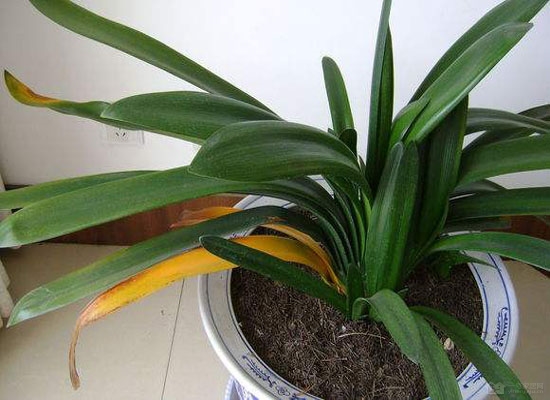
There are generally several situations in which Clivia leaves turn yellow. If the lowest leaves turn yellow because new roots are growing from the leaf axils, this is normal metabolism. In another situation, where leaves turn yellow without new roots forming at the leaf axils, it is mostly due to raw soil with poor air permeability, too much fertilizer, or poor control of watering dryness and moisture that has caused root rot - all of these can cause Clivia leaves to turn yellow.
1. Clivia leaves turn yellow, with the small central leaves turning black and rotting
When the small central leaves turn black and rot, further judgment is needed. Pry apart the two leaves to inspect: if the gap between the leaves is black and exuding decaying fluid, it can be determined that a formed Clivia flower scape failed to grow out from between the leaves in time and instead rotted directly in the middle of the leaves.
There are many causes of flower scape rot: one is excessive misting, which causes dirty water to flow into the gap and lead to bacterial infection and rot; another is careless watering that causes dirty water to splash into the gap and thus cause rot.
Consequences: under normal circumstances it will not affect the plant's life, but in high-temperature, high-humidity weather it can very easily cause the crown to rot off and the entire plant to rot.
Treatment: use toilet paper or tissue paper to absorb the decaying fluid, remove the debris that can be cleaned by appropriate means, and keep the environment relatively dry at ordinary times. A bottom-watering method (soaking the pot) is recommended.
2. All Clivia leaves turn yellow
When all leaves turn yellow, it is often a symptom of sunscald.
Solution: shade it immediately and cut off the yellow leaves.
3. Clivia leaves wither, yellow and droop
Withered, yellow or drooping leaves are a symptom of water deficiency.
Solution: when watering, follow the principle of not watering until the soil is dry, and do not let water accumulate in the pot.
4. Clivia leaves turn yellow in local patches
Local yellowing is very likely caused by scorching heat, cold wind, hot water, or acid or alkaline damage. Sometimes, insufficient nitrogen fertilizer can cause the plant to suffer from chlorosis, with reduced chlorophyll leading to yellowing leaves.
Solution: for the former, simply eliminate the external cause in time. For the latter, apply more fermented cake fertilizer water. (The growing methods differ depending on the season.)
5. Clivia leaves wrinkle and develop yellow spots
Excessive fertilizing causes root burn.
Solution: repot with fresh soil immediately, and soak the roots in a 0.1% potassium permanganate aqueous solution for 20-30 minutes, then rinse with clean water. After drying, cut off the rotten roots, apply plant ash to the wounds, and replant.
6. The two outer leaves of Clivia turn yellow (plant grown for 4 years)
This is normal metabolism.
Solution: simply trim off the two outer leaves.
7. Clivia leaves take on a grayish-yellow color
The main cause of grayish-yellow Clivia leaves is excessively strong direct sunlight.
Solution: the Clivia needs to be shaded.
8. Clivia leaves show symptoms of etiolation
Due to insufficient light, if the indoor spot is very dark, the Clivia will become etiolated.
Solution: supplement the light with a fluorescent lamp.
9. Clivia leaves are yellow and weak
Yellow, weak leaves indicate a fertilizer deficiency.
Solution: apply thin fertilizer frequently; if the leaves turn yellow because the soil is raw and not air-permeable, replace it with leaf mold soil or pine needle soil.
10. Yellowing of the lower leaves causes root rot
Solution:
① Pull the Clivia up roots and all.
② Use a utility knife to cut away the old leaves and rotten leaves.
③ Use scissors to cut off the roots that have already rotted as well as the old roots.
④ In a spray bottle, mix water and chlorothalonil in a 3:5 ratio.
⑤ Move the Clivia back into the pot.
⑥ Water it with Kuaihuolin rooting liquid and nutrient water.
⑦ At first, water about 2 times a month, for 5 months.
⑧ After 5 months, water about 4 times a month, for 2 months.
⑨ Return to a normal watering frequency.
It turns out there are still many causes of yellowing Clivia leaves, and the key is to find the cause. For those of us who are not professionals, the process of elimination may be the simplest way to confirm the cause.