Is the money tree easy to grow? Master its growth habits and care for it well
When does Anthurium bloom? Anthurium belongs to the Araceae family, and it is said that plants of this type are evergreen all year round, and Anthurium also blooms in all four seasons. However, many friends report that their Anthurium at home never blooms. So, what are the reasons Anthurium does not bloom?
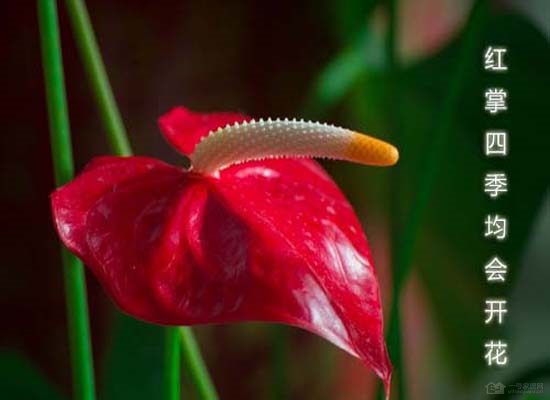
If Anthurium develops well and is not affected by disease or pests, it can bloom in all four seasons: spring, summer, autumn and winter. Anthurium pollinates and blooms through cross-pollination between companion plants. Under normal circumstances, Anthurium seedlings can bloom after one year of growth. Potted Anthurium has a relatively long flowering period, usually up to 4 months, while hydroponic Anthurium has a shorter flowering period, generally lasting about one month.
There are many factors that cause Anthurium not to bloom, such as temperature, light, fertilisation, watering and ventilation conditions.
1. The temperature suitable for Anthurium growth needs to be controlled between 15-30 degrees. Since seasonal temperature changes have a great impact on Anthurium growth, it must be ensured that the minimum temperature for Anthurium is not higher than 10 degrees and the maximum temperature is not higher than 35 degrees. Too high or too low a temperature will affect Anthurium growth and flowering, and should be adjusted moderately according to specific conditions.
2. Anthurium likes to grow in a warm and humid environment, so the light should mainly be scattered and even light, and Anthurium should be avoided being in direct sunlight for a long time. Anthurium should also not be kept in a dark place without light for a long time, which would prevent it from carrying out photosynthesis. For potted Anthurium, the pot can be rotated regularly to ensure even light exposure. Insufficient light or strong light can both easily cause Anthurium not to bloom and yellow leaves.
3. For Anthurium, if the temperature is not too high, fertilisation and watering are both carried out simultaneously in the form of water-soluble fertiliser. The amount of water-soluble fertiliser needs to be combined with the growth stage of Anthurium and temperature changes, using a reasonable watering frequency and ratio and dosage. Anthurium has less demand for water-soluble fertiliser during the seedling stage and flowering stage. Before and after flowering, increase the amount with higher potassium and phosphorus content as much as possible, while the later growth stage requires higher nutrient content. Insufficient or excessive supply of water-soluble fertiliser can easily cause adverse reactions in Anthurium, thereby affecting its flowering and growth.
4. Try to ensure that Anthurium has ventilation conditions; a good ventilation environment is beneficial to Anthurium growth. Poor ventilation will affect Anthurium metabolism, and the phenomenon of shorter flower stems or no flowering is likely to occur. For Anthurium's overly dense new branches and leaves, and withered and yellow old leaves and old branches, they should be pruned promptly to avoid affecting ventilation and light.
5. Pests and diseases will affect the blooming time of Anthurium. In severe cases, they will cause phenomena such as Anthurium not blooming, yellow leaves and spots. Commonly seen fungal diseases include leaf spot, root rot and anthracnose, while pests include aphids, red spiders and scale insects. For daily pest and disease phenomena, prevention should still be the main approach.
The characteristic of Anthurium blooming in all four seasons can make the home it decorates full of festivity and vitality. However, the premise is to know how to cultivate and grow Anthurium scientifically.