Garden Pea Planting Plan with Intercropping, Succession Planting, and Pruning Methods
Garden peas, including shelling peas, snow peas, and snap peas, have two characteristics that make them strong candidates for a super-productive planting plan. First, peas vine upward, and their vertical habit makes it possible to grow low-growing crops at their base. Second, in most climates, peas planted in spring finish producing by midsummer, leaving a good growing season to plant another main vegetable crop. Whether you call it intercropping (growing multiple vegetables in a shared space) or succession planting (following one vegetable with another in the same season), peas offer plenty of opportunities for innovation.
Every year, I grow three kinds of peas (snow peas, shelling peas, and snap peas), though these peas never make it into the kitchen, because we eat them in the garden. This makes maximizing the space we give peas even more important. Snap peas are the most productive variety. In a good year, our frozen peas last until spring.
Pea Intercropping Plan
All peas, including short varieties, need some kind of support. Your trellising options are endless, because peas will cling to almost any support with their strong tendrils. Your trellis design has a great deal to do with any intercropping scheme. If you have an upright trellis in the center of the bed, the available intercropping space is on the outside of the peas. These two simple pea planting plans (on the right, the top bed) show how you can grow leafy greens such as lettuce, arugula, or spinach, or shallow-rooted radishes and onions. I like leafy greens best, because leafy greens shade the pea roots and help keep them cool. To avoid disturbing the pea roots, I cut these salad greens rather than pulling them up.
Peas Can Climb Almost Anything
If you plant peas in widely spaced rows and provide a slanted diagonal trellis, the layout changes. This creates a sheltered spot in the middle of the rows where you can plant onions or potatoes (see the bottom two beds in the photo above). In climates where the mild spring weather does not last long enough, this is a good way to get a good summer crop of new potatoes, even though the weather starts turning hot early.
Pea Succession Planting
Waiting for pea plants to produce every last pea is natural, but you need a more ruthless attitude to terminate your peas and free up space for a new crop. Many gardeners (including me) like to follow peas with cucumbers or squash, which can use the trellis built for the peas. There is no need to pull the peas out; just cut them off at ground level. Any unused nitrogen nodules on the pea roots will help feed the next crop right in place.
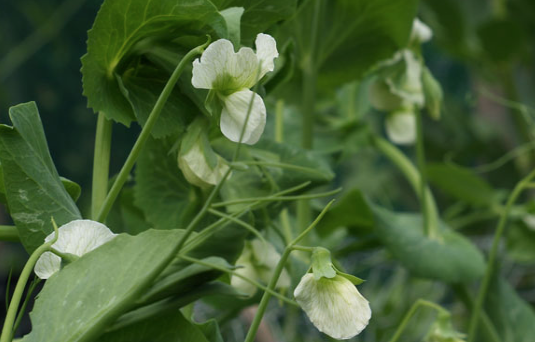
Pea Flowers
Several gardeners I know run a covert operation in their pea patches, cutting down the pea plants and slipping in cucumber or squash seedlings while the remaining peas are still growing. How do you know when to launch the successor? Regardless of their type and size, peas eventually run out of steam, and it is obvious when new pods form at the tips of the stems rather than on side branches. Pods on peas always grow in a predictable order from the bottom of the plant to the top. When only pods remain at the very top of the stem, it is time for a change.
If you are ready for a thorough overhaul of the pea bed (unavoidable when intercropping with potatoes), treat carrots as your follow-on crop. A good friend of mine, also one of the best vegetable gardeners I know, strongly recommends this succession. In long, lovely autumn weather, you can also plant cauliflower after peas. Please share what works for you in your garden, because few people can ever get enough peas.