Mimosa Pudica: Characteristics and the Reasons Behind Its Shyness Explained
Mimosa pudica, native to the tropical regions of the Americas, is a perennial herbaceous plant in the genus Mimosa of the Fabaceae family. Because of its unique physiological habits, it has many alternative names and nicknames, such as see-laugh grass, sensitive plant, shout-call grass, know-shame grass, shy grass, bashful grass and husband-and-wife grass.
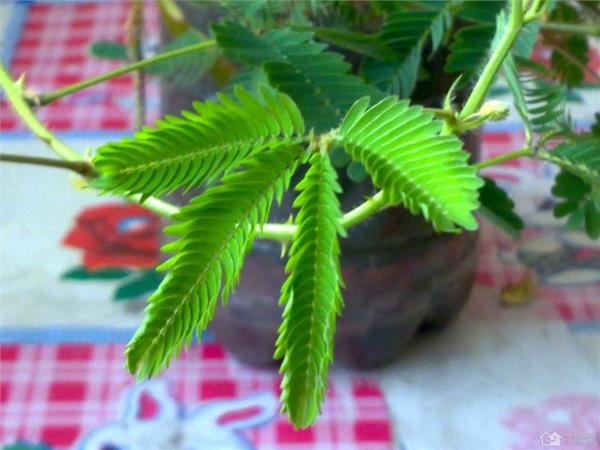
I. Characteristics of Mimosa Pudica
1. The most notable characteristic of Mimosa pudica is that when it is stimulated (such as by touch), its leaf surfaces contract and fold together. If the stimulus is relatively strong, this stimulus is quickly transmitted in turn to the adjacent leaflets and even to all the leaflets of the entire compound leaf, causing the petiole to droop. If the stimulus is strong enough, it can even cause the leaflets of the whole plant to close up and the compound leaves to droop. But after a period of time, it can return to its original state. Mimosa pudica also reacts very quickly to vibration; it begins to respond 0.1 s after being stimulated and completes the response within a few seconds.
2. At night, Mimosa pudica also folds its leaflets together and lets its petiole droop, and during the day, when some leaflets are stimulated by vibration, they also fold together in pairs. It is more sensitive when the light is weak. Normally, the water in the pulvinus supports the leaf blade; but when it is stimulated by an external force, the water in the pulvinus immediately flows elsewhere, causing the leaves of Mimosa pudica to close. In addition, at night it automatically contracts (that is, sleep movement). This unique feature is precisely the source of the name and nicknames of Mimosa pudica.
3. Because Mimosa pudica has strong vitality and grows in a relatively messy way, many places classify it as a type of grass, but in fact it also flowers. The flowering period of Mimosa pudica is from July to October each year, but its flowering period is very short; the flowers fade less than two days after blooming. The flowers are pink, and the capitulum is spherical, shaped like a pom-pom. After flowering, it also produces pods, and the fruit is flat and round.
II. Reasons for the "Shyness" of Mimosa Pudica
1. The cells of Mimosa pudica are supported by a fine network-like protein called "actin." When Mimosa pudica performs its closing movement, the phosphate on actin dissociates. As long as Mimosa pudica absorbs a compound that prevents phosphate from dissociating, it will not change even when touched. When the actin bundles disperse, the cells are destroyed, and as a result water escapes, which causes the closing movement. Actin is generally found in the muscle fibers of animals and is related to muscle contraction and relaxation. It was unexpected that it also exists in Mimosa pudica, which can be said to be quite rare.
2. The leaves and petioles of Mimosa pudica have a special structure. At the base of the petiole and at the base of the leaflets of the compound leaf, there is a relatively swollen part called the pulvinus. The pulvinus is most sensitive to stimulation. Once the leaf is touched, the stimulus is immediately transmitted to the pulvinus at the base of the petiole, causing the two small leaflets to close. If the touch is a little stronger, it is transmitted not only to the pulvinus of the leaflets, but also quickly to the pulvinus at the base of the petiole of Mimosa pudica, and the entire petiole droops.
3. Because there is a very large vacuole inside its leaves, and at the position between the leaf and the petiole there is a part scientifically called the pulvinus. When these parts are stimulated, some sensory cells inside with relatively low electrical potential immediately release water, and then the petiole droops, and because the leaves lose water, they lose the expansion between internal cells, causing the leaf blades to close. In fact, it also closes at night, all because of the internal cell turgor pressure. In fact, its principle is the same as that of the Venus flytrap. As for the pulvinus, it is relatively sensitive to external stimuli. When stimulated, the cell sap in the cells of the pulvinus is expelled, thereby making the internal pressure unbalanced, which causes the leaves to close and produces the shy response. In fact, the "symptoms" of shyness in Mimosa pudica are greatly related to the environment of its place of origin. The place of origin of Mimosa pudica is tropical South America, where strong rainstorms often occur. When rain falls, Mimosa pudica promptly closes its leaves to avoid damage from storms and protect itself.
4. The shyness principle of Mimosa pudica is largely related to its original environment. Because in tropical regions there is abundant water and rainy weather occurs frequently, Mimosa pudica promptly closes its pinnate leaves to prevent wind and rain from damaging the leaves. In fact, this is also a manifestation of evolution in the natural world.
The above are the reasons why Mimosa pudica becomes shy. I believe that after reading this, you will like this plant even more.