Information about Mimosa pudica: Why Mimosa pudica Is Shy
Mimosa pudica is quite an interesting plant, isn't it! Speaking of Mimosa pudica, I believe everyone knows something about it. It is a magical little plant that shrinks when touched. Next, let's take a look at why Mimosa pudica is shy.
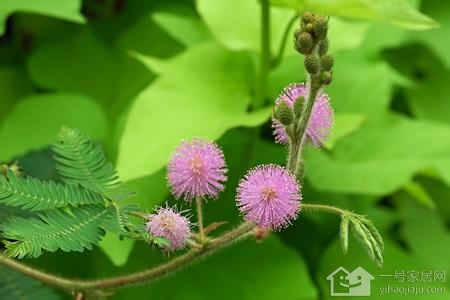
Information about Mimosa pudica
Mimosa pudica is native to the tropical regions of the Americas. It is a perennial herbaceous plant of the genus Mimosa in the Fabaceae family. Because of its unique physiological habits, it has many aliases and nicknames, such as see-laugh grass, sensitive plant, he-hu grass, know-shy grass, fear-ugly grass, shy grass and husband-and-wife grass.
Origin and distribution: Mimosa pudica is native to the tropical regions of the Americas and has now spread to many parts of the world. Because of its strong growth ability, it is treated as a weed in many countries.
Morphological characteristics: Perennial herbaceous plant. The flowers are pink and shaped like pom-poms. After flowering, it produces pods, and the fruit is oblate. The leaves are feather-like compound leaves arranged alternately, in a palmate arrangement. When touched by the outside world, the petiole droops and the leaflets close.
Why Mimosa pudica Is Shy
1. The biggest characteristic of Mimosa pudica is that when it is stimulated (such as by touch), its leaf surface contracts and closes together. If the stimulus is stronger, this stimulus will quickly pass in turn to nearby leaflets, and even to the leaflets of the entire compound leaf, causing the petiole to droop. If the stimulus is strong enough, it can even make the leaflets of the whole plant close and the compound leaves droop. But after a period of time, it can return to its original state. Mimosa pudica also responds very quickly to vibration; it begins to react 0.1 s after being stimulated, and completes the response within a few seconds.
2. At night, Mimosa pudica also closes its leaflets and droops its petiole. During the day, when some leaflets are stimulated by vibration, they also close in pairs. It is more sensitive when the light is weak. Normally, the water in the pulvinus supports the leaf blades; but when it is stimulated by external force, the water in the pulvinus immediately flows elsewhere, causing the leaves of Mimosa pudica to close. In addition, at night it automatically contracts (that is, sleep movement). This unique feature is exactly the source of the name and nicknames of Mimosa pudica.
3. Because Mimosa pudica has strong vitality and grows rather untidily, many places classify it as a type of grass, but in fact it also blooms. The flowering period of Mimosa pudica is from July to October each year, but its flowering period is very short; less than two days after blooming, the flowers fade. The flowers are pink, and the capitulum is spherical, shaped like a pom-pom. After flowering, it also produces pods, and the fruit is oblate.
4. At the base of its petiole there is a swollen organ called the "pulvinus". Many parenchyma cells grow inside the pulvinus, and these cells are very sensitive to external stimuli. Once the leaf is touched, the stimulus is immediately transmitted to the pulvinus. At this time, the cell sap in the parenchyma cells begins to flow toward the intercellular spaces, reducing the cells' ability to swell. The pressure between the cells in the lower part of the pulvinus decreases, resulting in the phenomenon of leaf closure and petiole drooping. After 1-2 minutes, the cell sap gradually flows back into the pulvinus, and then the leaf blades return to their original appearance.
The leaves and petioles of Mimosa pudica have a special structure
At the base of the petiole and the base of the leaflets of the compound leaf, there is a relatively swollen part called the pulvinus. When vibration is transmitted to the pulvinus, the cell sap in the parenchyma cells of the upper half of the pulvinus is discharged into the intercellular spaces, reducing the turgor pressure of the cells in the upper half of the pulvinus, while the intercellular spaces of the parenchyma cells in the lower half still maintain their original turgor pressure. As a result, the small leaflets stand upright, the two small leaflets close together, and even the entire leaf droops.
Someone has done research showing that within 0.088 seconds after Mimosa pudica is stimulated, its leaves close. After a little while, the small leaflets unfold again and the petiole also stands up. The recovery time is generally 5-10 minutes. However, if we continue to tease it and stimulate its leaves again and again, it will feel "annoyed" and no longer react at all. This is because continuous stimulation causes the cell sap that controls opening and closing in the pulvinus cells to be lost and unable to be replenished in time. Very interesting, isn't it! If you want to learn more related information, you can continue to follow No.1 Home Network.