How to grow geraniums? Understanding their ecological habits is key
Geranium, also known as hydrangea flower or foreign hydrangea, is a perennial evergreen herbaceous or subshrub flowering plant in the family Geraniaceae, genus Pelargonium. It originates from southern Africa and is widely cultivated around the world. Geraniums have a long flowering period and strong adaptability to the environment; their plant size suits home pot cultivation, and they are easy to propagate, making them very popular. They are one of the common potted flowers in homes and also a commonly used flower for flower beds in warm winter regions. Geranium florets cluster together, and the large inflorescence resembles a hydrangea, with vivid colors. They can be used for indoor decoration and also for arranging spring flower beds and venues. Below is a detailed introduction to geranium cultivation methods.
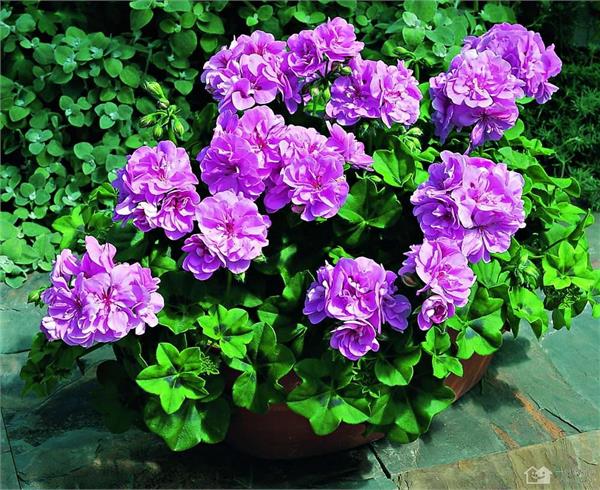
1. Geranium ecological habits
Geraniums originate from southern Africa. They like a warm, humid environment with plenty of sunlight. They have poor cold tolerance and fear waterlogging and high temperatures. The suitable growth temperature from March to September is 13-19°C, and the winter temperature is 10-12°C. From June to July, they enter a semi-dormant state, and watering should be strictly controlled. They prefer fertile, loose, and well-drained sandy loam. The winter temperature should not be lower than 10°C, and they can tolerate short periods of 5°C low temperature. Single-petal varieties require artificial pollination to improve the seed-setting rate. Seeds mature about 40-50 days after flowering.
Geraniums like warm winters and cool summers. Indoors in winter, maintaining 10-15°C during the day and above 8°C at night allows them to bloom normally. However, the optimal temperature is 15-20°C. Geraniums like dryness and dislike dampness, so watering should not be excessive in winter; water only when the soil is dry. If the soil is wet, the stems become tender, which is unfavorable for the sprouting and opening of flower branches; long-term excessive moisture causes the plant to grow leggy, the flower branch attachment points to move upward, and the leaves to gradually yellow and fall off. Geraniums need sufficient sunlight during the growth period, so in winter they must be placed in a sunny spot. Insufficient light leads to leggy stems and leaves, thin and weak pedicels, and poor inflorescence development; flower buds under weak light often fail to open smoothly and wither prematurely. Geraniums do not like heavy fertilizer; too much fertilizer makes geraniums grow excessively and is unfavorable for flowering. To make flowering abundant, apply a dilute fertilizer solution (decomposed soybean cake water) once every 1-2 weeks, and apply 800 times diluted monopotassium phosphate solution every 7-10 days to promote normal flowering. After flowering, promptly cut off the withered flower stems, which can increase light between plants, induce new leaves to sprout, and produce new flower stems. Pruning and pinching: to encourage more branching and more flowers in geraniums, the plant should be pinched multiple times to promote increased branching and bud formation. After flowers fade, timely cut off the remaining flowers and remove overly dense and thin weak branches to avoid excessive nutrient consumption, but in cold winter, heavy pruning is not advisable.
2. Fertilization
Proper fertilization is also a key point in growing geraniums. If too much fertilizer is applied, it will cause geraniums to dehydrate and affect their normal growth, but if you do not fertilize them for a long time, it will also cause insufficient nutrients. The amount of fertilizer for geraniums is directly related to the quality of the soil, the size of the flowers, and the size of the flower pot. Therefore, when purchasing, it is best to ask the shop to understand the required fertilizer amount and frequency.
3. Water
Geraniums originate from southern Africa and are plants that do not like too much water. Therefore, during cultivation, never water geraniums too much. If watered too much, the roots of geraniums will rot. If they grow in such a water-rich environment for a long time, it will affect their growth and lead to death. Therefore, when growing geraniums, it is enough to water them once every two to three days, but each watering must be sufficient.
4. Temperature
Geraniums like a warm, humid environment with plenty of sunlight. The most suitable growth temperature is between 10 and 20°C, which is the temperature of spring and autumn. Therefore, protective measures must be taken in both winter and summer. In winter, place them in an environment where the temperature is not lower than 0°C to avoid frost damage, while in the hot summer, move them to a cool place to avoid exposure to the scorching sun.
5. Propagation methods
Commonly propagated by sowing and cuttings
Sowing propagation
It can be done in spring and autumn, with indoor pot sowing in spring being preferable. The suitable germination temperature is 20-25°C. Geranium seeds are not large, so after sowing, the covering soil should not be deep; they germinate in about 2-5 days. If sown in autumn, they can bloom in the summer of the following year. Seedlings propagated by sowing can be selected to breed excellent intermediate-type varieties.
Cutting propagation
Except when the plants are in a semi-dormant state from June to July, cuttings can be taken at any time. Spring and autumn are preferable. In high summer temperatures, cuttings easily turn black and rot. Choose cuttings 10 cm long, with the top part being best, as it has vigorous growth and roots quickly. After cutting the cuttings, let the cut surface dry for several days to form a film, then insert them into a sand bed or a mixed substrate of expanded perlite and peat. Be careful not to damage the stem skin of the cuttings, otherwise the wound will easily rot. After inserting, place in a semi-shaded place, maintain a room temperature of 13-18°C, and roots will form 14-21 days after insertion. When the roots are 3-4 cm long, they can be potted. During the cutting process, soaking the base of the cuttings in 0.01% indolebutyric acid solution for 2 seconds can improve the survival rate and rooting rate of cuttings. Generally, cuttings cultivated for 6 months will bloom, that is, cuttings taken in January bloom in June; cuttings taken in October bloom in February-March of the following year.
Greenhouse propagation
Geraniums have strong adaptability, bright flower colors, and a long flowering period, and are suitable for indoor placement, flower bed arrangement, and so on. The greenhouse breeding techniques are introduced below.
Tissue culture
Geraniums can also be propagated by tissue culture. Using MS medium as the basic medium, adding 0.001% indoleacetic acid and kinetin promotes explants to produce callus and adventitious buds, and 0.01% indoleacetic acid promotes rooting. Tissue culture provides a new approach for the improved breeding and selection of new geranium varieties.
Geraniums are very easy plants to grow. As long as you understand their growth habits and give them a little care in daily life, they will bloom into beautiful and brilliant flowers. The above is an introduction to geranium cultivation methods. If you are interested, please follow No.1 Home Network.