Why Asparagus Fern Leaves Turn Yellow and How to Care for It
What should you do when asparagus fern leaves turn yellow? There are many reasons why asparagus fern leaves turn yellow, and to find a solution, you need to find the root of the problem. We have gathered some solutions that we hope will be useful to you. Let's take a look together below.
Reasons Why Asparagus Fern Leaves Turn Yellow
1. Temperature too high. Although asparagus fern likes warmth, it should not be placed near a fire for long periods, otherwise the entire fronds will turn yellow and drop off, and the stems will also dry up.
2. Direct scorching sun. Asparagus fern cannot be exposed to direct strong sunlight, as this will cause the branches and leaves to wither and yellow; in addition, if the asparagus fern is exposed to strong light for too long, the plant will first stop growing, and then the leaves will turn yellow and fall.
3. Improper watering. Asparagus fern likes moisture. If you neglect watering, or only water the surface layer of the potting soil, the roots will not absorb enough water and the stems and leaves will slowly turn yellow. But never let water accumulate in the pot either; too much water easily causes root rot and yellowing, withered leaves.
4. Insufficient light. Asparagus fern likes warmth; if it is placed in a shaded environment for a long time, the plant will grow weakly and then turn yellow. In winter, it is best to place it in a spot with ample sunlight. If it is placed in a place with insufficient light, plus poor ventilation and cold, it is prone to causing withered and yellow branches and leaves. If this phenomenon occurs, you should replace the asparagus fern with new potting soil.
5. Improper fertilizing. You should fertilize the asparagus fern regularly so that it has enough nutrients. When the nutrient supply falls short of demand, the phenomenon of yellowing branches and leaves will appear. If the concentration is too high or fertilizer that has not yet decomposed is applied, it easily burns the seedlings and even causes them to dry up. If fertilizer is not applied for a long time, it will also become nutrient-deficient and turn yellow.
At different times, the focus of care for asparagus fern is also different. In late November, you can fertilize the asparagus fern once. Starting in December, move it indoors, water once every half a month (using the soaking method), supplement light with a fluorescent lamp on cloudy and rainy days, and mist once every two or three days.
In March of the following year, the asparagus fern can be moved out of the room to receive full light, but avoid direct strong light. Whether the potting soil needs watering can be determined by the daily weather conditions and the dryness or moisture of the potting soil, while misting once in the morning and once in the evening happens almost every day. Fertilize with nutrient solution (a urea solution can be used) once a week.
From early May to late August, the plant needs to receive indirect sunlight or be shaded, and cannot be exposed to scorching sun. Water once every 2-3 days, sprinkle more water around the environment, and raise the air humidity. In this way, the asparagus fern can maintain a vigorous growth momentum.
Note that when the temperature is too high in summer, the plant can be placed under tree shade, but the plant must not be placed under an air conditioner to be blown by the wind, as this easily causes yellow leaves.
From September to November, move the plant out from under the tree and place it directly on a platform, turning the pot once a week. The management of fertilizer and water is the same as spring care.
Reasons Why Asparagus Fern Leaves Turn Yellow and Care Methods
1. Strong light exposure. Asparagus fern prefers semi-shade when cultivated; in summer, it should not be exposed to strong direct sunlight, otherwise it will cause withered and yellow branches and leaves. The solution is to move the flowerpot to a shady place and spray more water on the branches and leaves to increase humidity.
2. Incorrect watering. Although asparagus fern likes moisture, it can also become waterlogged from being too wet, so during cultivation it is best to keep the potting soil alternating between dry and moist. Generally, do not water unless it is dry, and when you water, water thoroughly, but do not let too much water accumulate on the pot surface when watering. If overwatering occurs, you can temporarily stop watering and instead only spray the leaf surface to keep the asparagus fern moist.
3. Improper fertilizing. Applying fertilizer that is too concentrated or applying undecomposed fertilizer will both cause asparagus fern leaves to turn yellow and drop. And if the potting soil used for planting is too nutrient-poor, it will likewise cause asparagus fern leaves to turn yellow. Therefore, when fertilizing, pay attention to applying thin fertilizer, which can be done more times but in smaller amounts, and use decomposed fertilizer. For situations that have already occurred, changing the potting soil can be used to solve them. It is worth noting that fertilizing is not suitable during the low-temperature period in winter and the high-temperature period in summer.
4. Gas poisoning. Asparagus fern is very afraid of smoke and dust. If it is often exposed to harmful gases such as smoke and dust, the asparagus fern will show the poisoning phenomenon of yellowing branches and leaves. When this happens, promptly move the flowerpot away from its original location and increase the work of sprinkling water on the leaf surface to remove dust.
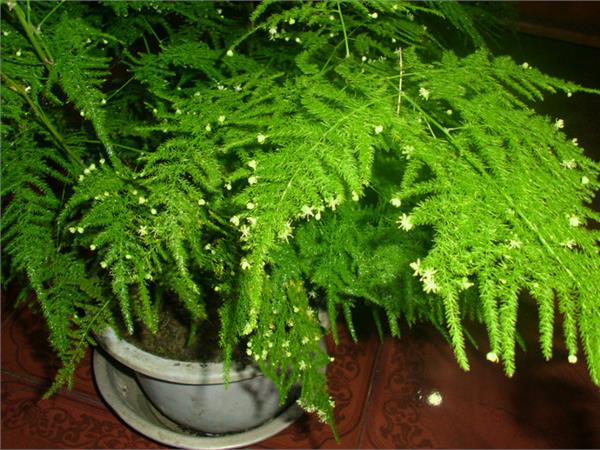
Understanding its living habits is key. Asparagus fern is a shade-loving plant that likes a warm and humid climate; it can neither tolerate cold nor endure summer heat. In winter, the temperature must not be lower than 10°C. If it drops below 5°C, it will suffer damage. If the summer temperature exceeds 5°C, growth will stop and it will turn yellow. It has relatively strict requirements for light conditions; it can neither be shaded all year round nor withstand exposure to sunlight. Being exposed to scorching sun for half a day will also cause it to wither and yellow. Therefore, it is advisable to move the asparagus fern indoors for cultivation and place it in diffused light to grow, avoiding direct sunlight. Keep the soil fertile, with good drainage and air permeability, and control the indoor temperature above 5°C in winter so that it can pass the winter safely.