How to Grow Black Prince? Detailed Guide to Cultivation Techniques and Propagation Methods
Echeveria plant. It is a cultivated variety. The rosette form is the same as that of general Echeveria. The spatulate leaves are relatively thick; when growing vigorously, a single plant can have more than 100 leaves, with a plant spread of over 20 cm. The leaves are blackish-purple; when light is insufficient, the leaves near the growing point turn dark green.
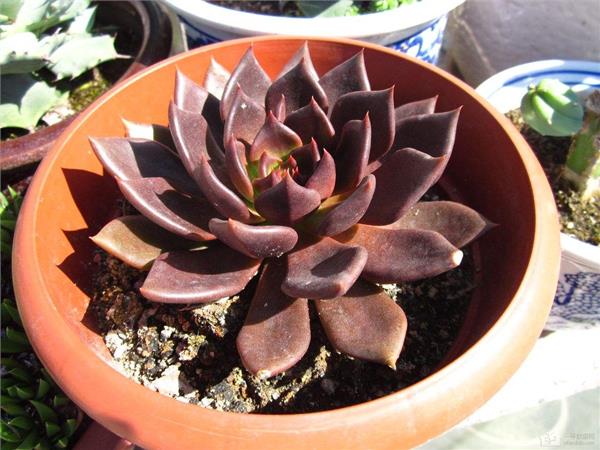
Black Prince is a perennial succulent herbaceous plant of the genus Echeveria in the Crassulaceae family. The plant has a short stalked stem, and the fleshy leaves are arranged in a standard rosette. The leaves are spatulate, slightly thick, with a small tip at the apex, and the leaf color is blackish-purple. Black Prince's neat and perfect rosette leaf disc and special leaf color give it high ornamental value and make it very eye-catching. Its cultivation and propagation are also simple and convenient, making it an excellent choice for home potted plants.
Black Prince resembles a black lotus, giving a sense of nobility, and its flowers are brightly colored. It is a succulent plant excellent in both flowers and leaves. Both have unique forms and beautiful leaf colors, making them very suitable for home cultivation and appreciation.
Cultivation Techniques of Black Prince
Black Prince has a brief dormant period when temperatures are high in summer. At this time the plant grows slowly or completely stalls. It can be placed in a well-ventilated spot for care, avoiding prolonged rain, with slight shading, reduced watering, and no fertilizing. Spring, autumn and early summer are the main growing seasons for the plant, and it should be given plenty of sunlight. Although it can also grow in semi-shade, the area near the growing point will turn dark green, and the blackish-purple color of the leaves in other parts will also fade to light brown, affecting its ornamental value.
In addition, excessive nitrogen fertilizer in the soil and overly vigorous plant growth can also cause this phenomenon. Therefore, usually keeping the potting soil slightly dry and letting the plant grow a little more slowly will actually produce better results. In winter, if the minimum temperature is not lower than 10°C, normal watering can be given to allow the plant to continue growing, but fertilizing is not necessary; if such a high temperature cannot be maintained, reduce watering to induce dormancy, and it can also tolerate low temperatures of 3-5°C.
Repot once every 1-2 years. The potting soil should be fertile and well-draining. A common mix is 2 parts coarse sand or vermiculite, 1 part leaf mold, and 1 part garden soil, mixed evenly. If conditions permit, adding an appropriate amount of plant ash or bone meal as a base fertilizer will give better results. Relatively speaking, Black Prince has stronger growth vigor, so management can be slightly more extensive.
Propagation Methods of Black Prince
For the propagation of Black Prince, during the growing season, mature and complete leaves can be broken off for cuttings. Let them dry for 1-2 days before inserting, place them slightly tilted or flat on vermiculite or sandy soil, and keep them slightly moist. They will quickly root at the base and grow new buds. Once the new buds have grown somewhat larger, plant them separately to become new plants; young plants sprouting beside the old plant can also be used for cuttings, and they also root easily.
Propagation can be done by two methods: cutting the top to induce tiller buds, and leaf cuttings. The success rate is much higher than that of general Echeveria. The cutting medium is a relatively important factor for survival. It is suggested that gardening enthusiasts put more effort into choosing the medium; if conditions do not allow, sandy soil can be used.
Landscape Uses of Black Prince
Black Prince resembles a black lotus, giving a sense of nobility, and its flowers are brightly colored. It is a succulent plant excellent in both flowers and leaves. Both have unique forms and beautiful leaf colors, making them very suitable for home cultivation and appreciation.
Among succulent plants, those with blackish-purple leaves are relatively rare. Aeonium arboreum 'Zwartkop' and Black Prince in the Crassulaceae family are two of them. Their leaves are both arranged in a lotus rosette, and their color is the same mysterious and noble blackish-purple, standing out uniquely among various plants and possessing high ornamental value.
Black Prince's neat and perfect rosette leaf disc and special leaf color give it high ornamental value and make it very eye-catching. Its cultivation and propagation are also simple and convenient, making it an excellent choice for home potted plants.