Is Mimosa pudica toxic? Understanding its growth habits in one article
Mimosa pudica originated in the tropical regions of South America. With international development, Mimosa pudica is now widely cultivated in China. Mimosa pudica has very strong adaptability to the environment and likes to grow in warm, humid environments. It is more commonly seen on mountain slopes in forests and in moist places beside roads. Now many families grow Mimosa pudica as an ornamental houseplant. Let's take a look below: is Mimosa pudica toxic?
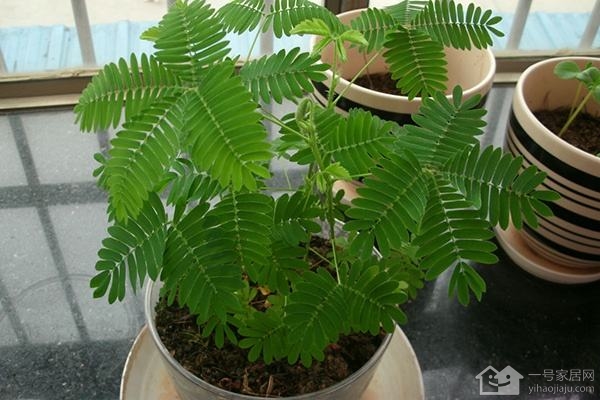
I. Introduction to Mimosa pudica
We all know that plants do not have a nervous system, which is an important feature distinguishing them from animals. But the stress response of Mimosa pudica behaves more like animal behavior. Why is that? This must start with the physiological structure of Mimosa pudica.
At the petiole and the base of the leaves of Mimosa pudica, there is a swollen part, scientifically called the pulvinus. The pulvinus is the core reason why Mimosa pudica is "shy." In the middle of the pulvinus there is a vascular bundle, surrounded by parenchyma tissue. When the pulvinus, which is most sensitive to stimulation, is touched, it causes the cell sap of the upper half of the parenchyma cells within the pulvinus to be expelled, creating an imbalance in turgor pressure between the upper and lower halves, causing the leaflets to close and droop.
This stress behavior of Mimosa pudica takes only 0.08 seconds before and after it occurs, meaning the transmission speed is as high as 10cm/s. It can be said that the reaction is very fast. The time needed to return to its original state is about 5-10 minutes.
The reason Mimosa pudica is "shy" is closely related to its native environment. Mimosa pudica originated in tropical South America, where the climate is harsh and violent storms are frequent. To protect itself, when the first raindrop falls on the leaves of Mimosa pudica, it promptly and effectively closes its leaflets quickly and droops its petiole, avoiding damage from storms. This is the self-adjusting nature of the biological world.
II. Classification of Mimosa pudica
There is no major classification of Mimosa pudica by variety, but by appearance it is divided into thorny Mimosa pudica and thornless Mimosa pudica.
① Thorny Mimosa pudica - that is, some small white fine hairs grow from the stem of the Mimosa pudica, and there are small thorns at the branching points of the branches and leaves, slightly hard.
② Thornless Mimosa pudica - the stem is smooth, without fine hairs, and there are no thorns at the branching points of the branches and leaves.
III. Growth habits
The flowers, leaves, and pods of Mimosa pudica all have good ornamental value, and it is very easy to keep alive. It is most suitable as a potted plant placed on a balcony or indoors. It can also be grown very well in courtyards. Moreover, Mimosa pudica is different from ordinary plants: when it is touched by people, its petiole droops and its leaflets close, and because of this people interpret it as being shy. It originated in the tropical regions of South America, likes warm and humid environments, and has low requirements for soil.
IV. Is Mimosa pudica toxic?
Mimosine o-β-D-glucoside is mildly toxic. Long-term contact with or ingestion of it can cause the hair follicles in skin cells to decline, thereby causing hair and eyebrows to turn yellow and even fall out. Mimosa pudica is somewhat toxic, and it must never be taken alone; it needs to be used together with other medicines. In addition, due to mimosine, it can also cause cataracts and growth inhibition. And eating Mimosa pudica can also cause hair loss. Therefore, Mimosa pudica is not suitable for indoor cultivation.
Although Mimosa pudica has wonderful biological characteristics and cute fuzzy Mimosa pudica flowers, it is somewhat toxic and not very suitable for indoor cultivation, especially for families with children, where even more attention should be paid. The above is an introduction to whether Mimosa pudica is toxic. If everyone wants to learn more about Mimosa pudica, please follow No.1 Home Network.