Spider Plant Care: How to Grow It and Fix Yellow Leaves
Spider plant, also known as ribbon plant, Gui lan, hook lan and bracket plant, is a perennial evergreen herbaceous plant of the Liliaceae family. Let's take a look at how to plant and care for spider plants.
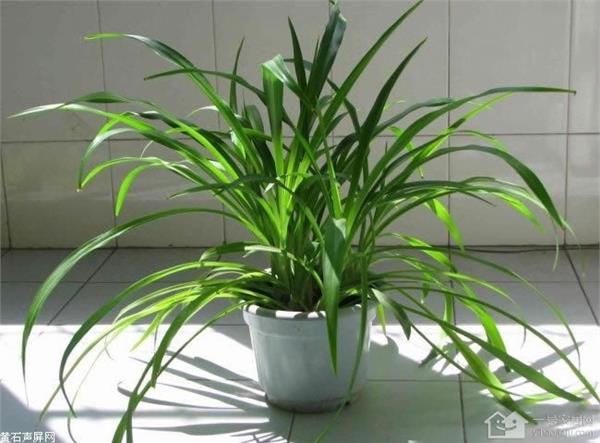
Spider plants are easy to grow and highly adaptable, and are one of the most traditional hanging plants for the home. Its leaves are slender and soft, and small plantlets grow out from the leaf axils, hanging down from the rim of the pot, spreading and trailing gracefully like flowers, staying green all year round. The spider plant is the "king of formaldehyde removal" among plants.
Spider plants can absorb more than 80% of the harmful gases indoors, and their ability to absorb formaldehyde is extremely strong. Generally, keeping 1-2 spider plants in a room can absorb almost all the toxic gases in the air. One spider plant in a room of 8-10 sq m is equivalent to an air purifier: within 24 hours it can kill 80% of the harmful substances in the room, absorb 86% of the formaldehyde, and absorb almost all the carbon monoxide and nitrogen peroxide given off by stoves, electrical appliances and plastic products. That is why the spider plant is also known as the "green purifier".
There are many kinds of spider plants, with different forms and characteristics. Five are common: the spider plant, purple spider plant, flowering spider plant, golden-leaf spider plant and silver-edged spider plant.
Spider plant: the stems and leaves are not distinct, the leaves droop and are dark green. It blooms in June and July each year, with light yellow and white flowers.
Purple spider plant: also called rainbow spider plant. The main vein of the leaf is purple, the stems are jointed, and a leaf grows at each joint. The leaves are thick and glossy, all drooping downward. It blooms from June to October each year, with pink flowers.
Flowering spider plant: the stems are trailing, the branches and leaves droop, and the leaves are peach-shaped. The leaf margins have golden markings that run through the center of the veins, and the underside of the leaf is purple and glossy.
Golden-edged spider plant: the green leaves have yellow lines around the edges, making a particularly attractive contrast.
Silver-edged spider plant: the green leaves are edged in white, making them even more vivid and distinctive to look at.
Golden-centered spider plant: the center of the leaf has yellow longitudinal stripes.
Silver-centered spider plant: the area around the main vein of the leaf has silvery-white longitudinal stripes.
Broad-leaf spider plant: the leaves are broadly linear, entire or slightly wavy. The flower scape emerges from the leaf cluster, and after flowering it forms creeping stolons that can take root and sprout into new plants. The flowering period is spring and summer. The capsule is three-angled, flat and spherical.
Middle-striped spider plant: the leaves are narrow and long, lanceolate, creamy white with green stripes and margins.
How to care for spider plants:
[Care methods] Spider plants can be propagated by cuttings, division and sowing. Cutting and division propagation can be done at any time from spring to autumn. Spider plants are highly adaptable and have a high survival rate, so they are generally very easy to propagate. For cuttings, simply take a 510 cm stolon with new buds and insert it into the soil; it will root in about a week, and after about 20 days it can be transplanted into a pot. Water it thoroughly and keep it in a cool, shaded place for care.
1. Temperature control. Spider plants like a warm, humid climate and are not cold-tolerant. They grow fastest at 20-24°C, stop growing above 30°C, and the leaves easily turn yellow with dry tips.
2. Light adjustment. When grown outdoors in summer, pay attention to shading so the light is not too strong, otherwise sunscald easily occurs.
3. Water and fertilizer control. During the peak growing seasons of spring and autumn, water generously. The potting soil should be kept moist at all times, and the leaves and branches should often be sprayed with clean water at about room temperature to prevent dry tips, but there should be no waterlogging.
4. Pruning and repotting. As the plant grows, old leaves at the base should be trimmed frequently to maintain a good shape.
5. Pest control. Spider plants have dense clumps and poor ventilation, making them prone to scale insects, so prevention should be the priority.
What should you do when spider plant leaves turn yellow?
Yellowing leaves during the growth of spider plants can be caused by many reasons.
1. Over-fertilizing, exceeding the plant's needs. At first the leaves become glossy and uneven, then the root system rots and the leaves turn yellow. Stop fertilizing, water generously with clean water, or repot the plant, clean the roots and replace the soil with new soil.
2. Not repotting or changing the soil for a long time. The various nutrient elements in the potting soil have been used up, and the three key elements nitrogen, phosphorus and potassium have not been replenished in time. The plant lacks nutrients and the leaves become yellow and thin. Repot in fertile loam in time and water with alum fertilizer water.
3. Although spider plants are semi-shade flowers, they still need at least four hours of diffused light every day, otherwise chlorophyll decreases and the leaves turn yellow.
4. Poor air permeability and water permeability of the potting soil. If the potting soil stays waterlogged and does not dry out for a long time, the roots have difficulty breathing, causing the leaves to turn yellow. Loosen the soil and control watering in time. 5. Watering with only a little water for a long time. The roots of the spider plant lose water and the lower old leaves turn yellow. Water thoroughly and keep the potting soil warm and moist.
If you want to learn more related information, you can keep following No.1 Home Network.