What kind of plant is Mimosa pudica, and what is it good for?
Mimosa pudica has unique characteristics that give it a lovely, endearing feel, making it very suitable for home decoration. Next, let us take a look at the appearance and characteristics of Mimosa pudica.
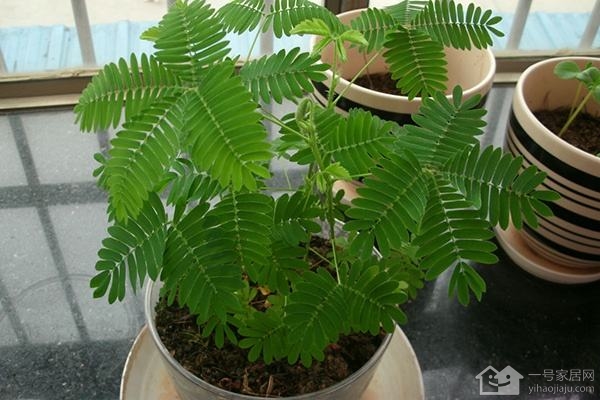
Introduction to the appearance of Mimosa pudica
Mimosa pudica is a sprawling, subshrub-like herb, and its plant height can reach 1 m. The stem is cylindrical, branched, with scattered, downward-curving hooked prickles and reversed bristles. The stipules of Mimosa pudica are lanceolate, 5-10 mm long, with bristles. When an external force touches the pinnae and leaflets, it closes and droops. The pinnae are usually 2 pairs, arranged digitately at the top of the common petiole, 3-8 cm long. The leaflets of Mimosa pudica number 10-20 pairs, linear-oblong, 8-13 mm long and 1.5-2.5 mm wide, with an acute apex and bristly margins.
The head-like inflorescence of Mimosa pudica is spherical, about one cm in diameter, with a long common peduncle, solitary or 2-3 borne in the leaf axils of Mimosa pudica. The flowers of Mimosa pudica are relatively small, pale red in color, and numerous. The bracts are linear, the calyx is extremely small, the corolla is bell-shaped with 4 lobes, covered with short pubescence on the outside, and the stamens inside the flower number 4, extending beyond the corolla; the ovary has a short stalk and is hairless; there are 3-4 ovules, the style is filiform, and the stigma is small. After Mimosa pudica flowers, it forms a legume; the pod is oblong, about 1-2 cm long, flat, and slightly curved. Its flowering period is from March to October each year, and its fruiting period is from May to November.
Characteristics of Mimosa pudica
Mimosa pudica is different from other plants because when it is touched by the outside world, the petiole droops and the leaflets close. It is precisely because of this characteristic that it is called Mimosa pudica. Mimosa pudica is supported inside by a fine, web-like protein called "actin." When closing occurs, the phosphate on the actin inside it falls off. If Mimosa pudica is made to absorb a compound that prevents phosphate from falling off, it will not change when touched. Generally, actin is found only in animals, but among plants, Mimosa pudica contains this substance. When the leaves of Mimosa pudica are touched, they immediately close up; the greater the force of the touch, the faster they close, and the entire leaf will droop, looking weak and listless. The whole action is completed in just a few seconds. This is because the leaves and petioles of Mimosa pudica have a special structure. This structure is very sensitive to stimulation.
Uses of Mimosa pudica:
Uses of Mimosa pudica: 1. Ornamental
Mimosa pudica has a scattered plant form, and its feathery leaves are slender and elegant; its leaves close as soon as they are touched. Mimosa pudica has many flowers and is delicate and lovely, giving people an impression of fragility and elegance. It can be planted in the ground at the corner of a courtyard, or grown in a pot on a windowsill or desk. When giving it as a gift, gently cover the potted plant with pink gauze and tie it with a pink decorative ribbon bow. If it can be further decorated with pink mohair pompoms, it will be even more interesting.
Uses of Mimosa pudica: 2. Weather forecasting
Mimosa pudica is a wonderful plant that can foretell changes in sunny and rainy weather. If you touch it with your hand, its leaves close very quickly and open very slowly when opening, this indicates that the weather will turn clear; if when touching Mimosa pudica its leaves contract slowly, droop slowly, or even close slightly and then open again, this indicates that the weather will turn from clear to overcast or that it is about to rain.
Uses of Mimosa pudica: 3. Earthquake prediction
According to Turkish seismologist Erjiang, a few hours before a strong earthquake occurs, the leaves of Mimosa pudica, which are sensitive to external touch, will suddenly shrink and then wither. In Japan, where earthquakes are frequent, scientists have found through research that under normal conditions, the leaves of Mimosa pudica open during the day and close at night. If the leaves of Mimosa pudica show the abnormal phenomenon of closing during the day and opening at night, it is a precursor to an earthquake.
Uses of Mimosa pudica: 4. Medicinal use
It has effects such as clearing heat and promoting diuresis, resolving phlegm and relieving cough, calming the nerves and relieving pain, detoxifying, dissipating blood stasis, stopping bleeding, and astringing. It is used for colds, high fever in children, acute conjunctivitis, bronchitis, gastritis, enteritis, urinary stones, malaria, and neurasthenia; for external use, it treats swelling and pain from falls and blows, sores and swellings with toxin, hemoptysis, and herpes zoster.
If you want to learn more related information, you can continue to follow No. 1 Home Network.