How do you care for an African violet? Master these growing essentials
The African violet, also known as the chimera violet, originated in Africa. It was discovered in 1892. In just ninety years, it was grown all over the world, and the number of varieties increased to more than two thousand. In Tanganyika there is a province called Usambara. The local district commissioner was Warrington. Baron Saint Paul, influenced by his father since childhood, was very interested in plants. Once, in the woods near the city of Tanga, he discovered a low-growing herbaceous plant growing in the humus soil in cracks of limestone. This plant bore single blue flowers with a beautiful flower shape, and this was the first African violet discovered. Below, let us look at some knowledge about African violets.
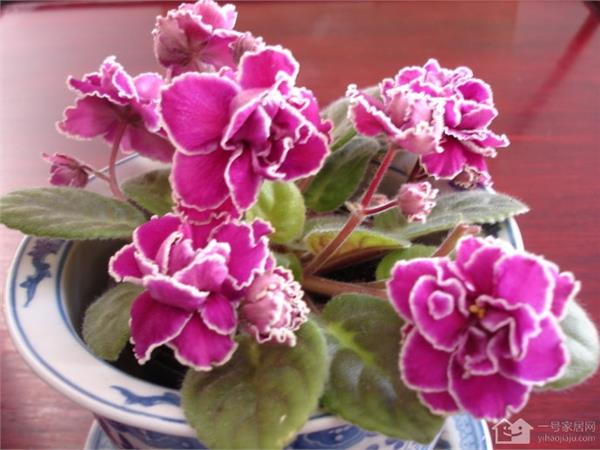
Cultivation techniques for African violets
1. Watering
In cultivating African violets, watering is very important. In early spring, when temperatures are low, watering should not be excessive, otherwise the stems and leaves are prone to rot, affecting flowering. In summer, with high temperatures and dryness, more water should be given, and water should be sprayed to increase air humidity, otherwise the flower stalks droop and the flowering period is shortened. However, when spraying water, if too much water splashes onto the leaves, it can also cause leaf rot. In autumn and winter, as temperatures drop, watering should be appropriately reduced. African violets are semi-shade plants, and 8 hours of light per day is most suitable. If light is insufficient on rainy or snowy days, artificial light should be added. If light is insufficient, the leaf stalks elongate, flowering is delayed, and flower color becomes dull. In midsummer, if light is too strong, young tender leaves can be scorched or turn white, so shade protection is needed. It requires nighttime temperatures to be higher than daytime temperatures; with 24°C at night and 16°C during the day, stems and leaves grow luxuriantly and flowers are large and numerous. During growth, fertile, loose leaf mold is most ideal. Fertilize once every half month. If fertilizer is insufficient, flowering decreases and flowers become smaller. After flowering, remove faded flowers at any time to prevent them from becoming moldy and rotting.
2. Fertilizing
Generally, when the light source is sufficient, only a small amount of additional fertilizer is needed to maintain normal plant growth, and too much fertilizer can instead cause growth disorders; however, in an environment with insufficient light, even if ample fertilizer is provided, the plant will still grow poorly or even die. Therefore, fertilizer should generally be applied under conditions where there is no concern about light, so that its effectiveness can be shown. As long as light is ample, the environment is suitable, and management is correct, merely mixing base fertilizer into the medium or the fertility stored in the medium is enough for the plant to grow normally and bloom even if no fertilizer is added during the growing period. However, if you want to pursue plant vigor and flower quality, you must use suitable fertilizers according to the different growth stages.
For African violets, the fertilizers needed and fertilizing essentials at different growth stages are as follows:
(1) Rooting stage - such as propagation, transplanting, and repotting. Just after handling, because there are no roots or the roots are injured, absorption capacity is poor, so it is not suitable to fertilize immediately; wait 2-4 weeks before fertilizing. Fertilizers with higher nitrogen and potassium content are suitable, such as fertilizers with nitrogen, phosphorus, and potassium ratios of 7-6-19, 14-12-14, etc.
(2) Vegetative growth stage - such as from seedling growth to before flowering and after the flowering period. Fertilizers with a relatively high nitrogen component are suitable, such as fertilizers with nitrogen, phosphorus, and potassium ratios of 30-10-10, 25-5-20, 5-1-1, etc.
(3) Flowering stage - begin applying about 2 months before the expected flowering time. Fertilizers with a relatively high phosphorus component are suitable, such as fertilizers with nitrogen, phosphorus, and potassium ratios of 10-30-20, 15-30-15, 12-36-14, 0-10-10, etc.
3. Repotting
Aged plants, seedlings being moved into new pots, plants with diseased roots, plants with salt deposits on the pot rim and outer wall, and plants that are misshapen or unattractive should be repotted promptly. Plants in different conditions have their own suitable repotting methods and essentials. Taking a healthy plant (small or medium seedling) being moved from a small pot to a larger pot and an aged plant as examples, the sequence and essentials are as follows:
(1) Tidying the plant and inspecting root health - first, remove the lowest leaves that are smaller or growing poorly, and inspect the roots: if they are white, they are healthy; if they are brown or dark brown, they are unhealthy or even rotting. Unhealthy root tissue must be removed with a blade or scissors, along with about 1/3 to 1/2 of the medium; generally, the more severe the browning, the greater the proportion of medium that should be removed. Healthy plants, however, do not need any root treatment, and injury to the root tissue should be avoided as much as possible.
(2) Potting into a new pot - when moving a plant from a small pot to a large pot, first place a small amount of new medium in the bottom of the larger pot to be used, place the plant with its medium into the large pot, and fill the gaps with new medium.
(3) Aftercare after repotting - water thoroughly and then place in a suitable environment for cultivation. After repotting, plants are usually weaker or have injured roots, and root absorption capacity is reduced. Avoid fertilizing within 2 weeks after repotting. It is best to choose a season with suitable climate for repotting so that the plant can recover smoothly. Generally, when repotting, it is suitable to maintain the temperature between 18-26°C. In Taiwan, China, spring and autumn are more suitable, but if grown in an environment with air-conditioning equipment where the temperature can be maintained at around 25°C, repotting can be done in all four seasons.
The above is some knowledge about African violets. I hope it can help you.