How to Grow Mimosa Pudica and Why Its Leaves Close Up
When stimulated (such as by touch), the leaves of the mimosa pudica fold up and close together, a trait that has made many flower lovers adore it. Mimosa pudica has strong vitality and adapts well to its environment. Fertile, loose sandy loam is best, and the soil should be deep, fertile and moist. Let's take a look at how to grow mimosa pudica properly, and we hope it will be helpful to fellow flower lovers.
I. Basic Information About Mimosa Pudica
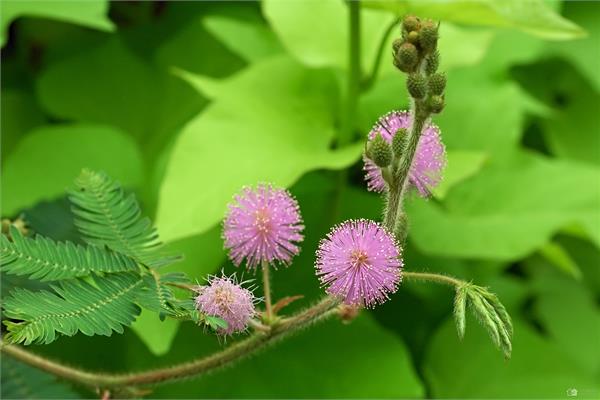
Mimosa pudica is a perennial herb or subshrub of the Fabaceae family. Because its leaves react to heat and light and close immediately when touched by an external force, it is named mimosa pudica ("shy grass"). It is native to the tropical regions of South America, prefers warmth and humidity, and is not demanding about soil. Its flowers are pink and shaped like fuzzy balls, lovely and endearing. After flowering it produces pods, and the fruit is flat and round. The leaves are pinnately compound, alternate, and arranged in a palmate pattern. The flowers, leaves and pods of mimosa pudica all have good ornamental value, and it is relatively easy to keep alive, making it suitable as a potted flower for balconies and indoors, and it can also be grown in courtyards and other places.
II. Characteristics of Mimosa Pudica
The greatest characteristic of mimosa pudica is that when it is stimulated (such as by touch), its leaves fold up and close together. If the stimulus is strong, this stimulus is quickly transmitted in turn to the neighboring leaflets, and even to the leaflets of the entire compound leaf, causing the petiole to droop. If the stimulus is strong enough, it can even make the leaflets of the whole plant close up and the compound leaves droop. But after a period of time, it can return to its original state. Mimosa pudica also reacts very quickly to vibration; it begins to respond 0.1s after being stimulated and completes the response within a few seconds.
III. Why Mimosa Pudica Gets Shy
The reason mimosa pudica gets shy is closely related to its native environment. Mimosa pudica originates from tropical South America, where the climate is harsh and fierce storms are common. To protect itself, when the first drop of rain falls on the leaves of the mimosa pudica, it promptly and effectively closes its leaves and droops its petiole, avoiding damage from the storm. This is the self-adjusting nature of the biological world.
IV. How to Grow Mimosa Pudica
1. Soil. It can be cultivated in general soil, but fertile, loose sandy loam is best, and the soil should be deep, fertile and moist.
2. Fertilizing. It needs little fertilizer during the growing period; applying dilute liquid fertilizer 2-3 times is enough. Fertilizer should not be excessive; as long as the leaves are green and the growth is robust, that is sufficient. Do not let it grow leggy, because mimosa pudica is mainly a novelty foliage plant and is best kept small.
3. Watering. Mimosa pudica likes moisture and needs frequent watering; during the summer growing period, water once a day. Mimosa pudica is originally a tropical plant and likes a moist environment, so the potting soil should be kept moist at all times. In summer, water according to the condition of the potting soil, roughly once a day; do not let the soil dry out. You can mist the plant frequently. In winter, reduce the amount of watering to prevent cold damage.
4. Light. Ensure sufficient sunlight. Mimosa pudica likes sunlight, so it is best placed on a sunny balcony or by a window. Full exposure to sunlight is good for the growth of mimosa pudica; if there is too little sunlight, it may hinder its growth.
5. Pest and disease prevention. Mimosa pudica generally has few pests and diseases. The most common pest is the slug. If any are found, sprinkle some lime powder to control them. If the plant is not growing well, check whether there is insufficient light or not enough water.
These special abilities of mimosa pudica make people fall in love with it without even trying. If you grow one at home, when you are unhappy you can touch it and it will close its leaves. Isn't that fun? The above is an introduction to how to grow mimosa pudica. If you want to learn more about mimosa pudica, please stay tuned for more wonderful content.