How should roses be planted to grow them beautifully and vibrantly?
Vanda orchids, beneath their beautiful and dignified appearance, possess an even tougher heart, able to bloom brilliantly even under the harshest conditions. The stems of Vanda orchids climb upward, and as one flower fades, another blooms, giving people endless confidence and hope. Precisely for this reason, Vanda was chosen by Singaporeans as their national flower. So, what is the flower language of Vanda? Let's take a look at what kind of flower language it has!
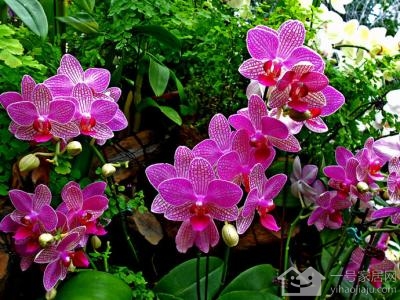
I. Introduction to Vanda
Vanda is the collective name for plants in the orchid genus Vanda, with the scientific name Vanda (originally Sanskrit from the India region, meaning an orchid that hangs on a tree), and is a strong member of the tropical orchid family. In Chinese, it is transliterated as "Wandai." It belongs to the Orchidaceae family, genus Vanda, which contains about 50 original species, with very rich hybrid varieties, making it one of the most important ornamental flowers.
Vanda is heat-tolerant and also tolerates a certain degree of drought, but fears cold and waterlogging. Even in summer when temperatures reach as high as 35°C, Vanda can grow healthily, almost unaffected, and does not need much growing medium when cultivated. Vanda can be managed extensively. Many flower farms in Thailand often nail wooden strips into small square frames, place a few pieces of charcoal, broken bricks or coconut fiber inside, and the plant can continue to grow. Some even simply use a nylon rope to tie the plant up, hanging it under a orchid shed or tree, and only need to regularly spray water and fertilizer for it to grow leaves and bloom. This self-reliant, ever-thriving characteristic is something that some pampered famous flowers cannot compare with.
II. What is the flower language of Vanda?
Vanda is a type of orchid, and its flower language and symbolic meaning is: individuality.
Singapore's national flower is a type of Vanda called Vanda Miss Joaquim, symbolizing excellence, beauty, and everlasting endurance. Orchids (Hu Ji Hua) is the general term for orchids in Southeast Asia. It was a Spanish horticulturist named Agnes Joaquim, residing in Singapore, who bred an excellent new variety of orchid in her own garden. In 1981, the Singapore Ministry of Culture declared it the national flower.
Vanda is a typical epiphytic orchid. Unlike Cattleya and Dendrobium, it is a monopodial tropical orchid with obvious stems and aerial roots. Its roots are thicker than those of Cattleya and Dendrobium, not only responsible for absorbing water and nutrients, but also supporting the stem to grow upright. New roots grow from the stem in spring, usually white, with the root cap at the tip often green. If the root cap breaks, growth stops immediately. Vanda relies on its thick root system to attach to other plants or rocks for growth.
Vanda has a clear and dignified appearance, standing out from the crowd, while always showing humility, symbolizing the character of the people of Singapore; Vanda has a beautiful lip and five sepals, with the lip spreading in four directions, symbolizing the equality of Singapore's four major ethnic groups and the four languages of Malay, English, Chinese and Tamil; the column in the center of the flower, combining both male and female organs, symbolizes the root of happiness.
The Vanda flower is supported by the opposite lobes below, symbolizing harmony, sharing joys and hardships, and sharing honor and disgrace; behind the lip there is a bag-shaped spur containing sweet nectar, symbolizing a place where wealth converges and gathers; lifting the pollen cap on the column reveals two pollinia, like two "golden eyes," symbolizing far-sighted vision. The stem of Vanda climbs upward, symbolizing upward development and prosperity; as one flower fades, another blooms, symbolizing the lifeblood of the Singaporean nation, with a long and continuous history, possessing infinite confidence and hope.
Finally, that's all for the knowledge about Vanda flower language. If you are also a flower lover who likes it, then you must learn about its flower language! Only then can you understand its symbolism.