A Detailed Guide to the Introduction and Cultivation of Cattail
Cattail is a plant that possesses ornamental, medicinal, and economic value at the same time. It originally grew mostly in the wild, but now it can also be grown indoors in pots.
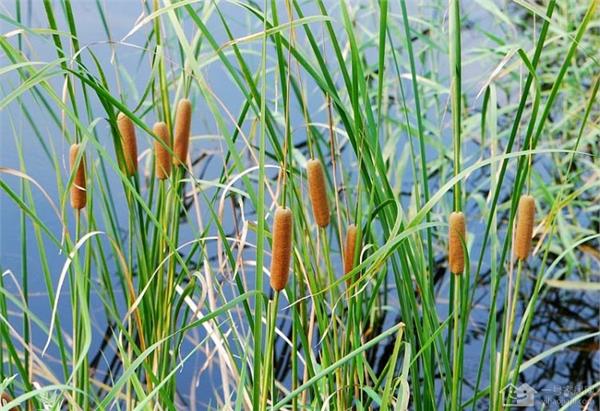
Introduction to Cattail
Morphological characteristics: A perennial herbaceous emergent marsh plant with persistent roots. The rhizome is white, long, and spreads horizontally. The stem is cylindrical, upright, hard in texture, and solid inside. The leaves are flat and strap-shaped, reaching over 1 m in length, smooth and hairless, with a long sheath at the base that clasps the stem. The flowers are unisexual, borne in a terminal cylindrical spadix resembling a candle, with small grayish-brown flowers.
Ecological habits: Prefers a warm environment with ample light; extensive management.
Garden uses: For accenting garden ponds and lakesides, flower borders, and potted cultivation.
Species identification: The difference between cattail and sweet flag (Acorus calamus) is: the cattail's spadix is grayish-brown and borne in the middle-to-upper part of the plant; its leaves are slender with no midrib. Sweet flag has a distinct leaf-like spathe, a yellow-green spadix borne at the base of the plant; its leaves are slightly wider with a midrib.
Main value: It has relatively high economic value. The pollen, known as Puhuang, is used in medicine; the leaves are used for weaving, papermaking, and so on; the young leaf bases and rhizome tips can be eaten as vegetables; the female inflorescence can be used as filling for pillow cores and seat cushions. It is one of the important aquatic economic plants.
Cattail Cultivation Methods
1. Cattail cultivation uses asexual propagation. Before planting, select and dig from the cattail field seedlings with relatively thick pseudostems, relatively wide leaves, leek-green and glossy, robust growth, and with some roots and rhizomes attached, to serve as planting stock. The planting spacing is 50 x 50 cm or 65 x 65 cm. When planting, if the water layer is shallow, plant deeply, so that all the seedling roots enter the soil; if the water layer is deeper, dig holes, support the seedlings, and mound soil to stabilize the roots, but the seedling leaves must be exposed above the water surface, otherwise the cattail seedlings will suffocate from lack of oxygen. After planting, keep the cattail field at a shallow water level to favor the sprouting of cattail buds and tillering.
2. Cattail is an aquatic crop, so cattail cultivation cannot be separated from water, and its water requirement throughout the entire growth process is very large. Therefore, when planting cattail, choosing a place with an adequate water source is the first and most important thing.
3. After planting cattail, what needs attention is shallow-water maintenance. Regularly clearing weeds and appropriately adding fertilizer during the cattail growth period have a very good effect on cattail growth, and also result in a great many flowers. Therefore, in cattail cultivation, every step and detail cannot be ignored.
4. Cattail itself has extremely high requirements for water and temperature, so usually if the temperature reaches 20°C, then cattail is very easy to survive, and such an environment also makes cattail grow quite fast, making the cattail leaves broader and more glossy in color, growing better. Cattail is very sensitive to temperature, so its entire growth period includes three different stages: sprouting, tillering, and flowering, and temperature needs to be controlled.
5. When most cattail plants have stopped growing, the leaf color is dark green and mature, and the tissues are already full, this is the suitable harvest time. Harvesting too early or too late both affect the quality of the cattail leaves and are unfavorable for weaving and processing. To favor the regeneration of the cattail plant's perennial roots, choose a sunny day and harvest when there is no dew on the cattail plants. The harvest height should follow the requirement of leaving most of the cattail plant's pseudostem, achieving "cut the leaves evenly at the sheath." Newly planted cattail fields generally yield 1500-2250 kg of dry cattail per hectare in the first year; it can double in the second year; and reach a maximum of about 5300-6000 kg in the third year. After that, because the cattail plants age year by year and soil fertility declines, the yield also declines year by year, and by the fifth or sixth year renewal must be carried out.
The cattail's plant form is upright and unique, with a very distinctive ornamental effect. If you are interested in it and want to add more warmth and moisture to your home, you can choose to grow some aquatic plants, and sweet flag is a very good choice.