Introduction to Jacaranda and the Love Legend Behind It
Jacaranda is a highly ornamental plant. Although it is named "blue jacaranda," what it actually produces are purple-blue flowers, and it bears an abundance of them, exceedingly beautiful and evoking a romantic mood. It is a tree species valued for its ornamental form, foliage, and flowers, and is widely planted in tropical and warm subtropical regions. So, what is its flower language? Let us take a look together.
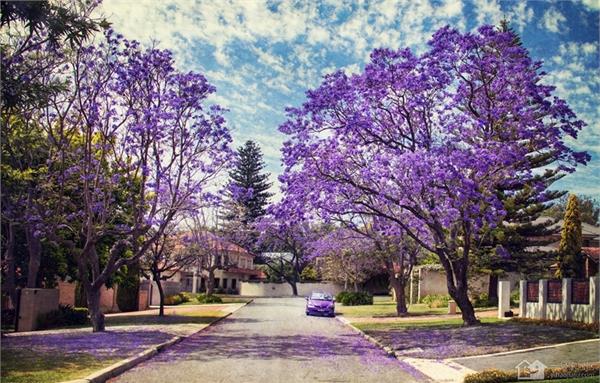
I. A Brief Introduction to Jacaranda
Jacaranda, also known as: blue mist tree, Chinese milk vetch, purple cloud wood, Brazilian trumpet tree, African crape myrtle, etc., is a deciduous tree belonging to the genus Jacaranda in the family Bignoniaceae. Its leaves are dicotyledonous and opposite, with odd-pinnate leaflets, and the crown is tall, reaching heights of over 15 m. Its flower colors include white, pink, blue-purple, red, etc., but the pale purple is the most beautiful flower color, and it also bears blue flowers.
It is a deciduous tree. The crown is tall, 12-15 m in height, and can reach up to 20 m at its tallest. This species is a beautiful foliage and flowering ornamental tree. It blooms once each in summer and autumn every year. At the peak of blooming, the entire tree is covered in purple-blue flowers, extremely elegant and graceful. Especially in the tropics, tree species with blue flowers are relatively rare, and when it blooms, all its leaves have fallen off, so jacaranda is truly a rare and precious woody flowering plant. In addition, in Grafton, Australia, the Jacaranda Festival is held from the second-to-last weekend of October to the first weekend of November each year.
II. The Love Legend of Jacaranda
In the season when jacaranda is in full bloom, intoxicating and gorgeous blue flowers are everywhere, a sight beyond compare. It has a poignant love legend. During the Republic of China era, a young lady from a wealthy family, Xiaolan, and a down-and-out scholar, Huang Xinying, fell in love. But the man was poor and could not even afford betrothal gifts, so he could only go to the South Seas to seek gold. The two agreed that after three years, regardless of wealth or poverty, they would be united forever. After Huang Xinying left, he sent back a jacaranda from the South Seas, and Xiaolan carefully cultivated it in her back garden. Three years later, Xinying had not returned, but Xiaolan received a letter telling her to marry someone else and not wait any longer. Heartbroken, she fell gravely ill. Under her family's arrangement, she prepared to marry a high official from the west of the city. Before the wedding, she finally learned from Xinying's mother that Xinying had already fallen ill and died in the South Seas, and fearing it would ruin her life, he had falsely claimed to have changed his heart. Xiaolan followed Xinying in death. Thereafter, the jacaranda transformed into towering trees waiting in bloom, covered in blue flowers. Legend says that when the jacaranda is in full bloom and the moon is full, one can hear murmuring whispers from the treetops. If a couple joins hands and makes a wish beneath the tree, they will grow old together and hold hands for a lifetime. Moreover, the jacaranda's leaves falling completely in winter represents despair, but when spring arrives and it blooms with purple flowers, it astonishes everyone. So it is called "waiting for love in despair."
III. What Is the Flower Language of Jacaranda
The flower language of jacaranda: waiting for love in despair.
The flower language of jacaranda is tranquility, profundity, melancholy and quietness, openness, coldness, lack of vitality, steadiness, deep seclusion, clear and refined elegance beyond the ordinary, and waiting for love in despair, honorable even in defeat. The most important among these is that the flower language describes people waiting for love in despair. This flower's blooming period is about 30 days, and because of its flower language, it is not very suitable for giving as a gift.
At the peak of blooming, the jacaranda is covered in purple-blue flowers, extremely elegant and graceful. Especially in the tropics, tree species with blue flowers are relatively rare, so jacaranda is truly a rare and precious woody flowering plant. It is a beautiful foliage and flowering ornamental tree, widely planted in tropical and warm subtropical regions worldwide as a street tree, courtyard tree, shade tree, and landscape tree.
Because blue is the boundless color of the sky, it is non-irritating and makes people feel profundity, coolness, quietness, and openness; but prolonged exposure can make people feel cold, melancholic, and lacking in vitality. Pure blue flowers are not many; they usually carry some purple or other colors, and especially deep blue flowers are even rarer, and thus precious. Whether pale blue or deep blue, they give a feeling of tranquility, steadiness, deep seclusion, and clear and refined elegance beyond the ordinary. Therefore, the flower language of jacaranda also carries the meanings of "representing tranquility, profundity, melancholy," "profundity, coolness, quietness, openness," and "coldness, lack of vitality, steadiness, deep seclusion, clear and refined elegance beyond the ordinary."
Finally, the above is the content about the flower language of jacaranda brought to you, and we hope it can be helpful to friends who love jacaranda. Jacaranda is truly a very beautiful flower. If you like it, you can plant it in your own yard.