How to grow Rebutia minuscula and what to pay attention to when growing it
Rebutia minuscula is a fairly typical succulent plant. Its body covered in spines and its squat, round, plump form can store a large amount of water, so Rebutia minuscula is also a fairly typical "lazy person's plant," very suitable for office workers to grow.
I. Morphological characteristics of Rebutia minuscula
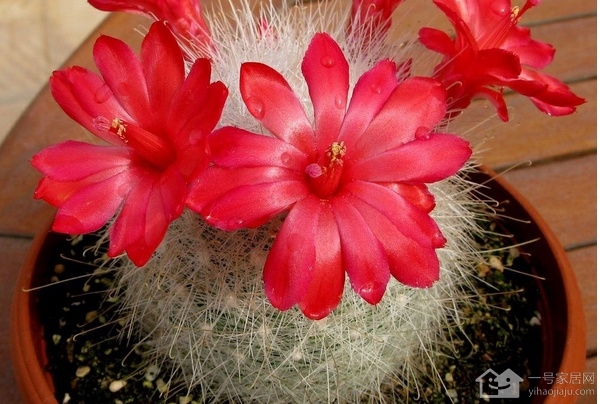
Rebutia minuscula is a spherical plant with a spiny surface, similar in shape to the cactus ball we often see in daily life, and the sphere is round and smooth. After flowering, red berries remain on top of the sphere for a long time, giving it fairly high ornamental value. Grown alone as a potted plant, it also makes a rather novel and attractive indoor decoration. Rebutia minuscula is initially solitary and later slightly clustered, taking a round or oblong form. The plant is about 6 cm in diameter and its skin is bright green and glossy. Rebutia minuscula has hooked spines that easily catch on clothes and fingers, so special care is needed.
II. The role of Rebutia minuscula
Beautifying the home: the sphere of Rebutia minuscula is very elegant and beautiful, and the red berries after flowering remain on top of the sphere for a long time, making its ornamental effect even more perfect. Grown alone as a potted plant, it can also nicely accent a living room, with a distinctive charm.
Purifying the air: Rebutia minuscula is similar in shape to a cactus and is a potted plant very suitable for growing indoors. It can release oxygen and thereby purify the air.
III. Points to note when growing Rebutia minuscula
Habits: Rebutia minuscula is native to Mexico and is also known as red-flowered Rebutia. It likes a warm, dry environment with plenty of sunlight. It is not cold-tolerant, tolerates partial shade, and fears scorching sun. A loose, fertile, slightly acidic sandy loam is suitable. In winter the temperature should not be lower than 5°C.
Propagation: the methods often used are sowing and grafting. For sowing, April to May is the best time. We can often sow indoors in pots, and about 10 days after sowing it will sprout. Its seedlings are very tender, so remember that the potting soil must not alternate between dry and wet, and strong light must not shine directly on them. It will only flower after 3-4 years. If the grafting method is used, June to September is the best time. About 10 days after grafting it will heal and survive, and after 1-2 years of cultivation it can also flower.
Fertilizer and water: in fact, managing its sown seedlings is fairly difficult. Generally we must strictly control watering for it. During the summer growing period, the potting soil also needs to be kept moist at all times, while in winter the potting soil only needs to be slightly damp, because being too moist in winter can easily cause disease. And while it is in the growing process, we can fertilize it once every half month.
Disease control: Rebutia minuscula is often harmed by anthracnose and brown ball disease; spray with a 1000-fold dilution of 65% zineb wettable powder. Pests include red spider mites and scale insects; spray to kill them with a 1000-fold dilution of 40% omethoate emulsifiable concentrate.
All right, that is all for the introduction to Rebutia minuscula. After reading the above, have you also become interested in growing this plant that, though covered in spines, is still rather cute?