Introduction to Monkshood: How Toxic Is It Really
Monkshood (Aconitum) is a flower that does not match its appearance; judging by its looks alone, you would never associate it with a poisonous plant. But in fact it is severely toxic, and even its flower meaning carries malice within it.
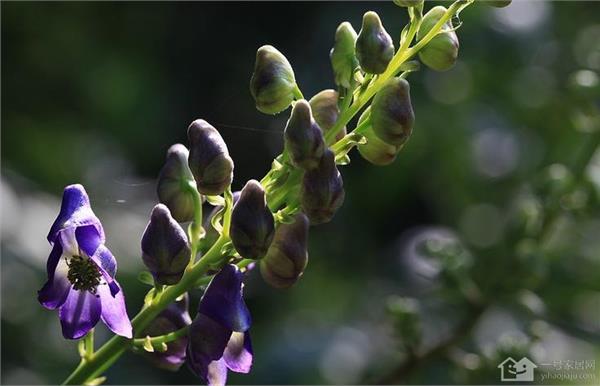
I. Introduction to Monkshood
Perennial herb. The stem grows 100-130 cm tall, leaves are alternate, leathery, ovate, stalked, palmately divided 2 to 3 times, with the lobes having incisions. After the Start of Autumn, blue-purple flowers bloom at the top of the stem in the leaf axils, the corolla resembling a helmet, in panicles; 5 sepals, 2 petals. The follicle is oblong, composed of 3 divided ovaries. Seeds are yellow, numerous and tiny. Flowering period June-July, fruit ripening period July-August.
The flower meaning of monkshood is malice. Flower meaning interpretation: the root of this plant contains severe poison. In ancient times people smeared its sap on arrows to make poison arrows. Therefore, the flower meaning of this flower represents "malice." People who receive blessings from this flower are mostly two-faced, like a femme fatale. They enjoy toying with others' feelings, yet in truth they are even more easily hurt themselves. So it is better to mend one's "wicked" ways early and earnestly give true feelings with all one's heart!
At the same time, monkshood is also the birthday flower for people born on May 19.
II. The Medicinal Value of Monkshood
[Nature and Flavor] Pungent and sweet, hot, toxic.
① "Shennong Bencao Jing": flavor pungent, warm.
② "Wu Pu Bencao": Qibo and Leigong: sweet, toxic. The Li family: bitter, toxic, very warm.
③ "Bielu": sweet, very hot, highly toxic.
④ "Bencao Zheng": pickled, very salty, nature very hot, toxic.
[Meridian Entry] Enters the Heart, Spleen and Kidney meridians.
① "Tangye Bencao": enters the Triple Burner and Mingmen.
② "Bencao Jingshu": enters the hand Jueyin, Mingmen and hand Shaoyang, and also enters the foot Shaoyin and Taiyin ☆forbidden☆ meridians, and can also enter the foot Taiyang.
③ "Bencao Jiejie": enters the foot Jueyin Liver meridian, foot Shaoyin Kidney meridian and hand Taiyin Lung meridian.
④ "Bencao Zaixin": enters the Heart, Liver and Kidney three meridians.
[Effects and Actions of Monkshood Root] Restores yang and rescues from collapse; supplements fire and assists yang; disperses cold and removes dampness. Mainly treats yang collapse on the verge of desertion; cold limbs and faint pulse; impotence and cold womb; cold pain in the heart and abdomen; deficiency-cold vomiting and diarrhea with chronic dysentery; yin-cold edema; yang deficiency with external contraction; wind-cold-damp impediment; yin flat abscess and sores.
[Usage and Dosage] Internal use: decocted in soup, 3-9 g (processed product); for restoring yang and rescuing from collapse, 18-30 g may be used; or made into pills or powders. External use: appropriate amount, ground into powder and mixed for application, or cut into thin slices and placed over the affected area or acupoint, then burned with moxa cones. For internal use it should be processed, and long decoction is advisable; for external use, the raw product is mostly used.
[Precautions] Those with yin deficiency and yang excess, true heat with false cold, and pregnant women are all forbidden to take it. This product is pungent, hot, dry and violent; anyone with yin deficiency and yang hyperactivity and pregnant women should avoid it. It is incompatible with Banxia (Pinellia ternata), Gualou (Trichosanthes kirilowii), Beimu (Fritillaria), Bailian (Ampelopsis japonica) and Baiji (Bletilla striata). Because it is toxic, internal use must be processed. If taken internally in excess, or if the processing or decoction method is improper, it can cause poisoning.
III. The Toxicity of Monkshood
The toxic components of monkshood are diterpenoid alkaloids, of which the most toxic is aconitine; just a few milligrams can kill a person. Moreover, like pufferfish toxin, it is a neurotoxin; after being consumed it causes a disturbance of nervous activity throughout the body, making non-painful areas feel pain and painful areas feel no pain, the muscles no longer obey, the heart beats erratically, there is drooling and diarrhea, and the ultimate cause of death is either paralysis of the respiratory center or severe cardiac arrhythmia.
The toxins of monkshood can enter the body through the mouth or skin, and once poisoned, symptoms appear almost immediately. These symptoms include a burning and numbing sensation, stiffness of the tongue, throat and face, nausea, vomiting, blurred vision, a prickling sensation of the skin, paralysis of the respiratory system, chest tightness, dizziness, night sweats and convulsions. As the toxin gradually spreads, body temperature gradually drops, the body feels ice-cold, and the patient feels as if ice water is flowing through the blood vessels. Finally, severe pain arrives, and the facial muscles become paralyzed. Breathing is initially very rapid, then gradually slows, and finally stops, and the heart muscle also slowly becomes paralyzed, leading to death.
Patients often remain conscious until the very last moment; some report that their vision turns yellow-green, accompanied by tinnitus. After contact with monkshood, a person can die within ten minutes after a few hours.
Although monkshood also has medicinal value, here it must be stressed that: without a doctor's guidance, please absolutely do not try to consume monkshood, otherwise it will bring you very great danger.