Propagation, Cultivation, and Pest and Disease Control Methods for Moon Cactus
Cactus balls are not only very easy to grow, but can also protect against radiation and purify the air. So what varieties of cactus balls are there? Let's take a look together!
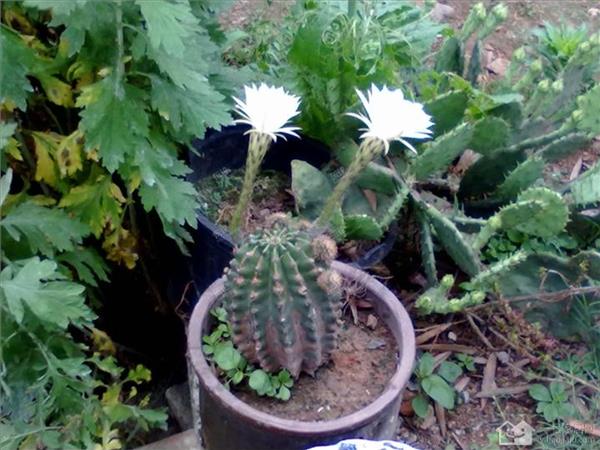
Cactus balls, commonly known as grass balls and also called Echinopsis multiplex, originated in South America and generally grow in hot, dry, rain-scarce desert regions. They like dryness and are drought-tolerant. The main growing season for cactus balls is summer, which is also their peak flowering period.
Cactus balls are dicotyledonous plants and belong to the Cactaceae family in plant taxonomy. There are many kinds, about 40 or more varieties, with different spherical shapes, including stem-spherical and oval, with vertical ribs arranged in a radial pattern; the spines and hairs also differ in length and density; flower colors include golden yellow, white, red, and so on. In spring and summer, large long trumpet-shaped flowers bloom from the stem. Small offsets can grow on the body.
Many small offsets often grow laterally from the body, with an elegant and refined form. In terms of appearance, cactus balls can be divided into woolly types, warty types, treasure types, hairy column types, strong-spined types, sea urchin types, and crown-flowering types. The spines and hairs of cactus balls also vary in length, shortness, sparseness, and density; the hair colors include red, yellow, golden yellow, and so on. Because of their peculiar shapes, bright flowers, and ease of cultivation, cactus balls are loved by people.
There are many kinds of cactus balls with various postures. The plants are not large, easy to care for, and bloom readily, with bright flower colors, making them very suitable for home cultivation and appreciation. If planted in small pots and placed on windowsills, balconies, bookshelves, desks, and other places, they are like living artworks, peculiar and interesting.
Cactus balls all originate from the tropical desert and semi-desert regions of the Americas. They like warm, dry, sunny environments, are tolerant of drought and partial shade, and fear waterlogging. Different varieties have greatly different habits due to different growing environments. During cultivation and care, they should be classified by variety.
Basic Types of Cactus Balls
1. Cactus ball: also known as grass ball, Echinopsis multiplex. The stem is round and spherical, while old stems are round barrel-shaped, and the flowers are white and fragrant.
2. Short-haired ball: the plant is spherical or cylindrical, and after flowering the flowers are very large, with white flower color.
3. Echinopsis multiplex: the body is yellow-green or pale green, the flowers are large, pale pink, and fragrant.
4. Golden ball: the body is yellow-green, clustered, and the flowers are large and white.
5. Vigorous ball: the plant is gray-green, spherical or cylindrical, and the flowers are large, dark pink or deep red.
6. Golden tiger ball: the stem is round and spherical, solitary or clustered. The top of the ball is densely covered with golden yellow wool. It has 21-37 ribs, prominent.
Cactus Ball Varieties
Cactus Ball Varieties Classified by Appearance
From the appearance, the types of cactus balls can be divided into: woolly types, warty types, treasure types, hairy column types, strong-spined types, sea urchin types, and crown-flowering types. The spines and hairs of cactus balls also vary in length, shortness, sparseness, and density. Hair colors include red, yellow, golden yellow, and so on. Among them, cactus ball varieties that can be grafted include Gymnocalycium mihanovichii 'Hibotan', Gymnocalycium mihanovichii 'Cui Mudan', Notocactus magnificus 'Shan Chui', Rebutia minuscula 'Red Sun', Eriocactus leninghausii 'Jin Huang', Cleistocactus colademononis 'Jin Niu', Parodia scopa 'Bai Yu Weng', and Schlumbergera truncata, among others.
Cactus Ball Varieties Classified by Edibility
From the perspective of whether they are edible, cactus balls can be divided into edible and ornamental cactus balls, and there are some differences between the two: edible cactus balls have 12-14 ribs, with straight and hard spines; ornamental cactus balls are not edible, their ribs can be many or few, their appearances are also varied, and their spines are soft and pale yellow, while edible cactus balls are dark green, and the whole edible cactus ball has a strong cactus smell, while ornamental cactus balls do not.
Cactus Ball Varieties Classified in the Narrow and Broad Senses
The types of cactus balls can be discussed from both narrow and broad senses. In the narrow sense, cactus balls specifically refer to cactus balls of the Cactaceae family and the Echinopsis genus, while in the broad sense, cactus balls generally refer to all spherical or approximately spherical cactus plants. Here we mainly introduce the types in the broad sense.
Common ornamental cactus balls include 'Grass Ball', 'Lion King', 'White Snow Light', 'Colorful Old Man Jade', 'Great Commander', 'Exquisite Palace', 'Seedling Ball', 'Seedling Ball Variegated', 'Golden Star', 'White Bird', 'Dragon King Ball', 'Black Beauty Ball', 'Astrophytum asterias', and others.
Varieties with robust growth include 'Grass Ball', 'Dragon King Ball', 'Lion King', 'Astrophytum asterias', and others. Varieties with weaker growth are small balls such as 'Seedling Ball' and 'Black Beauty Ball'. Because varieties such as 'White Bird', 'Exquisite Palace', and 'Colorful Old Man Jade' come from higher-altitude places of origin, they are suitable for growing in environments with sufficient light, good ventilation, and large day-night temperature differences. In addition, their white spines and hairs get dirty easily, so it is best to keep them indoors in a place with sufficient light all year round for care.
The above is all the content I have summarized for everyone on the common varieties of cactus balls. I hope this article can help everyone.