How to Grow Morning Glories and What Their Flowers Mean
Morning glory, also known as trumpet flower, jiaojiaolazi, large morning glory, and qinniangzi, is an annual twining herbaceous flowering plant of the genus Ipomoea in the family Convolvulaceae. The trailing stems are slender, about 3-4 m long, and the whole plant is densely covered with short bristles. The leaves are alternate, and the cymes are axillary, bearing 1 to several flowers. The corolla is trumpet-shaped, and the flower colors are vivid. This encyclopedia entry mainly introduces morning glory from several aspects: how to grow morning glories, the medicinal value of morning glories, the flower language of morning glories, and morning glory pictures.
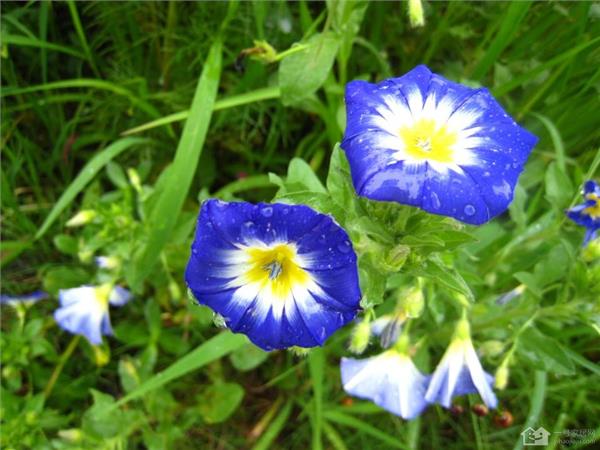
How to Grow Morning Glories
Morning glories must be grown in pots, which makes scientific management easier and also makes it easier to ensure seed collection from superior varieties.
First, raising seedlings
The suitable temperature for morning glory seeds to germinate is 20-30°C. Generally, sowing in late April to early May is best, and in southern regions it can be done earlier. Sow in rows by variety in a seedbed of fine sandy soil; when the humidity is moderate, they will sprout in about 10 days. After another 10 days or so, the cotyledons fully open. When the true leaves have just begun to emerge, they should be transplanted into small pots. Too early and the seedlings are weak; too late and the roots are damaged. Small pots should be marked and labeled with the variety name.
Second, planting out
After the seedlings grow two or three true leaves, the root system is well developed and they can be planted out in medium pots, with base fertilizer added in advance. Morning glories are not afraid of heavy fertilizer; horse hooves, cooked hemp residue, and similar materials can be used as base fertilizer. The development of the morning glory root system requires warmth, and black pots absorb heat better. Turn the pots frequently to keep sunlight exposure even, so the root system develops fully.
Third, pinching
After the morning glory grows three or four true leaves, the center begins to produce vines, and at this point they should be pinched off. After the first pinching, side vines grow again from the leaf axils. After the side vines produce three or four leaves, pinch again, and at the same time combine this with shaping. After each pinching, topdress with fertilizer. Be careful not to let fertilizer water and mud stain the leaves and cotyledons, so as to prevent the leaves from dropping. Once the side vines have grown, the plant enters the flowering stage. Ideally, the first leaf of the side vine produces axillary buds again, and flower buds emerge from the leaf axils of the second and third leaves. After the flower buds take shape, the stipules of the buds can be removed to facilitate bud development. To ensure nutrients are fully supplied to the flower buds so they produce large, brilliantly colored flowers, some buds can be removed to cultivate single blooms. After flowering, remove the spent flowers and do not let them set seed, so as not to affect the nutrition of the next batch of flowers.
Fourth, shaping and pruning
This is mainly done for open-ground planting as a hedge decoration: when the main vine produces 7-8 leaves, pinch it, keeping 4 leaves; after 3 side vines grow, keep 4 leaves and pinch again. After 9 side vines have grown, distribute them evenly over a fence or wall and tie them in place, and a green hedge and flower wall can quickly form.
For indoor ornamental growing in pots, when the seedlings are 6 cm tall, a flower support can be set up in the pot to let them twine upward. Alternatively, when there are 7-8 leaves, keep 4 leaves and pinch; after 3 side vines grow, keep 1 leaf and pinch. Keep each pot to no more than 9 flower buds. In this way, the plant shape becomes full and the flowers large.
Fifth, seed saving
Good varieties must have their seeds saved well. After they mature in autumn, collect the seeds, label them by category, and store them. If variations appear, they should be kept with even greater care.
The Medicinal Value of Morning Glories
First, medicinal value
The seeds of morning glory are a commonly used traditional Chinese medicine called chouniuzi. The black ones are called "heichou," and the cream-yellow ones are called "baichou"; a mixture of black and white seeds is called erchou. Heichou is mostly used in medicine, while baichou is used less often. It has the effects of promoting diuresis, reducing phlegm and clearing fluids, and expelling parasites and breaking up accumulations. It mainly treats symptoms such as edema of the limbs, nephritic edema, ascites due to cirrhosis, constipation, and abdominal pain from worm accumulation. In particular, note that heichou has a certain slight toxicity, so never take it orally.
Second, ornamental value
Morning glory is a common twining herbaceous flower of summer and autumn. It can be used to shade small courtyards and room windows, beautify small trellises and hedges, and can also be planted as ground cover. It has relatively high ornamental value.
The Flower Language of Morning Glories
Morning glory: everlasting love, spiritual love, calmness, illusion.
Dwarf morning glory: a sense of security, of one heart with you.
Pink morning glory: delicate tenderness.
If you want to learn more related information, you can continue to follow Yihao Home Network.