How long does the night-blooming cereus flower last, and what effect does it have on the home environment?
Although the night-blooming cereus has a short blooming period, getting it to bloom is actually not very difficult, as long as the conditions for blooming are met. Let's take a look at the following content~
When does the night-blooming cereus bloom
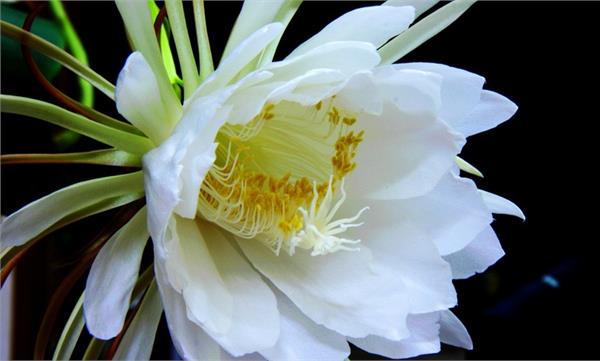
The night-blooming cereus usually blooms in summer and autumn late at night, when all is quiet, which is exactly when it blooms and shows off its beauty. Around 9 p.m. is when it most often reveals its charming figure. The purple flower stalk holds up a very large night-blooming cereus bloom, with pure white petals neatly layered one over another, and the heavy flower, weighing down the branch to the point of breaking, trembles gently. Amid the trembling, the petals slowly open and stretch out, revealing a beautiful face. Dense, fine white filaments spiral out from the flower's core, and at the top of the filaments are yellow, slightly swollen anthers - these are the stamens. The pistil of the night-blooming cereus is very distinctive, surrounded by the stamens, slightly thicker than the filaments, and also white, especially the stigma at the tip, which opens into a small white flower resembling a chrysanthemum. Elegant, pure white, charming, proudly holding its head high, it blooms open. The whole flower is graceful and refined, overflowing with fragrance, and dazzling. Therefore it enjoys the reputation of "beauty under the moon." Interestingly, after the flower gradually unfolds, it slowly withers again after 1-2 hours, and the whole process lasts only about 4 hours. Hence the saying "a flash in the pan" (the night-blooming cereus appears only briefly).
How long does the night-blooming cereus bloom
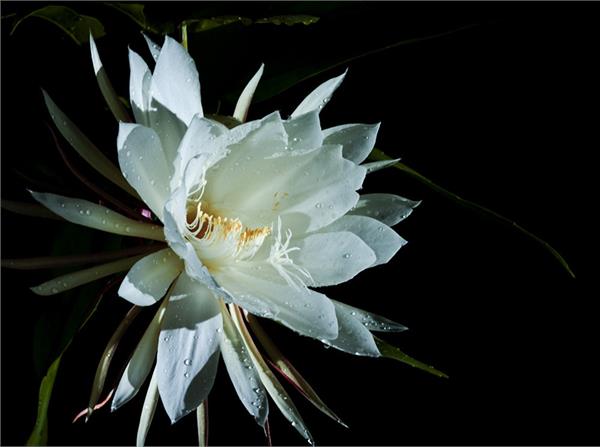
The reason for the saying "a flash in the pan" is that the flowering period of the night-blooming cereus is indeed a bit shorter than that of other flowers. After the night-blooming cereus is in full bloom, it usually withers in 3 to 4 hours, because when it is in full bloom all its petals are open, making it very easy to lose water. When water is insufficient, the petals close, and the flower withers very quickly.
How many times a year does the night-blooming cereus bloom
How many times a year can the night-blooming cereus actually bloom? Relevant records state 4-5 times, while the conclusion drawn from years of potted-growing experience by flower enthusiasts is: it can bloom 6 times a year.
Some flower enthusiasts conducted potted night-blooming cereus experiments on a balcony. Over more than 10 years, they potted (including cuttings) 46 pots of night-blooming cereus. Last year, 20 pots bloomed, and the group bloomed 8 times in one year, with a cumulative total of 26 days of blooming and a total of 151 flowers. Among them, a single plant potted for 10 years bloomed 6 times, with a cumulative total of 20 days of blooming and a cumulative total of 34 flowers.

Why does the night-blooming cereus bloom at night
1. The night-blooming cereus originated in the Mexican desert of tropical America, where the climate is both dry and hot. Through long-term adaptation to natural conditions, the night-blooming cereus developed the trait of not fearing drought. Its leaves have degenerated into very small needle-like shapes to reduce water transpiration. During the day, temperatures are high and water evaporation is great, so it cannot obtain enough water to open its flowers. Only at night, when temperatures are lower and evaporation is less, can it obtain enough water to bloom.
2. This is related to climatic conditions - only under suitable humidity and temperature will the delicate night-blooming cereus bloom. Summer nights in South America are much cooler than the daytime, and blooming at night allows the flowers to avoid harsh sunlight: 21:00-22:00, with a temperature of 20-26°C and relative humidity above 80%, are the conditions required for the night-blooming cereus to open. Late at night, as the temperature drops, the night-blooming cereus gradually wilts; such a blooming period avoids damage from high and low temperatures.
The effect of the night-blooming cereus on the home environment
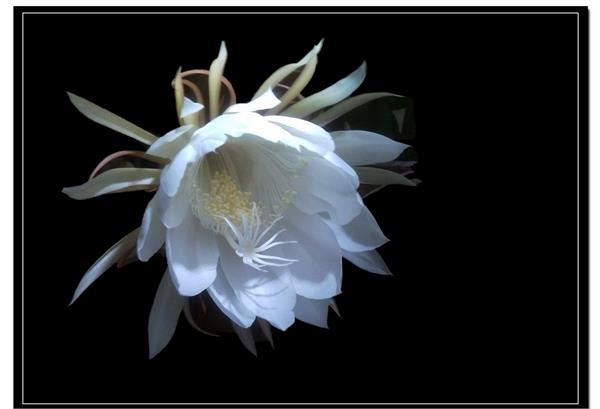
1. The night-blooming cereus can absorb carbon dioxide and release oxygen at night. Although ordinary flowers can purify the air, they only do so during the day. When night comes, they all become like the human body, absorbing oxygen and exhaling carbon dioxide. Therefore, if too many such flowers are placed indoors, it will cause flowers and people to compete for oxygen, affecting people's health. The night-blooming cereus is exactly the opposite. It is a common plant with CAM metabolism. It closes the stomata on the underside of its leaves during the day, and at night, after the surrounding temperature drops to an appropriate level, it opens the stomata on the underside of its leaves, releases oxygen, and absorbs carbon dioxide.
2. The night-blooming cereus can increase the negative ion content indoors. When it blooms, it is beautiful and noble, with a light fragrance filling the air, and it has always been a beautiful flower favored by people. Not only that, it can release negative ions, making the indoor air fresh and pleasant. Negative ions can be said to be the vitamins of the air. When the negative ion content in a room decreases, people will feel suffocated and short of breath. Therefore, the night-blooming cereus, which can increase the concentration of negative ions in the air, is truly a rare, beautiful, and beneficial flower.
3. The night-blooming cereus is a flower of the cactus family. Through people's vision and sense of smell, it can lower blood pressure and stabilize mood, and it has many benefits for human health. Its scent has the ability to sterilize and inhibit bacteria, filling the home environment with a healthy atmosphere.
If you want to learn more related information, you can continue to follow No. 1 Home Network.
It is truly a rare, beautiful, and beneficial flower.3. The night-blooming cereus is a flower of the cactus family. Through people's vision and sense of smell, it can lower blood pressure and stabilize mood, and it has many benefits for human health. Its scent has the ability to sterilize and inhibit bacteria, filling the home environment with a healthy atmosphere.
If you want to learn more related information, you can continue to follow No. 1 Home Network.