Growing Conditions for Gardenia and Precautions for Growing Gardenia
Summer has arrived, and the gardenias are blooming; their white, fragrant flowers catch people's eyes. Have you ever grown a gardenia? Do you know how to grow gardenias? Don't be overconfident, come and take a look at the growing methods and precautions for gardenias!
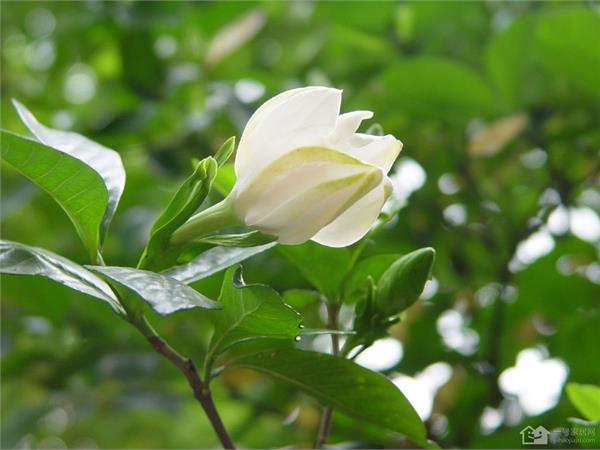
How to grow gardenias
First, grow in acidic soil
Gardenias need diffused light, so they like acidic soil. If the soil is alkaline, gardenias will not be able to absorb iron well, which greatly affects the formation of chlorophyll and further causes the flowering branches to wither and even die; therefore, the soil must be loose, fertile, acidic soil, and some substances with this effect can also be added to it.
Second, place in a shaded spot
Gardenias must never be placed in the blazing sun to be exposed, otherwise the leaves will turn yellow and wither, but this does not mean placing them in full shade, because they still need a certain amount of light. It is best to place them where 60% light is maintained each day. In addition, after April arrives, fertilize twice a month.
Third, air humidity
Gardenias like moisture, so the air must not be too dry. According to experts' statistics, if the air humidity is below 70%, it will affect the normal blooming of the flowers, but if it is too humid, it will also cause root and stem rot and yellowing leaves. So in addition to normal watering, clean water should also be sprayed nearby frequently. Another point to pay close attention to is that water must not be poured too much, otherwise it will also affect growth. When you see the soil is dry, tap the flowerpot with your hand; if there is a hollow sound, it needs watering, and stop when water starts leaking from the bottom of the flowerpot. It is best if some eggs, soy milk, etc. can be added to the water, as this is more conducive to growth.
Fourth, key points for fertilizing
Gardenias like fertilizer, but too much fertilizer must not be added at one time. Be sure to apply thin fertilizer frequently, and never cut corners, otherwise the branches will become thick, the leaves large and deep green, and it will lose its own ornamental effect.
Fifth, temperature requirements
The growing temperature for gardenias must not be too low, because they like warmth. Generally speaking, the temperature during the growing period is best at 18 to 22 degrees, and 5 to 10 degrees in winter. If it is below minus 10 degrees, they will suffer frost damage, and the north should pay special attention to this.
Sixth, proper pruning
Gardenias grow very easily into flourishing branches and leaves, creating a feeling that is impenetrable and chaotic. This causes nutrients to be dispersed and reduces ornamental value, so they need to be pruned. When pruning, it is best to keep 3 main branches, and remove new shoots sprouting from root suckers at any time. After the flowers fade, the branches should be cut short in time, so that new shoots will sprout below the cut. When the new shoots grow three nodes, they should be pinched back to prevent blind growth.
Precautions for growing gardenias
1. Gardenias are propagated by cuttings, layering, and division.
2. Pay attention to pest and disease control for gardenias. Generally, gardenias are prone to yellow horse disease, and leaf spot disease, canker disease, etc. also occur from time to time, so we should pay more attention. Gardenias are also easily attacked by a pest called Ma's whitefly. If you encounter this, you can consult professionals for pest control.
3. Gardenias are very sensitive to water, so a clay pot with good breathability should be used as the pot base. Only then will watering gardenias not cause water accumulation, which leads to yellowing and falling leaves and, in severe cases, even the death of the plant.
4. As for the cutting time for gardenias, April in the first half of the year and August to September in the second half are best. These two periods are the best seasons for gardenia propagation.
5. Fertilizer should not be applied before or after gardenia cuttings. At this time, they only need to grow naturally; even natural fertilizer, urea, chemical fertilizer, etc. are all unsuitable.
The growing method for gardenias is not complicated. On the contrary, it is a relatively easy plant to care for. No matter which corner it is placed in, it brings its own small value, especially when it blooms in early summer, when the floral fragrance is refreshing.
If you want to learn more related information, you can continue to follow No. 1 Home Network.