Key Cultivation Points and Seed-Sowing Techniques for Mahonia
Mahonia is a kind of plant. It is actually also a treasure. Its stems and roots can all be made into medicine, and its medicinal properties are quite good. It could obviously rely on its looks, but it insists on relying on its strength. Today, let us learn about its cultivation methods together. Owners who want to cultivate it, take a look, do not miss out.
Best propagation time: hardwood cuttings are best done from February to March; division can be done from mid-October to mid-November or from late February to late March, or combined with spring repotting.
Best growing soil: soil requirements are not strict; it grows best in loose, fertile, well-drained sandy loam.
Growing humidity requirements: Mahonia is best kept in a humid place.
Best growing temperature: Mahonia likes warmth; the best sowing temperature is 15-25°C; the best cutting temperature is 25-30°C.
Best growing light: Mahonia is shade-tolerant and avoids exposure to scorching sun.
Notes on cultivating Mahonia:
Fertilizer application:
Before the start of winter each year, apply once decomposed cake fertilizer or poultry and livestock manure, and it will grow robustly. During the growing season, apply once every 20 days a decomposed dilute liquid fertilizer; topdressing 2-3 times a year is enough, and in early spring apply an appropriate amount of cake fertilizer. If potted, keep the potting soil moist but not waterlogged. In winter, move it indoors to a sunny place, and the temperature should not be too high. Ground-planted plants are managed relatively extensively; they can be transplanted with a soil ball before budding in early spring, and sufficient base fertilizer should be applied when planting. 1-2 year old seedlings grow slowly, and growth accelerates from the 3rd year.
Watering key points:
Mahonia likes moisture. Usually water frequently to keep the potting soil moist, but it should not be waterlogged. Generally, during the spring and summer growing season, water appropriately more to promote sprouting and new shoots; in summer, water in the morning and evening, and spray water on the leaves so they are thoroughly wet; in winter, water around noon, and avoid watering late in the evening to prevent freezing damage to the roots.
Pruning essentials:
Mahonia can be pruned before spring sprouting to remove dead branches and fallen leaves and tidy the tree shape. At ordinary times, pruning can be done at any time, cutting off sprouting branches and overly dense branches to maintain a certain tree shape.
Potting soil replacement:
Mahonia is generally repotted once every 2-3 years. When repotting, you can combine it with division propagation, cut off dead roots and some overly long old roots, replace 1B2 of the old soil, and fill with new, loose, humus-rich potting soil.
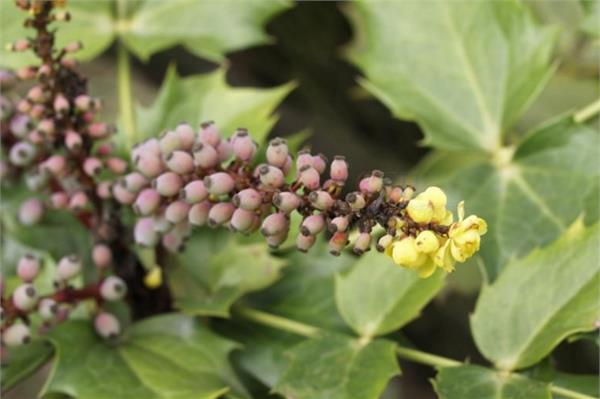
Mahonia illustration 2
Propagation key points:
Mahonia is commonly propagated by sowing, cuttings, division, and rapid propagation.
Sowing and seedling raising
Wild Mahonia is becoming fewer and fewer. This method is used when mass-propagating seedlings in garden nurseries. Sowing and seedling raising for Mahonia mainly involves getting the seed collection time, seed treatment method, sowing and soil-covering thickness, and careful post-sowing management right. In May, when the fruit is ripe, pick the oval berries, pile them briefly, then mix with fine sand and rub, or soak the seeds in warm water, rinse away the peel, pulp, and empty shriveled seeds, then scoop out the plump seeds, dry them in the shade, put them in a cloth bag, and hang them in a cool, ventilated, dry place for storage. After winter begins, store the seeds in low-temperature sand until the next spring, sow in March, cover with 1-2cm of soil after sowing, soak thoroughly with water, and place in semi-shade; they sprout in about 1 month. You can also sow directly after seed treatment is completed, sowing in rows in a seedbed in a semi-shade environment, covering with 3-5cm of soil. The suitable germination temperature for seeds is 15-25°C, and they can germinate and emerge in about 50d. The seedbed should be level, the soil particles should be fine and crumbly, and sowing should be done in furrows. Current-year seedlings can generally reach 8-10cm in height. During overwintering, add a little cold protection, leave them in the bed for another year of cultivation, and only in the 2nd year can they be transplanted with wider spacing. Seedlings usually must be cultivated for 4-5 years before they bloom and bear fruit.
Cuttings
For small-scale propagation, the cutting method can be used. Hardwood cuttings are best done from February to March, and from May to June, semi-hardwood branches are used for cuttings. Cut 1-2 year old healthy branches into segments about 15cm long, insert 2/3 into a sandy loam seedbed, keep the seedbed moist, begin building a shade frame in May, spray every day on sunny days to maintain moisture, and roots can form about 2 months after insertion. Softwood cuttings can be done during the plum rain season. Choose fully developed current-year branches, or use one-year-old branches, 15-20cm long; control the seedbed temperature at 25-30°C, and roots can form after one month, with a survival rate of over 90%. If the branches are treated with rooting agent, the rooting rate can reach over 90%.
Division
Division can be done from mid-October to mid-November or from late February to late March, or combined with spring repotting. Dig up clump-forming ground-planted plants, or take large clumps of potted plants out of the flowerpot, cut or tear them apart from the weak points where the rhizomes join, keep 2-3 stems and a portion of intact roots in each clump, trim the leaves slightly, and then plant in the ground or pot them.
Rapid propagation
With the expansion of Chinese patent medicine production, the demand for Mahonia plants is increasing day by day, and wild Mahonia faces a serious shortage of resources. Mahonia is usually propagated asexually, so rapid propagation of Mahonia through biotechnology means and achieving large-scale production will be an effective way to resolve this contradiction. It has certain reference value for carrying out research on artificial propagation of Mahonia and will provide a basic theoretical basis for the rapid propagation of Mahonia.
Pest and disease control:
Mahonia has strong resistance to pests and diseases. When other species tested at the same time, such as photinia, were harmed by aphids and other pests, Mahonia was not infected. Drain ditches in time to lower field humidity, maintain ventilation and light transmission, and enhance plant disease resistance. The main pests and diseases include: leaf noctuid, bagworm moth, Mahonia anthracnose, leaf spot disease, and so on. For leaf noctuid and large bagworm moth, spray with 90% trichlorfon original powder at 1000 times dilution to kill them. For anthracnose, spray with 70% thiophanate-methyl wettable powder at 1000 times dilution. During the scale insect stage, spray pesticides such as dichlorvos and parathion. Remove diseased fallen leaves and burn them. During the disease onset period, spray agents such as Bordeaux mixture or chlorothalonil.
Expanded knowledge - the value of Mahonia:
Mahonia has peculiar leaf shapes and is elegant and beautiful. Potted plants can be used for indoor display. Because of its good shade tolerance, it can be grown indoors for a long time under scattered light conditions. In courtyards, it can also be planted beside rockeries or in stone crevices, though it is best to have large trees for shade. Mahonia flowers are cool in nature and sweet in taste. The roots and stems are cold in nature and bitter in taste. They contain berberine, jatrorrhizine, magnoflorine, and so on. They have the effects of clearing heat and detoxifying, relieving cough and resolving phlegm. They have an inhibitory effect on Staphylococcus aureus, Shigella dysenteriae, and Escherichia coli. They mainly treat bacillary dysentery, gastroenteritis, infectious hepatitis, bronchitis, sore throat, conjunctivitis, burns, scalds, and other conditions. Collect the fruit and dig the roots in late autumn, collect the leaves throughout the year, and dry them in the sun or by heat for later use.
If you want to learn more related information, you can continue to follow No.1 Home Network.
It contains berberine, jatrorrhizine, magnoflorine, and so on. It has the effects of clearing heat and detoxifying, relieving cough and resolving phlegm. It has an inhibitory effect on Staphylococcus aureus, Shigella dysenteriae, and Escherichia coli. It mainly treats bacillary dysentery, gastroenteritis, infectious hepatitis, bronchitis, sore throat, conjunctivitis, burns, scalds, and other conditions. Collect the fruit and dig the roots in late autumn, collect the leaves throughout the year, and dry them in the sun or by heat for later use.If you want to learn more related information, you can continue to follow No.1 Home Network.