How to grow Jialuomu well: precautions for cultivating Jialuomu
Jialuomu, native to Japan, is a clumping shrub and a variety bred from the Northeast yew (Taxus cuspidata) with high ornamental value. Its flowering period is from May to June, and its seeds mature from September to October. So what do we need to pay attention to when cultivating Jialuomu? Let's find out together.
Cultivation methods for Jialuomu (basic knowledge):
Best propagation time: Jialuomu cutting propagation is best carried out in early spring before budding.
Best growing soil: Jialuomu should be planted in loose, fertile, slightly acidic soil. For potted Jialuomu, it is generally better to use a growing medium made by mixing 2 parts mountain soil and 1 part leaf mold.
Best growing temperature: Jialuomu is naturally cold-resistant and remains upright and verdant at a temperature of -10°C. In the south, it can overwinter outdoors in the open; in the north, it is enough to place it in a cold room.
Best growing light: Jialuomu likes light, fears heat, and tolerates cold. In summer, it should be placed in a spot with good sunlight to grow. If the sunlight is too strong (generally sunlight after 2 p.m.), a 50% shade net and curtain can be used for shading. For balcony cultivation, it can be determined according to the position of the light.
Precautions for cultivating Jialuomu:
Fertilizer application: During the spring and summer growing seasons, apply a thin nitrogen-based fertilizer once every 15 days to Jialuomu, and it can continuously send out new shoots 2-3 times. In early autumn, when new buds sprout at the tips of the branches and leaves, are tender green in color, and look like sesame seeds, topdressing is needed once to supply what is required for bud development and growth.
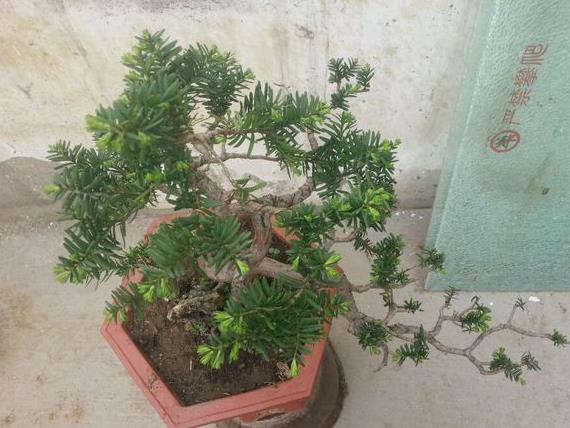
Key watering points: Water Jialuomu generally by the principle of watering when the soil is dry and withholding when it is wet.
In spring, it is generally moved out of the room before Qingming Festival. It is ideal to place it on a balcony or in a sunny spot, and it should not be placed close to a wall, so that it can receive more sunlight and rain to promote growth.
Repotting: Jialuomu bonsai is generally repotted once every 4-5 years, because the organic matter in the pot is limited and the roots grow relatively vigorously, so the interval between repottings should generally not be too long.
Key propagation points: Jialuomu is often propagated by cuttings, and both pot cuttings and ground cuttings are suitable.
Cuttings are best taken in early spring before budding. The cuttings should be cut from current-year tender branches with a small portion of two-year-old branches, cut into 8-10 cm lengths as cuttings, and inserted into slightly acidic mountain soil. Water thoroughly, provide appropriate shading, and maintain a certain humidity afterward. By early summer, they can take root and sprout branches and leaves, with a survival rate generally of 70%-80%. After the cuttings survive, the young seedlings can be divided and transplanted in autumn or the following spring, and attention should be paid to pinching to encourage early growth of side branches so as to maintain a graceful tree shape.
Pest and disease control: If Jialuomu is kept for a long time in a stuffy, poorly ventilated place, it is prone to damage by "cottony cushion scale" and "rice scale". Once discovered, promptly spray 25% phosmet or 5% fenitrothion at 800 times dilution for control.
Main uses of Jialuomu
Landscape uses
Jialuomu has a low plant form, spreads densely sideways, with feathery leaves and pale trunks, and remains evergreen all year round. Its graceful bearing resembles an ancient tree, elegant and unrestrained. When the seeds mature, the aril is bright red and translucent, like grains of rubies sparkling among the green, full of natural charm.
It is suitable for planting in courtyards or among tree clusters around lawns. Potted plants or bonsai can be placed on tables in studies and living rooms as decoration. It tolerates pruning and shaping, and is an excellent bonsai tree comparable to the five-needle pine and the Chinese podocarpus.
Bonsai making
Jialuomu has been an ideal material for small and medium-sized bonsai, especially commercial bonsai, in the past dozen years or so. Its leaves are small and dark green, its branches spread horizontally, its growth is relatively dense, it is evergreen in all four seasons, and cutting propagation is easy. It is a good material for making bonsai and also an excellent choice for indoor viewing.
In making Jialuomu bonsai, it is usually advisable to bind with palm fiber or metal wire, generally using the traditional curved-trunk style with cloud-like layered distribution. However, after Jialuomu bonsai takes shape, due to viewing and other reasons, problems such as falling branches and leaves and some branches becoming weak easily occur, which affects the ornamental value of Jialuomu.
If you want to learn more related information, you can continue to follow No. 1 Home Network.