How to grow hyacinths in soil and in water? All the planting precautions are here
Many people therefore also keep a pot of hyacinths at home. So, how do you grow hyacinths in soil and in water? Let's find out together!
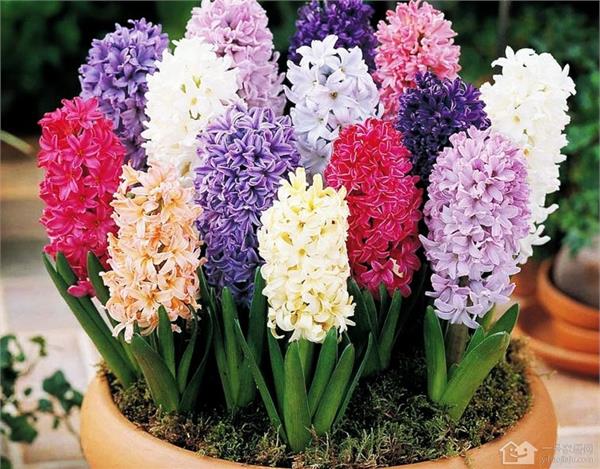
Soil culture of hyacinths:
1. If the hyacinth you get has already grown roots and leaves, and you like growing flowers in soil, you can still choose pot culture now.
2. Choose well-grown hyacinth bulbs and plant them in loose growing soil; you can use peat and large-grade perlite or coarse sand mixed evenly at 50% each.
3. Insert the bulb into the substrate with a little force, then add coarse river sand up to l/3 from the top of the bulb; leaving the top 1/3 of the bulb exposed above the soil layer will be more beneficial to the bulb's growth and development.
4. The number of bulbs planted depends on the size of the pot, generally ranging from 1-3.
5. When planting, note: the upper end of the bulb should be exposed above the potting soil; after planting, place it in sunlight and keep the potting soil moist. The temperature required for forcing blooms is 5-10°C.
Also note: hyacinths greatly need light and water. If light is insufficient, or if there is long-term dryness in winter, both will lead to poor flowering; sufficient watering is needed to maintain humidity. If you find the flower stem is too short to extend, you can place it in a dark place for several days to encourage spindly growth, and once the flower stem extends, return to normal cultivation. As for color, hyacinths have varieties in white, pink, peach red, purple red, purple blue, yellow and so on, and the cultivation method is the same.
Water culture of hyacinths:
1. There should be a 1cm-2cm gap between the water surface and the bottom of the bulb; never let the water submerge the bottom of the bulb!
2. The water temperature should not be high; below 15°C is better.
3. Place the bulb on the neck of the bottle. After roots begin to grow, you can lower the water level until the roots just barely touch the water surface; this allows the roots to fully absorb oxygen and promotes the growth of root hairs. After the roots develop, cover the growing container with black cloth to let the bulb develop further.
4. Before the bulb sprouts, do not place it under direct sunlight.
5. When the sprout grows to five centimeters, place it in a dark place; after the roots have fully emerged, place it in a warm place without direct sunlight, and add water frequently so that the water reaches the bulb.
6. When the leaves and flower buds emerge, expose it to sunlight for one to two hours daily to make the leaves and flower stalks sturdy; turn it to a different direction every day so it does not grow leaning to one side. No fertilization is needed, and in March or April of the following year it will bloom into a bright, fragrant hyacinth.
How to grow hyacinths
7. In an environment where your home temperature stays between 17°C and 20°C, you will enjoy the process of bud growth and color development. But do not place them directly near a heat source; this way the beautiful hyacinth flowers will stay open longer.
8. When growing in clear water, change the water once a week; when growing in nutrient solution, change it depending on how cloudy it becomes, keeping the water quality in the bottle clean.
Hyacinth planting precautions
1. Open-field cultivation is best carried out from October to November; choosing well-drained soil is the most important condition. Apply sufficient base fertilizer before planting, add a thin layer of sand on top, then arrange the bulbs with a plant spacing of 15 cm-18 cm, and cover with 5 cm-8 cm of soil. Also cover with grass to keep the soil loose and moist. Generally no other management is done before flowering; after flowering, if you do not intend to collect seeds, cut off the flower stem to promote bulb development, and the cut should be as high on the flower stem as possible. In early June, the bulbs can be dug out, spread out, graded, and stored in a cold storage room; the summer temperature should not exceed 28°C.
2. For pot culture, use loam, leaf mold, fine sand, etc. mixed as nutrient soil. Generally, a 10 cm diameter pot holds one bulb, and a 15 cm diameter pot holds 2-3 bulbs. Then bury the pot in the soil and cover it with 10 cm-15 cm of soil. After 7-8 weeks, when the sprouts grow to more than 10 cm, remove the covering soil to let sunlight reach them. Generally, plant from October to November, and they bloom in March.
3. Fill the water-culture container with clean water and place it in a dark place. Choose a large bulb so that the bottom of the bulb is immersed in water. When the roots reach 10 cm, move it to a bright place for sunlight, keeping the room temperature at about 15°C. Plant in October, and flowering can be expected by the end of the year.
4. For forcing cultivation, after late July, treat the bulbs at a low temperature of 8°C for 70-75 days, then pot them in early October and cultivate them in a greenhouse, so that they can be made to bloom at the end of the year. Because the forcing sensitivity of cultivars varies greatly, when carrying out forcing cultivation you should choose varieties suitable for forcing.
The above is the related introduction in this article. I believe after reading it you also have a simple understanding of this. If needed, you can continue to follow No.1 Home Network to learn more information.