How many colors do Oncidium orchids come in? Read this one article to understand the key cultivation points
Oncidium, also known as the dancing lady orchid, dancing girl orchid, or golden butterfly orchid, originates from tropical rainforests. Its flowers come in diverse colors and have a long blooming period. Next, let us take a look at how to cultivate Oncidium.
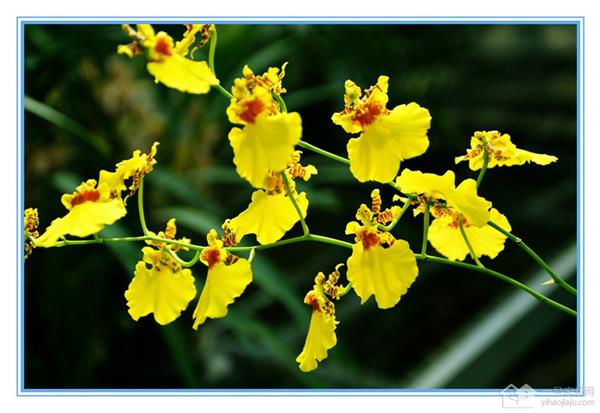
Oncidium, also known as the dancing girl orchid, golden butterfly orchid, or tuberculate-lipped orchid, is the general name for plants in the genus Oncidium in the orchid family. There are more than 750 native species of this genus worldwide, while the commercially used varieties in all their diverse forms are mostly hybrids. The plants are light and elegant, with slender, drooping flower stems and strange, lovely flowers shaped like flying golden butterflies, full of movement. They are one of the world's important types of potted flowers and cut flowers.
Oncidium originates from the United States, Mexico, Guyana, and Peru. The original-leaf type (also called the hard-leaf type) of Oncidium prefers warm environments, while the thin-leaf type (also called the soft-leaf type) and the sword-leaf type of Oncidium prefer cool climates.
Oncidium has 1-3 leaves and can be divided into thin-leaf species, thick-leaf species, and sword-leaf species. Generally, a single pseudobulb bears only 1 flower stem, though some robustly growing ones may bear 2 flower stems. Some species have only 1-2 flowers per stem, while others can have several hundred, such as the small-flowered species used as cut flowers, where one stem has several dozen flowers and several stems have from a hundred to several hundred. Their flowers are brightly colored, shaped like flying golden butterflies and also like gracefully dancing girls, hence the names golden butterfly orchid and dancing girl orchid.
The flower colors of Oncidium are mainly yellow and brown, with additional colors such as green, white, red, and magenta. In size, some are extremely small, like miniature Oncidium, while others are extremely large, with flower diameters reaching over 12 cm. The flower structure is highly unusual: the sepals are equal in size, and the petals are almost equal to or slightly larger than the dorsal sepal; the lip is usually three-lobed, either large or small, fiddle-shaped, with a ridge-like protrusion at the base of the middle lobe, and on the ridge there are small raised spots. It is quite peculiar, hence the name tuberculate-lipped orchid.
The key cultivation points for Oncidium are:
1. Cultivation materials: In hot, humid places, use tree fern, boards or pots made from non-oily hardwood of broadleaf trees, etc., while in dry climates, you can use sphagnum moss, fern roots, moss, etc., to plant them in porous pots.
2. Daily management: Oncidium generally has relatively low environmental requirements, but the winter temperature should not be lower than 15°C, and the air humidity should be around 80% in all four seasons. In spring, summer, and autumn, it needs a semi-shaded environment; in winter, it can be given plenty of sunlight, but never expose it to the scorching sun of midsummer.
Oncidium is mostly propagated by division. Generally, do not water immediately after division; when it is slightly dry, spray some water on the leaves, and wait until new roots grow before watering, then spray some balanced fertilizer, but the concentration must not be too high, generally 0.6% to 0.8%. During care, do not water too much, as this easily causes root rot, and attention should be paid to ventilation and light transmission. If there are diseased plants, they should be destroyed promptly and sprayed with some fungicide. During the flowering period, temperature and humidity should not be too high or too low, as this will affect flower longevity, shorten the blooming period, and may even cause bud drop or premature withering.
[Temperature management] During the seedling recovery stage, the daytime temperature is 25-28°C and the nighttime temperature is 23-25°C. New roots sprout quickly; after new roots grow, the temperature can be appropriately relaxed somewhat, but maintaining the above temperatures is beneficial to orchid seedling growth. After the pseudobulbs mature, when the day/night temperatures are (26-29°C)/(23-25°C), Oncidium can shift from vegetative growth to reproductive growth.
[Humidity management] Relative humidity should be controlled at 60%-80%. For newly planted seedlings, humidity should be around 80%. Humidity should not be too high or too low; too high makes them prone to disease infection, and too low is unfavorable to orchid growth. In hot summer, water should be sprayed on the ground around the plants, on the benches, and on the leaves to increase air humidity, while good ventilation must also be maintained; otherwise, it will lead to poor plant growth and the pseudobulbs will easily rot.
The above is the relevant introduction in this article. I believe that after reading it, you also have a simple understanding of this. If needed, you can continue to follow No.1 Home Network to learn more information.