A Detailed Guide to the Cultivation Techniques of the Graptopetalum 'Qiuli' Succulent
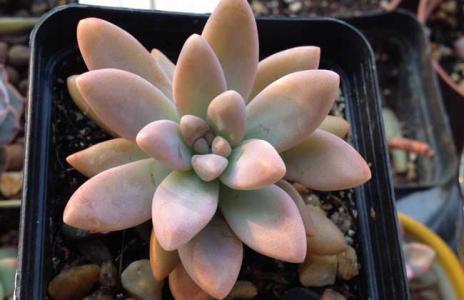
The leaves of Graptopetalum 'Qiuli' are relatively slender and elongated, smooth and slightly concave on the upper surface, with a distinct keel-like protrusion on the underside, and slightly pointed at the tip, though overall still fairly rounded. Graptopetalum 'Qiuli' grows relatively fast, with leaves arranged in a rosette pattern; the lower leaves tend to wither and drop off easily, after which side shoots sprout from the lower part of the stem, forming clusters. The flowering period is in spring, with cymose inflorescences bearing small yellow star-shaped five- or six-petaled flowers that are very fresh and lovely. Today we will give a brief introduction to the cultivation techniques of Graptopetalum 'Qiuli'.
Propagation methods:
Graptopetalum 'Qiuli' can be propagated by various methods such as cutting the top to encourage tiller buds, and leaf cuttings. The propagation success rate is very high. In spring and autumn (this can also be done in winter in areas north of the Yangtze River), twist off healthy, mature and intact leaves for cuttings. Place the leaves slightly tilted or flat on vermiculite, peat or coconut coir, keep them slightly moist, and they will soon root at the base and grow new buds.
When the new buds have grown a little larger, they can be planted separately to become new plants. In addition, young plants sprouting beside the old plant can also be used for cuttings. Before taking cuttings, the cut end needs to be dried, then the lower part of the stem should be shallowly buried in sandy soil. The other precautions are the same as for leaf cuttings. The cutting medium needs to be loose sandy soil so that the plant's root system can grow well.
Soil requirements:
Graptopetalum 'Qiuli' is best cultivated in neutral sandy soil with good drainage and aeration, to facilitate the removal of excess water and the growth of the plant's roots. It can be prepared with 1 part each of pine needle soil, vermiculite, leaf mold and sandy soil, and cinders and sieved particles such as akadama soil, kanuma soil and volcanic rock can also be added. Repot once every 1-2 years in spring, and the dead old roots can be trimmed off. The nitrogen content of the soil should not be too high.
Light conditions:
The more sufficient the light and the greater the temperature difference between day and night, the more vivid and glossy the color of Graptopetalum 'Qiuli' leaves. When temperature permits, it is best to place it outdoors for care to ensure sufficient light. When light is insufficient or the soil is too moist, it will become leggy, the whole plant will turn dull and green, the leaves will be sparse with elongated spacing, and it will accelerate upward growth, seriously affecting its ornamental value, and it may even die because the plant's photosynthesis is hindered.
Water conditions:
Because the plant has a high internal water content, Graptopetalum 'Qiuli' rots very easily in an overly humid environment. Never water too much. To avoid water accumulating at the roots, it is best to choose a pot with drainage holes at the bottom; beginners can choose a well-aerated terracotta pot (though this may affect how plump the leaves are); glass containers absorb heat and have poor aeration, so use them with caution. Water about once every 10 days, and just water thoroughly each time.
Temperature conditions:
Under normal circumstances, growth stops or slight frost damage occurs below 5°C, and at 0°C and below the water in the leaves freezes and the cells die. When the temperature is too high (above 35°C) or too low (below 5°C) in winter and summer, the plant stops growing; at this time, watering should be temporarily reduced or stopped, and the watering frequency should be resumed when the temperature is suitable. During high summer temperatures, pay attention to ventilation and prevent prolonged exposure to the sun.
Pruning and shaping:
Usually, the dried and withered old leaves of Graptopetalum 'Qiuli' should be removed promptly to prevent them from piling up and causing bacterial growth. When the plant becomes leggy or grows too tall, the height of the plant can be controlled and its shape can be molded by pruning the top branches and leaves, so as to maintain a graceful plant form. The cut top part can be dried at the wound and then inserted into slightly moist sandy potting soil to root, thereby becoming a new plant. The stem and branches and leaves at the base of Graptopetalum 'Qiuli' can sprout more side buds.
The above is the introduction to the cultivation techniques of Graptopetalum 'Qiuli' brought to you by the editor; we hope it is helpful to you!