What are the effects of keeping Phalaenopsis (moth orchids) at home? The price of Phalaenopsis
Clivia miniata is a high-grade, precious ornamental flower. The plant is elegant and handsome, with the bearing of a gentleman, and its flowers resemble those of an orchid, hence its name. The flower language of Clivia is nobility and the manner of a gentleman. Therefore, Clivia is loved by many people. It is native to the tropical regions of southern Africa, growing beneath trees, so it fears both heat and cold, prefers a semi-shaded and humid environment, and dreads strong direct sunlight. So, how do you make Clivia bloom every year?
I. Introduction to Clivia
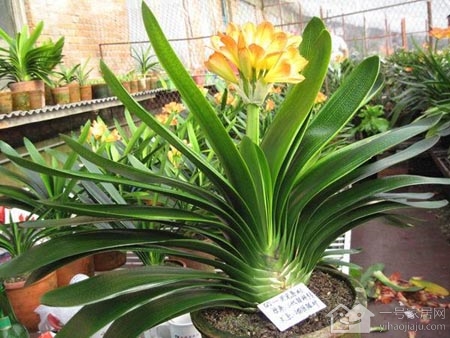
Clivia belongs to the Amaryllidaceae family. Clivia is a perennial herbaceous plant of the genus Clivia, with a flowering period lasting 30 to 50 days, mainly in winter and spring, and it also blooms around New Year's Day through the Spring Festival. It dislikes strong light and is a semi-shade-loving plant; it prefers cool conditions and dislikes high temperatures. The optimum temperature for growth is 15 to 25°C; below 5°C it stops growing. It prefers fertile, well-drained soil and humidity, and dislikes dry environments. Clivia has very high ornamental value. Its plant is elegant and handsome, with the bearing of a gentleman, and its flowers resemble orchids, hence its name. The roots are fleshy and fibrous, and the leaf bases form a pseudobulb. The leaves are sword-shaped, up to 45 cm long, arranged alternately, with entire margins. The umbel inflorescence is terminal; each inflorescence has 7 to 30 florets, and some can have more than 40. The florets have stalks and are arranged in an umbel at the top of the flower; the flowers are funnel-shaped, upright, and yellow or orange-yellow. It can bloom year-round, mainly in spring and summer. The fruit ripens around October. Both flowers and leaves are beautiful. It is attractive and elegant, and also shade-tolerant, making it suitable for potted indoor display; it is valued for both its foliage and flowers, and is also an ideal potted flower for decorating conference venues and hotel environments.
The Clivia plant is upright and handsome, with the bearing of a gentleman, and its flowering period lasts 30 to 50 days, making it especially suitable for Chinese-style homes. The Clivia flowering period is mainly in winter and spring, blooming around New Year's Day through the Spring Festival, which is very festive. Even when not in bloom, its green, spreading leaves also have a good decorative effect. Clivia prefers loose, fertile, well-drained, slightly acidic soil. For potting soil, it is best to use a culture soil made by mixing 80% forest leaf mold with about 20% coarse sand. Alternatively, use various Clivia culture soils sold on the market; these culture media are fertile, loose, breathable, and have good water permeability, which is beneficial for root growth.
II. How to make Clivia bloom every year
Some Clivia do not bloom again the next year after flowering once. There are many reasons for this phenomenon, the main one being a lack of nutrients. This is because after flowering, the Clivia has consumed a large amount of nutrients, and the nutrients originally in the potting soil are mostly gone. If it is not fertilized and no new culture soil is added, it will be very difficult for it to continue growing leaves and blooming. Even if it blooms, the flowers are often thin and small, with faded color, and of low ornamental value. To make it bloom every year, for plants that have already flowered, you should repot and change the soil in early spring after the flowers fade, and strengthen water and fertilizer management so that they grow robustly and can again form buds and bloom.
Clivia has well-developed fleshy roots that can store a relatively large amount of water, so overwatering easily causes root rot; too little water will in turn affect new leaf growth, root development, and flower scape emergence. The amount of watering should be adjusted according to specific circumstances: for small pots with small plants, high temperatures, good ventilation, fast evaporation, and well-aerated soil, water more; otherwise, water less. Generally, seedlings need little water, while the flowering period requires more water. In spring and summer, water more, generally once a day. In autumn, water once every 1 to 2 days. In winter, when temperatures are low, water less, generally once every 5 to 7 days. When watering Clivia, do not wait until the potting soil is completely dry before watering.
III. Key points for Clivia care
Clivia prefers neutral water. Clean, unpolluted tap water, well water, river water, etc. can all be used for watering, but because fresh tap water and well water are lower in temperature than the soil and contain some impurities, they should be left to stand for 1 to 2 days before use. As for watering, there are quite a few finer points here as well.
For small Clivia seedlings, the best method is to water with a spray bottle. Point the nozzle upward and spray onto the leaves. The advantage of doing this is that, besides achieving the purpose of watering, it can also wash off dust, and at the same time leave mist droplets on the leaf surface, ensuring a certain humidity on the leaf surface. In sunlight, the evaporation of water can lower the leaf surface temperature and prevent sunscald. However, for Clivia that are currently blooming, spray watering should not be used, to prevent water from entering the leaf sheaths and causing heart rot; for Clivia in the flowering period, water can only be poured into the pot.
The general watering principle is "moist then dry, do not water if not dry, water thoroughly when dry." Watering thoroughly means making all the roots of the Clivia be in the same humidity. Judging whether the water has penetrated thoroughly cannot be based only on whether water flows out from the bottom of the pot. This is because sometimes after the potting soil dries, it hardens and shrinks into a clump; after watering, the water quickly flows from the pot wall to the bottom and runs out through the bottom hole, while the central part of the potting soil has not been touched by even a little water. If watering is stopped at this time, the Clivia leaves may wilt, and when the flower scape is emerging, it may become trapped.
A simple and effective watering method is to immerse the entire flower pot in a basin or bucket filled with water, soak for half a minute, and then take it out. However, the disadvantage of doing this is that nutrients in the soil are relatively easily lost, so if you want Clivia to have deep roots and large leaves, you should also pay attention to replenishing nutrients in a timely manner. The nutrient elements needed by Clivia mainly come from organic fertilizers, such as soybean cake, peanut oil cake, animal offal, etc. Under normal circumstances, applying them once each in spring and autumn within a year is enough. In spring, apply once around late April to early May after flowering; in autumn, after the fruit is harvested, apply once more from about mid-September to late October.
Finally, that concludes the knowledge about Clivia care. In addition, Clivia can absorb carbon dioxide and release oxygen, and also has the function of absorbing dust. Clivia flowers are mostly bright red or orange, making them especially suitable for decorating the home during the winter flowering period and adding a lively and festive atmosphere.
The above is the relevant introduction in this article. I believe that after reading it, you now have a simple understanding of this. If needed, you can continue to follow No.1 Home Network to learn more information.