A Detailed Guide to the Morning Glory's Growth Habits and Flower Language
The morning glory can be said to be an extremely common flower around us. The morning glory has tenacious vitality; scatter its seeds casually on the ground and they will quickly take root and sprout, growing upward along whatever object they can cling to, until they produce beautiful blooms. What is the morning glory's flower language? Let's take a look together.
I. Introduction to the Morning Glory
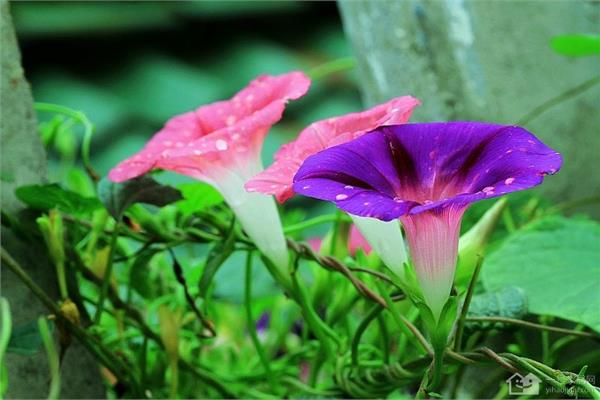
The morning glory has a folk name, "Diligent Lady"; as the name suggests, it is a very hardworking flower. Whenever the rooster has just crowed for the first time, when the hour hand still points around the "4", on the morning glory branches winding around fences and trellises, trumpet-like flowers open one after another. In the morning light, people breathe the fresh air while feasting their eyes on the fresh flowers dotted among the green leaves; it truly has a special charm.
There are about 60 or more varieties of morning glory, and the following are commonly cultivated. Ipomoea hederacea (ivy-leaved morning glory), with leaves deeply three-lobed, flowers medium-sized, 1 to 3 borne in the leaf axils, in translucent blue, rose red, or white. Ipomoea purpurea (common morning glory), with broad heart-shaped leaves, entire margins, smaller flowers, in white, rose red, translucent blue, and other colors.
The currently popular large-flowered morning glory has large leaves and long stalks, with three lobes, the central lobe being larger, and the leaves tend to develop irregular yellow-white patches. Flowers are borne 1 to 3 in the leaf axils, the common peduncle shorter than the leaf stalk, flowers large, with a flower diameter reaching 10 cm or more, native to tropical Asia and Africa. This species is most extensively cultivated in Japan, where it is called the asagao flower, and many horticultural varieties have been selected and bred, with diverse flower shapes and rich, colorful blooms, widely popular everywhere. The morning glory is not only ornamental but can also be used medicinally. It is cold in nature and bitter in taste, with the function of expelling water and reducing accumulation, and has particular efficacy for conditions such as edema and abdominal distension, athlete's foot, and difficult urination and defecation. Even today, some farmers still use it to treat illnesses.
II. The Morning Glory's Growth Habits
The morning glory is inherently tenacious, preferring environments with ample sunlight, a mild climate, and moderate ventilation. It has strong adaptability to soil, is relatively tolerant of drought and saline-alkaline conditions, and is not afraid of high temperatures and intense summer heat; it is a deep-rooted plant. It is an annual or perennial twining herbaceous plant, with short hairs all over. The morning glory is generally sown in spring and blooms in summer and autumn, with funnel-shaped flowers in colors such as blue, crimson, peach red, and purple, as well as bicolor varieties, with much variation in petal edges. The morning glory's leaves are usually three-lobed, with a heart-shaped base. The flowering period is most abundant in summer. The seeds have medicinal value.
The morning glory is also called the trumpet flower, because its flower shape is just like a little trumpet. I remember as a child, I once collected the ripe black seeds of morning glories from the roadside, took them to my own balcony, and planted them in flower pots; before long, the morning glories had taken hold. At that time, blue, purple, and rose red morning glories decorated the protective railing at home exceptionally beautifully.
III. The Morning Glory's Flower Language
Morning glory flower language: love, calmness, illusion, and everlasting love.
It likes to pursue the mature love of adults, but how can you, inexperienced in the world, understand the world of adults? Better to be more natural; your heart will feel freer. A child playing adult, putting on airs. An older woman enticing a younger man; in ancient times there was the saying of an old cow eating tender grass, and today there is the counterpart of old grass leading a tender cow. When you meet a woman like that, you can say: "Oh my, you must be a morning glory." You are full of courage and strength, and can quickly find the one you love and step into a solid life.
In France, the morning glory is called the beauty of the morning, and it is thought that if the morning glory could give off fragrance, it would be a flawless flower. In Japanese proverbs, there is a saying: "Though the morning glory is beautiful, its bloom lasts only a moment." Its meaning is that in a person's life, the glorious brilliance of youth is really too short. Therefore, the morning glory is also called the flower of short life.
In Europe, people regard the morning glory as a symbol of courage and energy; people associate it with its thick vines stretching toward the sky. Words of the wind: no matter how beautiful the morning glory is, it must climb other objects to grow upward, and only then can it form a brilliant scene; it always lacks independence, yet it is highly invasive.
This tiny flower sets my thoughts flying. I have had moments of emotion and moments of sorrow, but more than that, I have gained insights into life! Life is so fragile, yet also so tenacious; as long as you face it bravely, do not fear hardships and dangers, and unswervingly strive toward your set goal, hope will beckon to you, just like the morning glory. Although its life is short, it shows its most beautiful and brilliant side, so in this life, it has no regrets.
The above is the relevant introduction in this article. I believe that after reading it, you also have a simple understanding of this. If needed, you can continue to follow Yihao Home Network to learn more information.