A Detailed Guide to the Growth Habits and Propagation Methods of Petunias
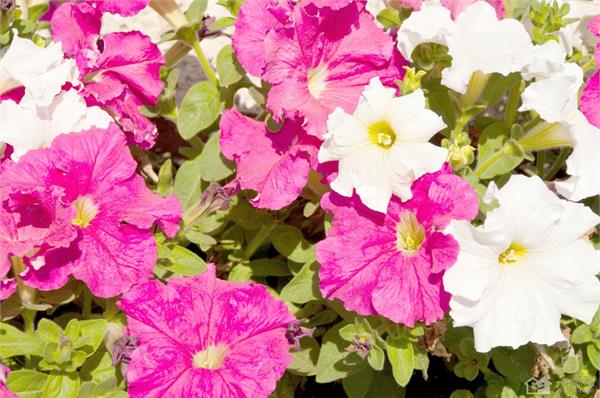
Petunia, also known as Lingzhi peony and petunia hybrida, is a perennial herbaceous flower of the genus Petunia in the Solanaceae family, often grown as an annual. Petunias have large flowers, rich colors, and a great variety of flower forms, and have become an important potted and flowerbed plant. Petunias are widely cultivated in Europe, the United States, Japan, and other regions. Below is a discussion of how to propagate petunias.
I. Growth Habits
Petunias are native to South America. They like light. They like warmth; in cool, overcast weather they produce fewer flowers and more foliage. They are not cold-tolerant, so in winter they should be given a little protection to avoid frost damage. They dislike waterlogging. They prefer well-drained, slightly acidic sandy loam. If the soil is too fertile, they tend to grow excessively, causing the branches to elongate and lodge.
II. How to Grow Petunias
1. Planting
They require slightly acidic, loose, fertile, well-drained soil. For the potting soil, generally equal parts sandy loam and leaf mold can be mixed evenly.
2. Fertilizing
Petunias have a long flowering period and need a continuous supply of nutrients to keep blooming, so during the growing period, generally apply a dilute liquid fertilizer once about every 10 days. During the bud stage, it is best to apply more phosphorus fertilizer to encourage more and brighter flowers.
3. Watering
Normally, water moderately to prevent the soil from becoming too dry or too wet. If too dry, the plant easily wilts; if too wet, the roots easily rot. In summer, when the weather is hot and evaporation is greatest, replenish water in time to keep the potting soil moist but not waterlogged. During the rainy season, drain promptly to prevent waterlogging.
4. Shaping and Pruning
When the seedlings reach about 10 cm in height, pinch off the growing tips to encourage side branches to sprout, which will produce more flowers. After each flowering, if seeds are not needed, promptly cut off the faded flowers and shorten the branches, and side branches will continue to sprout and bloom continuously.
5. Propagation Methods
1) Seed propagation. Petunias are often grown as annuals. The sowing time depends on the time of market launch, and the actual sowing time should also be adjusted according to the variety. Petunia seeds are very small, with 9000-10000 seeds per gram. The optimum germination temperature is 20-22°C. Sow indoors in pots, using a mixture of high-temperature-sterilized culture soil, leaf mold, and fine sand. After sowing, no soil covering is needed; simply press lightly, and germination occurs in about 10 days.
2) Cutting propagation. This can be done throughout the year when grown indoors. After flowering, cut off the sprouted tender terminal shoots, 10 cm long, and insert them into a sand bed. The cutting medium temperature is 20-25°C. Roots form 15-20 days after insertion, and after 30 days they can be transplanted into pots.
3) Tissue culture propagation. Explants include seeds, leaves, and fertilized ovaries, etc. Under sterile conditions, first soak in 75% alcohol for 8 minutes, then soak in 0.1% mercuric chloride solution for 7 minutes, remove and rinse with sterile water, then inoculate onto MS medium (with 6-benzylaminopurine 0.5-1.0 mg/L and naphthaleneacetic acid 0.1 mg/L added). Small shoots appear 15 days after inoculation. Cut the small shoots and transfer them to the original medium for subculture; after 20 days, one small shoot can produce more than 10 shoots. Transfer 1 cm strong shoots onto 1/2 MS medium containing naphthaleneacetic acid 0.05-0.2 mg/L. After 10 days, 100% root and become complete small plantlets.
The above is the relevant introduction in this article. I believe that after reading it, you now have a simple understanding of this. If needed, you can continue to follow No.1 Home Network to learn more information.