Growing Environment for String of Pearls: How to Grow String of Pearls Well
String of Pearls (Senecio rowleyanus) has the lovely names "Buddha's String of Beads," "Buddha's Beads," "Green Grapes," and "Green Bells." It is a plant with very high ornamental value, with plump, round, heart-shaped leaves that sway in the wind like strings of wind chimes, looking very beautiful. Many people like to grow it in their homes, as it not only adds beauty to the environment but also purifies the air. So, is String of Pearls easy to grow? Let's take a look at how to grow String of Pearls.
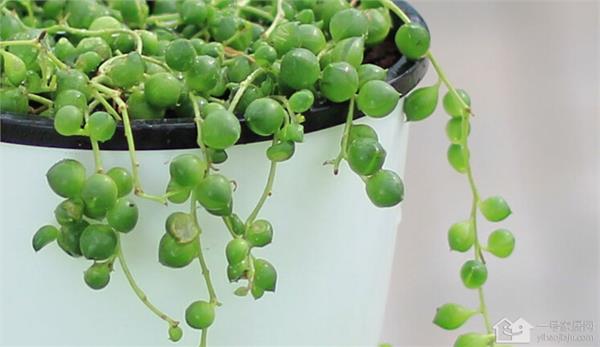
I. Growing Environment
String of Pearls has relatively high requirements for its growing environment. It prefers soil rich in organic matter that is loose and fertile. Especially in the early stages of growing String of Pearls, when the plant transitions from one growing environment to another, all external conditions can become fatal factors for it. However, String of Pearls is not so fragile that it cannot withstand anything. In a warm environment with high air humidity and strong indirect light, the plant can reach its optimal growing state.
II. How to Grow String of Pearls
1. Soil: The plant's root system is very shallow, so it can be planted in shallow pots. Generally, a piece of tile is used to cover the drainage hole, and a layer of coal cinder or coarse sand is spread on top to increase air permeability and drainage (especially when commonly used plastic pots are used for planting). The soil is best made of leaf mold (fallen leaves from trees in autumn and winter mixed with a certain amount of crushed soil, mixed with a certain amount of sand (soil-to-sand ratio of about 1:3).
2. Watering: Root rot is easy to occur in summer, so watering should not be too frequent. A small spray bottle should be used for watering.
3. Temperature: It likes warmth and humidity, is relatively cold-tolerant (when cultivated in the Jianghuai region, it can tolerate low temperatures of 0°C), and is heat-tolerant. The optimal temperature is around 20°C to 28°C. Growth is slow at both high and low temperatures, and it almost goes dormant in high-temperature environments.
4. Fertilizing: In spring and autumn, "apply light fertilizer frequently." Spraying 1 to 3‰ nitrogen fertilizer and potassium dihydrogen phosphate on the leaf surface often helps make it more emerald green and plump, improving its ornamental value.
5. Propagation: It is divided into two methods: cuttings propagation and layering propagation.
1) String of Pearls is propagated by cuttings. Cut the stems into 8 to 10 cm segments, lay them flat and half-bury them in the potting soil. At the beginning, maintain 50% to 60% humidity, and after half a month they will take root and survive. After surviving, control the amount of watering and keep the potting soil alternately dry and moist, which is beneficial for plant growth. When taking cuttings, choose to cut from above the position of the aerial roots of String of Pearls, and rooting will be a bit faster. After lightly burying the cut stems, remember to be sure to cover them with a layer of soil or small stones. Keep them out of direct sunlight, and water thoroughly immediately once dry.
2) Another new propagation method for String of Pearls: lightly bury the stems, then cover the surface with another layer of soil. Water immediately, and before long many new shoots will sprout from the soil. This method is very suitable when there are not too many stems. It is very slow in the beginning, but once the small shoots grow out, growth becomes very rapid. After another three months of growth, the String of Pearls had completely filled the pot. In half a year, many more were propagated. During this period, due to lack of care while away on a business trip, the String of Pearls was infested with root mealybugs, and coupled with the summer, many of them showed signs of rot. Fortunately, adjustments were made in time after returning home. All were re-propagated by cuttings, and they regained their vitality, with the quantity becoming even greater.
The verdant String of Pearls has a cute appearance, and its plump leaves have gradually made it an important plant for environmental decoration. Although the trailing vines do not have the gorgeous flowers of wisteria, the leaves are so cute that they look like innocent spirits deep in the forest. However, while we appreciate the beauty of String of Pearls and enjoy the coolness the plant brings us, we should still do something for the plant! It would not be good if the lovely String of Pearls were damaged beyond recognition by pests, and under our care, String of Pearls will also bring more beauty.
The above is the relevant introduction in this article. I believe after reading it, you have gained a simple understanding of this. If needed, you can continue to follow Number One Home Network to learn more information.