Detailed explanation of the growing conditions and methods for lipstick vine
Crown of Thorns (Euphorbia milii) is a common household plant, with thorns growing on its branches and small red flowers blooming at the tips, delicate and unique, very beautiful. Growing Crown of Thorns on a home balcony, windowsill, or similar spot can both decorate the home and offer some benefit for security. Let's take a look at how to grow Crown of Thorns below.
I. Basic information about Crown of Thorns
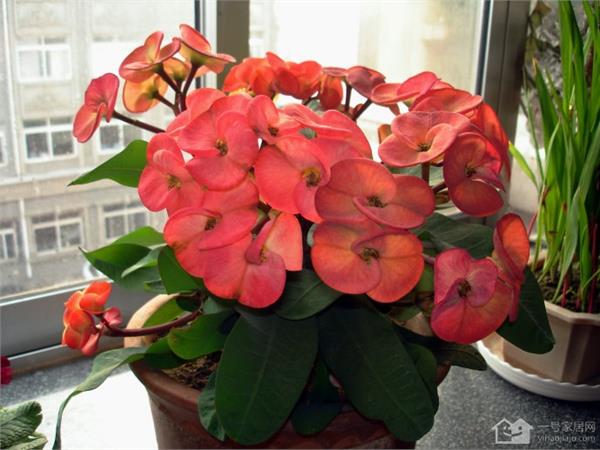
Crown of Thorns is also called "qilin thorn" and "tiger thorn." It is a popular indoor plant, and in tropical regions it is planted in courtyards. It is a deciduous shrub, with dense brown hard thorns on the stems and broadly lanceolate leaves. It sheds its leaves during the winter dormant period. Crown of Thorns likes a warm, humid environment with plenty of sunlight. It is slightly shade-tolerant, tolerant of high temperatures, relatively drought-tolerant, and not cold-tolerant. Loose, well-drained leaf mold soil is best. Crown of Thorns is a spiny, upright or slightly climbing small shrub, with a plant height of 1-2 m, many branches, and white sap inside the plant. The flowers are very small, born at the tips of the branches, and the flower color is bright red, said to be of two kinds of red. The flowering period is long, but flowering is most abundant when it rises in spring. Because the flower shape resembles plum blossom and the stems are thorny, it is called Crown of Thorns. The stems of Crown of Thorns are slightly climbing, branched, and can reach more than 2 m long. The stems have gray thick thorns, and the leaves are ovate. The flowers are small, borne in pairs in small clusters. On the outside there are two pale red bracts. The bracts can be yellow, and also dark red. The stems and small branches of Crown of Thorns are angled, with shallow grooves, densely covered with conical sharp thorns, thorn length 1-1.5 cm, diameter 0.5-1.0 mm, arranged in a spiral. The leaves are alternate, often densely clustered at the tips of new branches, obovate or oblong-spatulate. Crown of Thorns has no stalk or nearly no stalk; the stipules are subulate and fall early. The involucre is bell-shaped; there are several male flowers; there is 1 female flower. The flowering period is winter and spring. The capsule is trigonous-ovoid. There are 2 bract leaves, kidney-shaped, bright red above and pale red below, closely appressed to the inflorescence.
II. Methods for growing Crown of Thorns
1. Propagation methods for Crown of Thorns: Crown of Thorns is divided into two propagation methods, cutting propagation and tissue culture.
1) Cutting propagation method for Crown of Thorns: Crown of Thorns is mainly propagated by cuttings. Cuttings can be taken throughout the growing period, but May-June is best, with a high survival rate. Select mature branches from the previous year, cut them into 6-10 cm sections, with tip branches being best. White milky sap flows from the cut. After washing with warm water and drying, insert them into a sand bed. Keep it slightly dry; about 30 days after insertion, they can take root.
2) Tissue culture method for Crown of Thorns: Crown of Thorns generally uses the cutting propagation method, but Crown of Thorns has a low propagation coefficient and slow speed, making it difficult to achieve large-scale, commercialized, standardized production, so large-scale propagation generally uses the tissue culture method, which can achieve relatively good results. Crown of Thorns is a very popular indoor ornamental plant, with a long flowering period, bright flower colors, elegant form, and easy cultivation, so many people choose potted planting for display and beautification. In addition, many people also choose to plant it in courtyards, which also has a good effect.
2. Potted plants should be repotted every spring, and watering should not be excessive. During the summer and autumn growing period, sufficient water is needed, and fertilizer should be applied once a month. In winter, when the temperature is low, the leaves fall and the plant enters dormancy, so the potting soil should be kept dry. During the flowering period from March to December, keeping the soil moisture moderate can keep the flowers blooming continuously. If the winter room temperature is above 15°C, it can continue to bloom. When the plant grows too crowded and dense, the whole plant can be pruned in spring before new leaves sprout.
3. Crown of Thorns has a special nature and grows slowly, growing only about 10 cm each year, but it has a long lifespan and can live for more than 30 years in a pot. The flowering period is long; if light and temperature are suitable, it can bloom all year round. The branches of Crown of Thorns do not branch easily and will grow very long, with few flowers and a messy appearance, affecting ornamental value, so it must be pruned promptly every year, with tips pinched, and so on, to make it produce more new branches and more flowers. Generally, after the tip of a branch is pinched off, two new branches can grow. Crown of Thorns has a well-developed root system and grows vigorously, and can be used as rootstock for grafting Schlumbergera and Christmas cactus, but it has a shallow root system, spreads far horizontally, and has few root hairs.
4. Crown of Thorns likes warmth and is not cold-tolerant. It grows best at around 22°C during the day and around 15°C at night. In a greenhouse kept at 15°C to 20°C, it can bloom continuously all year round. If it drops to 10°C, the leaves fall and it enters a semi-dormant state, until the following spring when it sprouts new leaves and continues to bloom. Crown of Thorns likes light. The more sufficient the sunlight before flowering, the more brilliant and eye-catching the flowers and the longer they last. If there is insufficient light, the flower color becomes dull. If placed in shade for a long time, it will not bloom. Also note that air circulation should be maintained.
5. Crown of Thorns can use culture soil with hoof and horn pieces as base fertilizer. During the growing period, apply fertilizer once every half month, stop fertilizing after the beginning of autumn, and avoid fertilizers containing oils and fats to prevent root rot. Crown of Thorns is drought-tolerant. In spring and autumn, watering should follow the principle of watering when dry and keeping it moist. In summer, it can be watered once a day; in the rainy season, prevent waterlogging; in winter, do not water unless it is dry, and the pot should not remain moist for a long time; during the flowering period, water should also be controlled, as too much water can easily cause flower drop and root rot.
The above is the relevant introduction in this article. I believe that after reading it, you also have a simple understanding of it. If needed, you can continue to follow No. 1 Home Network to learn more information.