Detailed Explanation of the Morphological Characteristics and Cultivation Methods of the Crape Myrtle Tree
The crape myrtle tree is a relatively common flowering ornamental plant, with brilliant flower colors and a long blooming period. Many people choose to plant it in home courtyards. In addition, crape myrtle is also very beneficial for air purification. Below, let us learn about the cultivation methods of the crape myrtle tree.
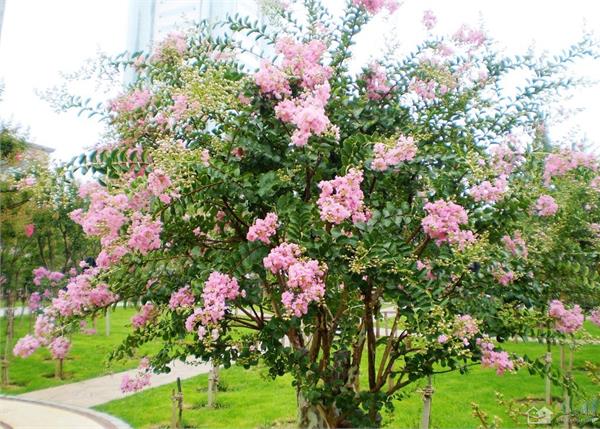
I. Morphological Characteristics
Crape myrtle belongs to the genus Lagerstroemia in the family Lythraceae, and people commonly call it the "ticklish tree." It is a peculiar tree species among trees. Crape myrtle is a flowering and leafy tree, also known as the barkless tree, Mantanghong, and Hundred-Day Red. Because its blooming period is especially long, with flowers blooming continuously from July to October, it is named Hundred-Day Red. The Song Dynasty poet Yang Wanli praised it in verse: "Like one intoxicated and enchanted, beautiful and fine; pressed by dew and bullied by wind, it leans all the more. Who says flowers cannot stay red for a hundred days? The crape myrtle keeps blooming for half a year." Xue Hui of the Ming Dynasty also wrote: "The crape myrtle flower lasts the longest, a splendid span of ten xun; summer passes into autumn's order, and new flowers continue to bloom on the branches." Northerners call the crape myrtle tree "monkey pricker-off," meaning the trunk is too smooth for even a monkey to climb.
Its precious quality is that it has no bark. Things are valued for being rare. Among the thousands of trees and plants in the world, how many are barkless? The trunk of a young crape myrtle grows outer bark every year and sheds it every year on its own. After the outer bark falls off, the trunk appears fresh and smooth. For an old crape myrtle tree, the trunk no longer grows outer bark, and its veins and texture stand out prominently. It is smooth, glossy, and clean. After the crape myrtle tree grows up, the outer bark of the trunk falls off, leaving it smooth and barkless. If people gently stroke it, its branches immediately shake and its leaves move, its whole body trembles, and it may even emit a faint "giggling" sound. This is a whole-body reaction of its "ticklishness," which is truly astonishing.
The genus Lagerstroemia has a total of 4 species, including red crape myrtle, silver crape myrtle, and green crape myrtle. The green crape myrtle with blue petals is the best. It has panicles borne at the tips of new branches, reaching up to 20 cm long. Each flower has 6 petals, and the petals are much wrinkled, resembling a wheel. When the flowers bloom all over the tree, they are as gorgeous as rosy clouds, hence it is also called Mantanghong. The fruit is a capsule, shaped like a soybean, containing many seeds, and ripens in November.
II. Cultivation Methods of the Crape Myrtle Tree
1. Soil: Crape myrtle has strong vitality and is easy to cultivate. It is not demanding about soil, but it grows best when planted in deep, fertile sandy loam.
2. Fertilization: Fertilizer can be applied each year after leaf fall in winter and before bud break in spring. Applying human feces and urine or sesame paste residue is even better, as it can make the plant grow vigorously the following year, with large flowers and bright colors.
3. Sunlight: It is light-loving by nature. Insufficient light will not only result in fewer flowers or no flowers, but may even cause weak growth, with thin branches and small leaves.
4. Watering: Crape myrtle is drought-tolerant and afraid of waterlogging. Each year, before bud break in spring and after leaf fall in autumn, it can be watered once with green-up water and once with freeze water. At ordinary times, if it is not too dry, there is no need to water. Generally, during spring drought, water 1-3 times. In the rainy season, drainage work should be done well to prevent excessive water from rotting the roots. It is not suitable to water in autumn.
5. Pruning: The inflorescences of crape myrtle are borne at the tips of new branches of the current year, so during pruning, one-year-old branches should be heavily cut back and shortened so that nutrients are concentrated and the new branches grow strongly. Water sprouts, dead branches, drooping branches, diseased and pest-infested branches, slender branches, and inward-growing branches should be cut off. During the young tree stage, lateral branches on the lower part of the main trunk should also be cut off in time so that the upper part of the main trunk can receive sufficient nutrients and form a good crown.
6. Pests: Common pests of crape myrtle include felt scale, yellow slug moth, and bagworm moth, among others. Attention should be paid to spraying pesticides for control.
The above is the relevant introduction in this article. I believe that after reading it, you also have a simple understanding of this. If needed, you can continue to follow No.1 Home Network to learn more information.