Introduction to indoor water-grown plants, friends who love growing plants should not miss it
Placing some water-grown plants indoors is not only a good decoration, but also has a certain effect on improving the temperature, humidity and air quality of the local environment. Next, let us take a look at what indoor water-grown plants there are?
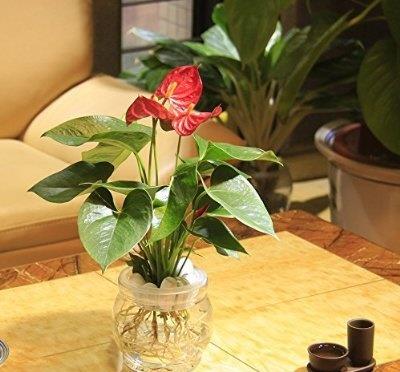
Water-grown plants have the following advantages: First, because water can evaporate freely, in the same environment they play a more obvious role than plants grown in potting soil in regulating air humidity; second, water-grown plants can omit the management work of potting soil, are clean and hygienic, and are simple to care for; third, if you choose some plants whose root systems can be exposed to light and match them with suitable containers, the whole plant can be viewed, fresh and elegant, with higher ornamental value.
There are two major categories of water-grown plants. One category is aquatic flowers, which grow in water in nature, such as the familiar lotus and water lily; the other category is flowers that can be hydroponically grown, which generally grow in soil or growing media, such as lucky bamboo and hyacinth. Because the light indoors is not sufficient enough, it is more suitable to grow the latter category. In addition, they have low nutrient requirements and can basically grow in tap water, and some only need a small amount of nutrient solution added.
Common indoor water-grown plants - hyacinth
Hyacinth, a perennial herbaceous plant, as long as you buy a seed the size of a garlic bulb and place it in water, it will sprout leaves and bloom when the temperature is suitable. The leaves are thick and full of tension. And the oval-shaped flowers are rich in color and full of beauty, and each petal is as thick and substantial as the leaves.
Common indoor water-grown plants - spider plant
There is no need to say much about the purifying ability of spider plant. Moreover, its slender vines and leaves reveal a sense of strength within their delicacy. In summer and autumn, spider plant will sprout young leaves and aerial roots at the tips or nodes, and produce white flowers, hanging naturally along the branches, very beautiful.
In addition, the method of growing spider plant in water is also relatively simple and hygienic, and ordinary care is enough.
Common indoor water-grown plants - pothos
Because its leaves are round and symbolize wealth, pothos has many admirers whether grown in water or in soil. It belongs to climbing foliage flowers, and because its natural growing environment is in forests, it likes a warm and humid growing environment. The stems and leaves are soft, and the leaves are alternate. It is enough to change the water every two or three days and pair it with a suitable nutrient solution. Because the vines can grow several meters, it can be hung above a window, and the decorative and purifying effects are both very good.
Common water-grown plants - ivy
Ivy is the most ideal variety for vertical greening, because it is evergreen, and its branches and vines are soft and have aerial roots, so it can climb onto surrounding objects. Therefore, many people use special shapes for ivy to climb on, so that before long, ivy can cover the frame. If a heart shape is used, there will be a green heart full of vitality.
Common water-grown plants - lucky bamboo
An evergreen upright shrub of the genus Dracaena in the Liliaceae family, very suitable for indoor water-grown flowers. The leaves of lucky bamboo are emerald green, and the stems are straight and round like bamboo. The leaves are ovate with pointed tips, and the base of the petiole clasps the stem. It is a very shade-tolerant plant and still grows well, upright and strong, under low-light conditions. It can be placed indoors for a long time to view its foliage, and does not need special care; as long as there is enough water, it can grow vigorously. When hydroponically growing it, cut the stems of lucky bamboo into small sections of more than 20 cm as cuttings and insert them into water; as long as 1/3 of the cutting can be immersed in water, it can take root and survive.
Common water-grown plants - asparagus fern
A perennial evergreen herbaceous flower of the genus Asparagus in the Liliaceae family. The stems are slender and weak, and the branches are fine and leaf-like, spreading horizontally. The flowers are small and white. The berries are spherical and black. After the fruit ripens, it presents a scene of dots of red amid dense green, clear and lovely. The plant has strong shade tolerance, and when placed at the bedside or on a desk, it is elegant and graceful, and is a very good indoor flower. Asparagus fern is also an ideal material for backing cut flowers. In recent years, water-grown asparagus fern has been successfully developed, and placing it indoors is even more clear and elegant.
Common water-grown plants - dieffenbachia
A plant of the Liliaceae family, with basal leaves that are thick and leathery, oblanceolate, broadly lanceolate or broadly band-shaped, 10-40 cm long and 2.5-5.5 cm wide, acute at the tip, narrowly long at the base, and with fibrous roots at the nodes. The flower stem is short and thick, 4-8 cm long including the inflorescence; the terminal spadix is oblong, with densely borne flowers, sessile, pale yellow, hemispherical. There are rich varieties, including many types such as green-leaf and variegated. It likes shady and humid environments, and in summer it should be placed in a shaded place to avoid strong light. It is an ornamental flower variety with strong adaptability, usually grown as a potted plant for viewing. In recent years, there have been more and more water-grown varieties, which are not only highly ornamental, but can also effectively clean indoor air pollution.
Common water-grown plants - dragon tree
An evergreen shrub of the Agavaceae family. The stem is round and straight, and the leaves are slender; new leaves extend upward, while old leaves hang down. The middle of the leaf is green, and the edges have purplish-red stripes. It likes high temperature and high humidity, and is also drought-tolerant and shade-tolerant. It is easy to grow in water and has a stylish appearance.
Common water-grown plants - Brazil wood
Scientific name fragrant dracaena, also known as Brazil iron tree, a plant of the genus Dracaena in the Liliaceae family. An evergreen tree with a neat plant shape and upright stem. The leaves are clustered at the top of the stem, 40-90 cm long and 6-10 cm wide, slightly blunt at the tip, curved into a bow shape, with bright yellow or milky white stripes; the leaf margins are bright green and have wavy undulations, glossy. The flowers are small. Yellow-green, fragrant. It likes an environment with sufficient light, high temperature and high humidity, and is also tolerant of shade and dryness, and grows well in bright scattered light and in the relatively dry environment of northern rooms. Brazil wood is mostly propagated by cuttings. As long as conditions such as temperature are suitable, Brazil wood can grow all year round, and it is a world-famous new-generation indoor foliage plant with a graceful and neat plant shape. In recent years, its hydroponic varieties have developed rapidly, and as long as enough slow-release fertilizer is provided, it can grow normally. Placed in the living room, study or sitting room, it has an elegant and simple style and is highly ornamental.
Common water-grown plants - African daisy
A perennial herb of the Asteraceae family, with relatively large flower diameter, rich flower colors, and blooming all year round. It likes a warm, sunny and well-ventilated environment, belongs to semi-hardy flowers, and likes fertile and loose soil. African daisy is a very good cut flower variety, lasts a long time in water, is highly ornamental, and is also good at absorbing formaldehyde.
The above is the relevant introduction in this article. I believe that after reading it, you also have a simple understanding of it. If needed, you can continue to follow No.1 Home Network to learn more information.