Money Tree Propagation Methods and Care Precautions
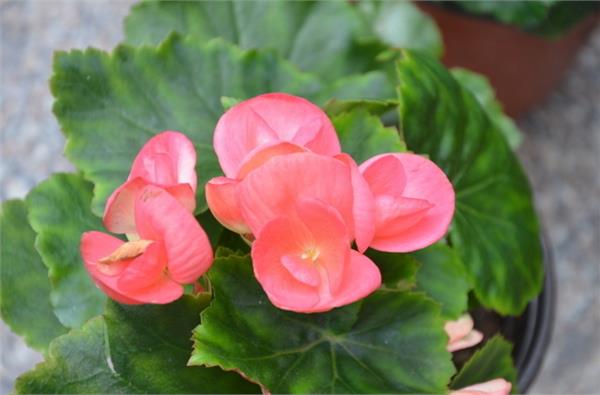
When growing Rieger begonias, some diseases may appear, and there is no need to worry excessively at that time; as long as you handle them a little, they will be fine. Common diseases include spotted wilt, gray mold, and bacterial leaf spot, etc. Next, let us understand the characteristics of their respective symptoms, and then look at how to prevent and control them.
I. Spotted Wilt
1. Symptoms
On Rieger begonias, the symptoms appear as yellow mottling on the leaves, with relatively large, round brown necrotic spots, and the veins on the petioles turn brown and necrotic. The pathogen is Impatiens necrotic spot virus, also known as Tomato spotted wilt virus 1, TSWV-1. In nature, the transmission vector is thrips.
2. Prevention and Control Methods
① Clear weeds at the field edges that may serve as sources of infection.
② Control thrips to prevent virus transmission.
II. Gray Mold
1. Symptoms
Gray mold usually appears on the lower leaves of cuttings that are in contact with the potting medium. Water-soaked spots rapidly expand and infect most of the leaf or even the entire cutting. As time passes, the infected area becomes necrotic and turns brown-black to black. When night temperatures are relatively low, daytime temperatures are relatively high, and humidity is also high, the pathogen easily forms spores on the leaves and produces gray-green conidial masses.
2. Prevention and Control Methods
Controlling gray mold is especially important in winter when the greenhouse is closed. Control the microclimate well and maintain air circulation; keep leaf surfaces dry at night and reduce humidity; fungicides such as Yili and Huimei Suke can be sprayed.
III. Bacterial Leaf Spot
1. Symptoms
This disease often occurs on begonias, and some growers do not even realize it is a disease. Rieger begonias are particularly sensitive to this pathogen, usually showing necrosis and wrinkling at the leaf edges. In the early stage of the disease, transparent small spots appear on the underside of the leaves, and then the number of lesions rapidly increases and the small spots expand into water-soaked spots.
2. Prevention and Control
There is no specific cure for this disease. The best way to control it is first to select cuttings free of this disease. For infected plants, if the degree of infection is relatively mild, only the infected parts need to be removed; if the condition is severe, the entire diseased plant must be removed to reduce the development and spread of this disease. In addition, using fertilizer at a concentration slightly higher than recommended will also help reduce the disease.
IV. Fungal Leaf Spot
1. Symptoms
The spots are usually at the leaf margins, leaf tips, and broken veins. The necrotic areas are dark brown and initially appear water-soaked. Examining the basal leaf surface generally reveals irregularly shaped, black clumps and a ring of white mycelium.
2. Prevention and Control
Apply fungicides; reduce damage; fertilize at the recommended concentration to reduce the harm of this pathogen.
V. Fusarium
It is only discovered when the fungus covers a relatively large part of the plant. This disease originates from the medium, invades the roots, and reaches the top of the plant through the vascular bundles. Once the fungus enters the vascular bundles, the plant begins to show symptoms: the growing point and leaves darken, large areas of brown wet rot appear on the stem, and later become dry rot. After a few days, white fungal mycelium appears on the outside of the stem. Fusarium is highly related to Fusarium oxysporum because these fungi all exhibit vascular parasitism. Once the disease occurs, it cannot be controlled, and producers can only try to ensure hygiene during work.
VI. Downy Mildew
This type of fungus is easy to find; white fungal mycelium can be seen on the leaf tips. These fungi spread by themselves into circular shapes and can be wiped off. In severe infections, fungal mycelium is present on the underside of the leaves, and these spots subsequently turn brown, with black spots on top. It usually appears first on older leaves and infects when environmental humidity is relatively low, especially at the vents of the greenhouse. The prevention and control method is: when air flow is too fast and conditions are relatively dry, use a sulfur evaporator at night, so that a thin layer of sulfur covers the plant surface, thereby inhibiting fungal growth.
VII. Rhizoctonia solani
If infected cuttings are not treated in time, the infected spots will rapidly spread to the entire cutting bed. Rhizoctonia solani infects plants or cuttings where the medium contacts the air, and film-covered cuttings are most susceptible. The prevention and control method is to use clean medium and clean water, and quickly handle infected plants.
The above is the related introduction in this article. I believe that after reading it, you also have a simple understanding of this. If needed, you can continue to follow No.1 Home Network to learn more information.